

Portfolio data is not something programs, projects and development teams always look forward to maintaining. And to be completely honest, I have been sometimes annoyed with the requests to fill in templates too, when not fully understanding what is it needed for and who actually uses the end results.
Portfolio data should not be only for reporting purposes, it should be used actively – to create transparency, communicate about progress, to have regular feedback loops on reaching objectives, balance demand and capacity, follow up on benefit realization and plan for the next steps.
Portfolio data was also emphasized by experienced professionals I interviewed during the spring and my notes are full of great insights how to make this part more meaningful and easier for development teams, stakeholders and management. Here are 5 tips consolidated based on interview results – I hope these are useful for you!
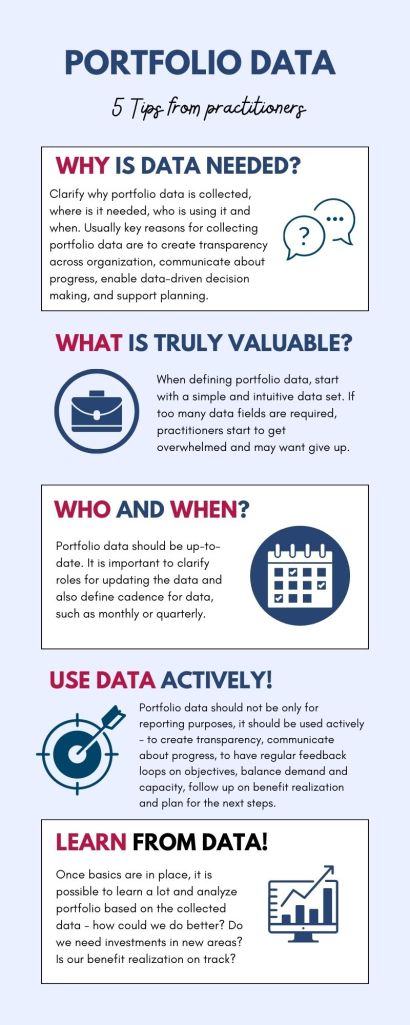
Let’s go through each area in more detail:
Why is portfolio data needed?
Clarify why portfolio data is collected, where is it needed, and by whom and when in your organization. Smart stakeholders working with development teams are more willing to maintain the data, when they understand why it is important!
Here are some key reasons relevant for many organizations:
- Creating transparency across organization – portfolio views are needed in enterprise business, and unit levels as well as for different stakeholder view points
- Communication – portfolio roadmaps, business cases and status updates are important tools to communicate about team plans to a wider group of people. If this data is hidden in slide decks, it may be difficult to manage dependencies across projects and portfolios.
- Data driven decision making – enabling better decisions, when seeing the big picture, understanding business case, risks and dependencies. Decision making is often needed in project, portfolio levels, and solid data is helping out a lot!
- Master data related to projects, continuous development and other work as well as strategic initiatives and programs is important – data, such as project name, should not vary across the systems.
- Balancing demand and capacity – when all demand and work across organization is visible, it is easier to plan capacity and also make better prioritization decision.
- Finances and planning – it is important to be able to forecast and follow up on actions and plan also future horizons (budgeting, long range planning). When portfolio data is up-to-date, budgeting and mid-term or long range planning is just updating plans, not collecting everything from the scratch.
What is truly valuable for your organization?
Often portfolio data sets may grow over time, as a new field is added every now and then – over the time portfolio templates may grow to be too complex – and no-one actually knows why a certain data field is needed today.
- When defining portfolio data, start with a simple intuitive data set. If too many data fields are required, practitioners start to get overwhelmed, don’t know what fill in and may give up. Think, what is truly valuable, and what data is followed up and used actively.
- If you have existing portfolio data, check out if different fields have been filled by practitioners, and if these data fields are actually used by someone. Be brave while leaning your data model! Simple is beautiful! No-one likes a project template filled with unnecessary details, which are nice to have.
- Note! If you need to do special portfolio analysis, you can also collect data separately; no need to have a huge amount of data fields, which you might (or might not) need one day.
Who updates the data and when?
Portfolio data has only little value, if it is not systematically maintained. Roles and cadence for data updates is important.
- Start with the definition: who maintains the data? Clarify the roles!
- What is the cadence for maintaining portfolio data? Many organizations have monthly cadence, but some fast moving areas may need weekly cycles. Also quarterly cadence may make sense, if organization does not have all portfolio management roles filled and if quarterly cycles are natural for the organization.
- Follow up – this is especially important at the beginning, when getting started with your portfolio data. Regular reminder and practical support sessions may be helpful, when getting started!
Use portfolio data actively – think about different use cases!
Data should not be only for reporting purposes, it should be used actively – to create transparency, communicate about progress, to have feedback loops on objectives, balance demand and capacity, follow up on benefit realization and plan for the next steps.
- Learn what works best for your organization – hear out what needs different stakeholders have!
- Think about different use cases and different roles using data – how to create transparency and different portfolio views?
- Avoid extracting data to static reports as it gets outdated fast – use tools and reporting capabilities as much as possible.
- Avoid having the same data in many different systems or tools, unless they are integrated, and one of the the systems is master. It is really difficult to maintain the data in many sources!
Learn from data – how could we improve?
Once basics are in place, it is possible to learn a lot and analyze portfolio based on the collected data.
- How could we do better? Do we have challenges in portfolio execution or managing our idea funnel?
- Are we achieving our objectives as planned?
- Is our benefit realization on track? Are we achieving our objectives as planned?
- Do we need investments in new areas? Is our portfolio balanced, or do we focus too much on keep the business running activities?
I would love to hear your pro tips how to make portfolio data easier to keep up-to-date and more helpful for different stakeholders!
 Strategic Portfolio Management