

Traditionally governance of project portfolio has been organized around gate decisions – scope, budget, business case and go-live decisions have been approved by passing a specific project gate. Today, as agile development teams have become more and more popular and many organizations are managing hybrid portfolios with projects and agile (See the previous post related to Hybrid development portfolios) or fully agile ways of working, also governance is impacted.
My search for interesting portfolio management literature continues! One of the golden nuggets from Cooper, Robert G., Scott J. Edgett, and Elko J. Kleinschmidt. “Portfolio management: fundamental to new product success” is the definition of two alternative portfolio approaches: 1) Gate dominate approach and 2) Portfolio review dominate approach. This article is focusing on pros and cons of both approaches, and could these be combined?

Stage-gate project models have been used traditionally in project portfolios. The idea with the gate model is that if process is working well, gate decisions are driving portfolio decision making. If you have strong gate model practices, this approach may your portfolio governance well!
However, today, many organizations have moved towards product portfolio management, and agile ways of working. Instead of stage-gate-projects, development may be driven by product development teams. For such portfolios, Portfolio review dominate approach might work better. Instead of focusing on individual project gate decisions, portfolio reviews are periodic meetings, which serve as check on portfolio: reviewing all projects together, checking priorities and making balancing decisions.
Stage-Gate driven Portfolio Process
Stage-gate projects have been used widely across industries and there are good reasons for the popularity of the model! By following the model, different stages of product development are systematically implemented, and between each stage, there are Go/Kill decision points, gates. Process starts typically from Discover stage with ideation focus followed by the first gate – if idea is promising, quick investigation and scoping stage of the project is done, typically mainly desk research. Again, if idea is considered viable after the scoping phase, next phase is focusing on Design. Design stage includes already a detailed investigation focusing on customer needs, markets and and technical solution, and results in business case and project plan among other outcomes. Typically gate decision before Develop stage is really important, as more resources and budget is typically needed for actual development work. During the Scale Up stage, new product is tested also commercially to ensure new product has a good go-to-market approach also solid production and operations plans. The full scale commercialization is part of the Launch stage. Read more about Stage-Gate model: The Stage-Gate Model: An Overview
Key topics to consider, if you have Stage-gate driven portfolio process
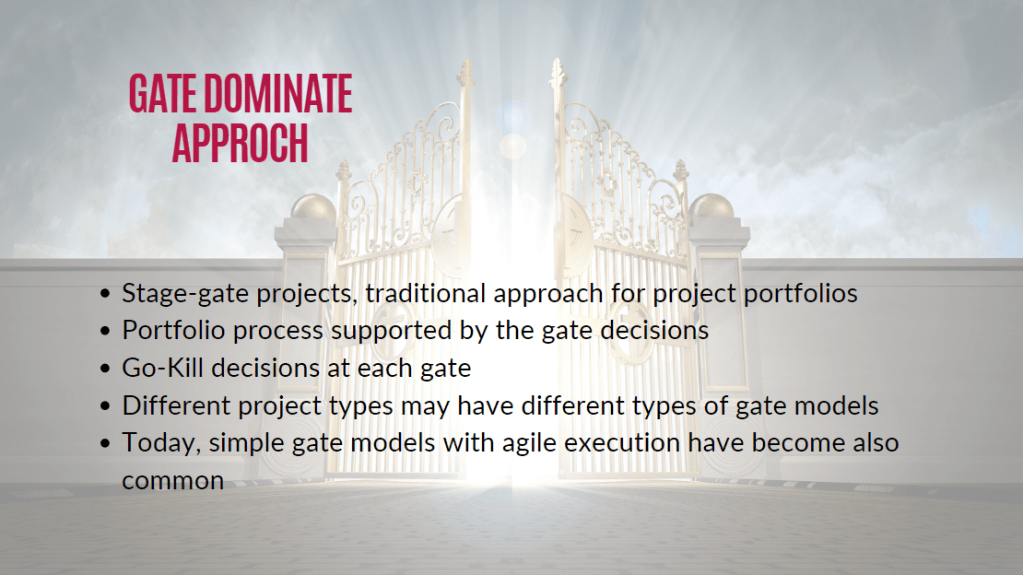
- Gate model gives a good framework to do systematical development work – process guides to take into consideration important decision points and also quality gates are typically built into the process.
- Go/Kill decision points – the idea within stage-gate process is that projects may be killed at any gate – if there is no business case, commercial or technical viability, project implementation should not continue. Kill decisions are typically difficult, and killing a project should not be seen as a failure of the project team – rather as an opportunity for learning as an organization.
- In some organizations, project models have become quite heavy over the time with many gates to pass, extensive check list and must have deliverables – collect feedback and see, if some leaning could be done. Consider also, how many gates are needed in your process and are all gates relevant for the portfolio governance.
- Different project types may also have different types of gate models, and based on the need, and one process does not need to fit all scenarios. See a great summary picture at the end of blog text: Stage-Gate International: What is the Stage-Gate® Discovery-to-Launch Process?
- Today, as agile ways of working have become more and more popular, stage gate models are often criticized as being too waterfall based – once scope is defined, there is no going back in the process, or once design has been frozen, no changes are allowed. For IT projects, a common model seems to be have a simple and lean state gate model, combined with agile implementation phase – actual development work may be carried out via iterations or increments. The benefit of having clear decision points to ensure good governance and also supporting phase deliverables is to ensure all important activities, such as architecture reviews and security checks are implemented and solution can be safely taken into service management scope.
Portfolio review driven approach
For dynamic portfolios, where business environment is rapidly changing, portfolio reviews may be a great approach!
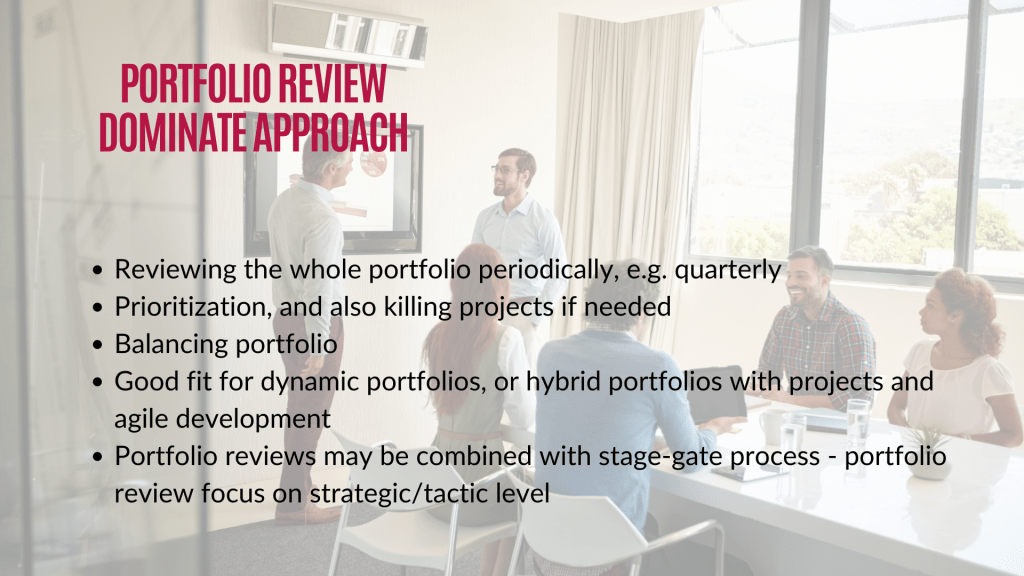
Here are topics to consider, if you have a portfolio review approach in your portfolio
- One of the challenges with Stage-gate process is, that product development does not end at the Launch phase, especially when developing complex digital services. Agile or continuous development teams or DevOps teams have become more and more popular. Gate approval driven portfolio process does not support optimally continuous nature of agile development work.
- If you have in parallel also gate process, could you simplify the governance by reducing the number of gate approvals needed or delegate decision making responsibility?
- For rapidly changing business environments, it is healthy to have a critical view over the whole portfolio periodically, not only once a year for budgeting purposes.
- Also balancing the portfolio, if needed, should happen during the portfolio reviews.
- Portfolio reviews could be considered as an event for mass approving (or killing) new initiatives (Cooper et al., 2002).
- For large portfolios with many projects ongoing, gate approvals can also happen regularity to keep projects running, where as portfolio reviews could focus on strategic and tactic level. See also previous blog post related to Quarterly reviews (Time for Quarterly Review?) on this topic!
References
Cooper, Robert G., Scott J. Edgett, and Elko J. Kleinschmidt. “Portfolio management: fundamental to new product success.” The PDMA ToolBook 1 for New Product Development 9 (2002): 331-364. Link
The Stage-Gate Model: An Overview
State-Gate International: What is the Stage-Gate® Discovery-to-Launch Process?


 Strategic Portfolio Management