

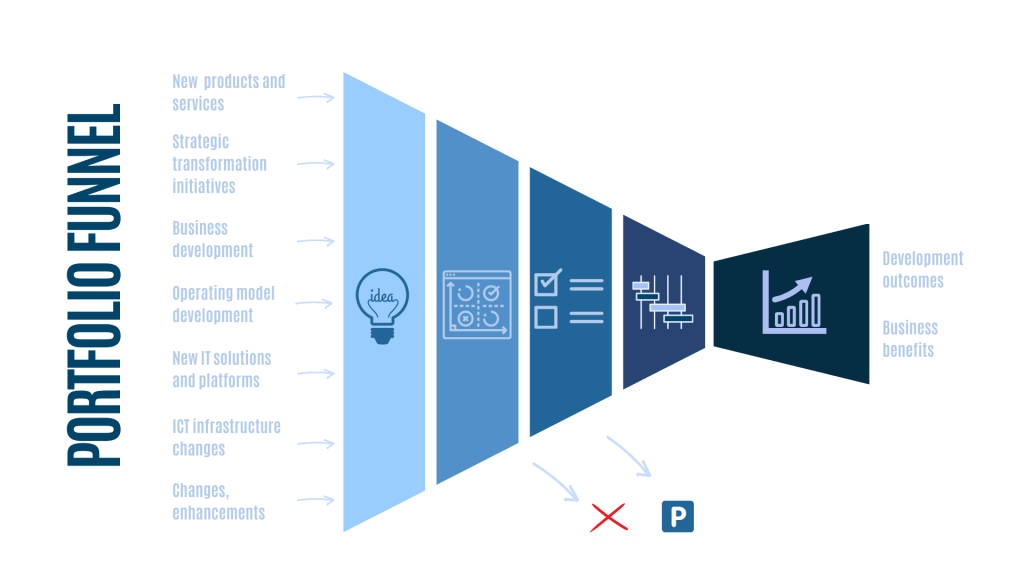
Smart people with a development mindset contribute to a large amount of development ideas. There may be innovative ideas related to new products and services ideated with customers, new business models to be experimented or process improvements. Also new IT solutions supporting business processes and improvements to existing solutions are typical content of large development portfolios. Strategy driven initiatives may also have significant impact on many different elements, also on operating model and ways of working. In addition to large development initiatives, there are also different types of development ideas to enhance current ways of working via processes or IT systems.
Systematical way to manage Portfolio Funnel
Systematical way of working to track and manage new development ideas is important – not only for budgeting purposes, but not to miss excellent ideas! Agile teams maintain also their own development backlogs, including new requirements, features, or use cases for developing for example an IT solution. Items in the portfolio level should be of a size of a project, or portfolio epic – an item with specific business objectives and typically significant work required from multiple teams.
Managing portfolio funnel, not a tunnel
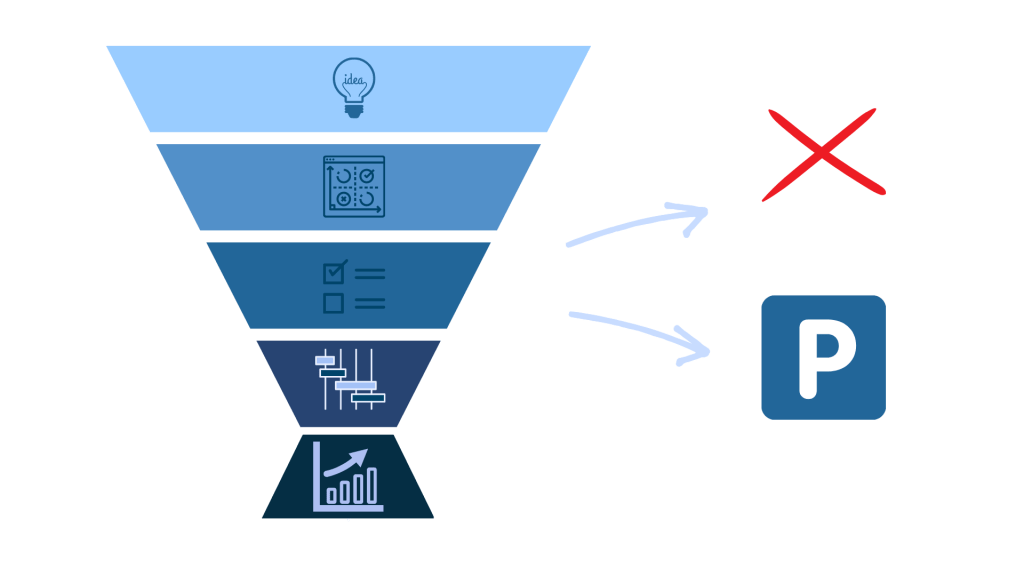
One of the key deliverables of portfolio management process is the support for prioritization of the development ideas in the portfolio level. For all ideas, it is good to do a brief analysis – is this idea viable, and where would this belong to – to be implemented as project or as a part of agile development teams. Also, is the idea something we would like to proceed in a near future, or should we park it?
Prioritization of the development ideas is also needed. Prioritization could happen within regular governance meetings, e.g. monthly or quarterly or during the planning processes such as long range or mid-term planning or yearly budgeting. Saying no to development ideas which are not part of the portfolio scope or priorities is important, to create clarity and focus. Also parking ideas, which are not viable right now, but could be worked in in the future is also beneficial.
What is in your portfolio funnel?
One of the key challenges many organizations struggle with is the pipeline gridlock – there are too many development initiatives ongoing at the same time and nothing gets completed as planned as capacity is too thinly spread across initiatives. Also, if there are many small items consuming time of the development teams, there may not be enough focus on big important items. Key topics to look into
- How many initiatives and how big initiatives do you have in the pipeline? If there are too many small initiatives in the funnel, difficult to get large important initiatives completed!
- How many big initiatives can manage simultaneously?
- What is the available capacity?
- What are the key constraints? Experts? Money? Would you need to have extra help for for the critical areas, where experts would be needed?

The first step to solve this challenge is to create transparency across the portfolio pipeline – this is a great tool for the senior management also to start to work on prioritization.
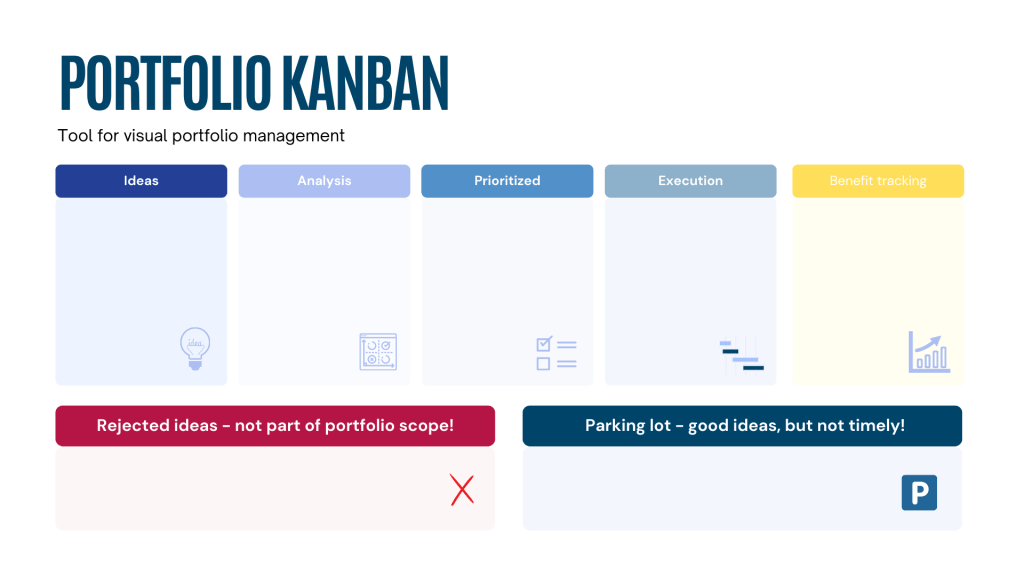
Portfolio Kanban for visual management
One of the great tools for visual portfolio management is Portfolio Kanban. The idea is, that within portfolio Kanban, you may include different types portfolio level ideas, epics or other initiatives, such as projects, and systematically evaluate the prioritize the different ideas – and see different portfolio items visually via the Kanban board. It is good to keep the Kanban as simple as possible; also Kanban can be used for portfolio idea funnel only, if execution is happening via portfolio roadmaps as a part of different programs, projects and agile development work.
For project stage gate models, the idea is other way around – project has own phases, which are driving the portfolio process. However, also a systematical process is needed for other development ideas, which are not projectized and not following project model.
Tip! Scaled Agile Framework (SAFe) Lean portfolio management includes also Portfolio backlog – have a look, if interested to learn more about how development organized there!


 Strategic Portfolio Management
2 thoughts on “Do you manage a Portfolio funnel, or Portfolio tunnel?”