

Development roadmaps are a great tool to create transparency across organization. However, when reviewing roadmaps, sometimes one does not really understand what will actually be developed. What will be outcomes from the initiation state, explore phase or product development stream?
Also, roadmaps are not always easily available and up-to-date – and there may be hundreds of different formats used across company.
Here are 3 easy steps to improve your portfolio roadmaps:
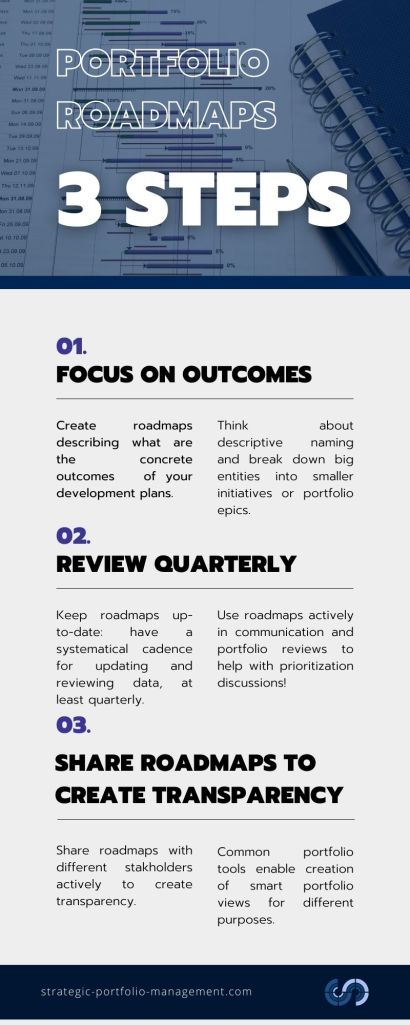
1. Focus on development outcomes
In global roles within large corporations, I have seen hundreds of roadmaps for different development areas. I have seen many excellent roadmaps, but also some, which are not easy to understand. Instead of showing project stages or program phases or streams within your portfolio roadmap, show what concrete outcomes will be achieved during the project, program or other development initiatives. Best roadmaps are often defining development outcomes – what are the results of the development? In a sense, outputs of the development are easier to define and measure, but real benefits come from outcomes. As portfolio level is heavily focusing on benefit realization, portfolio roadmaps could also focus more on real development outcomes.
One of the frequently asked questions is what is the correct level of transparency in portfolio level, and what should be visible in the project plans or team backlogs? Each portfolio may have own definitions for this part, but a good rule of thoub is to include all bigger entities such as programs, projects or other larger initiatives and, value streams/ continuous development teams and portfolio epics if used in your company.
Also, sometimes other larger development activities may be visible in the portfolio roadmaps, if they have business importance or complex dependencies. Each development team or project will maintain their own plans via backlogs, Kanbans or other task management system, which can be linked to portfolio plans to create full transparency. Portfolio financials play also a key role – typically all items which have significant external budgets or internal work costs are visible in the portfolio level.
A bit similar idea is also with goal oriented roadmaps, with a healthy reminder – roadmap is not yet a commitment: Comic Agilé no. 78 – The Goal-Oriented Roadmap:
2. Update and review roadmaps quarterly
Roadmap creation should not be once a year activity to get funding. It is actually a huge effort to do as one time activity – and the benefits of the hard work will be lost, if roadmaps are not updated regularly.
My recommendation is to update portfolio roadmaps at least quarterly – within quarter updates are usually still quite small, and easy to manage. Quarterly cycles are a good fit for many organizations due to financial processes, and also a great cadence for portfolio reviews and planning, see my previous blog post: Time for quarterly review? Reviewing a common roadmap is a great tool to create alignment across the stakeholders – if item is not visible in the roadmap, it is not included into the plans – and prioritization discussion may be needed.
Also a good practice is to update portfolio data and roadmaps during the monthly portfolio catch ups with different teams – this can be a standard item in agenda – do you have something new in your plans or has something changed in the timelines? It is a small effort to change few dates or add a new project as needed, and as an end result, your portfolio roadmaps will stay up-to-date!
3. Share roadmaps to create transparency
One of the key benefits of roadmaps is to create alignment and transparency across organization. Even though a single portfolio would have great practices for managing own development roadmaps, there is a need to share plans across different units, to manage dependencies and ensure alignment. If roadmaps are scattered around different power points, it is difficult to find roadmaps and keep them up-to-date.
Portfolio management tools provide great help – and today have also nice visualization capabilities for road mapping. When data is maintained in the tool, it is possible to create smart portfolio views for different purposes and use cases. These smart views help to reduce creation and maintenance of road maps via power points or other presentations. Optimally all development roadmaps within company are in the same tool, and can be found there to create transparency across different portfolios, units and functions.
For the top management, it is great, if different units have same format and way to share development roadmaps. If every unit has an own format, level of detail and approach, it is really difficult create a consolidated view in the enterprise level portfolio management. Using common tools helps also in the capacity management and financial processes – for example long range planning and yearly planning may get easier, when data is updated in the same place, with the common cadence.
For smaller companies or single portfolios, there may be lighter approaches, such as common road mapping template to create a common way of working. Projects or agile teams have their own roadmaps, with more details, in addition to high level portfolio view. Some organizations have created a integration between portfolio and backlog management tools, to support with drill down into more detailed plans. Even a link to teams power point roadmap in the portfolio tool is a great practice – those who are interested, can go an check out the details!
Do you want to learn more about Portfolio Management?
Fundamentals online course available via Udemy platform:
Recommended reading
The Business of IT Blog: Outcomes vs Outputs: What’s the Difference?
 Strategic Portfolio Management