


Today more and more development is carried out via agile teams. When discussing with colleagues from different companies, the terminology and the ways of working seem to vary a lot across companies and even within one organization. This is not surprising, as there is no one and only way for agile – agile mindset, values and principles may be implemented using a large variety of practices and methodologies.
Agile manifesto was published 2001, defining 4 core values and 12 principles. These values and principles should be share across agile teams, but there is a huge amount of practices and also many agile methods used among the practitioners. Some companies have implemented enterprise agile, based on SAFe or LeSS frameworks, but in many organizations agile has grown organically, and each team has optimized the ways of working and applied agile practices to best fit their unique needs.
When discussing with peers, I have come up with at least the following terminology related to agile teams: agile team, continuous development or continuous improvement team, Scrum team, Kanban team, DevOps team, product team, and task force. Then there may be value streams, ARTs, teams of teams, or tribes. A beloved child has many names – what do you call your agile teams?
I will try to consolidate some of my favorite content and links here related to agile teams, as this is an area, I want to learn more, too! If you have great content related tips, please ping me!
How is team defined in Agile?
So how is team defined in Agile? Let’s have a look!

A “team” in the Agile sense is a small group of people, assigned to the same project or effort, nearly all of them on a full-time basis. … The notion of team entails shared accountability: good or bad, the outcomes should be attributed to the entire team rather than to any individual. The team is expected to possess all of the necessary competencies, whether technical or business.
Agile Alliance glossary, https://www.agilealliance.org/glossary/team/
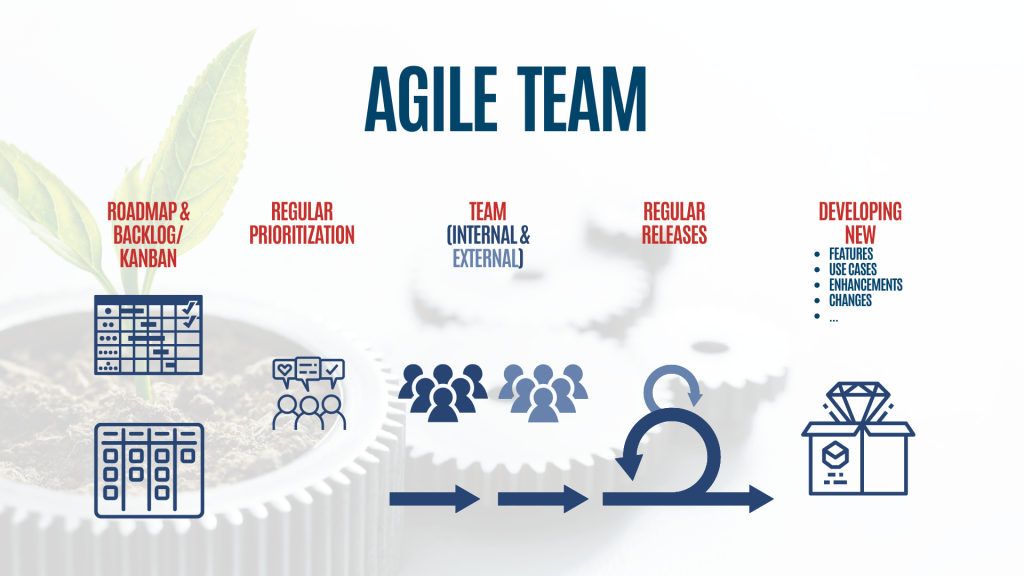
The definition provided is quite wide, and there are many great ways to work with agile methods. Even though methodologies and approaches from team to team seem to differ a lot, there are certain common characteristics across different teams. Here are a few which I have noticed are quite common:
- Developing something new – as all teams are unique, it may be new beautiful product features, a use case in a sales tool enabling a new business model, enhancement of ERP system for better efficiency, or a change in the business process
- Regular releases or delivery of new content – the release cycles differ a lot from team to team from daily releases to quarterly releases
- The team works together, learns together, and achieves together – there may have company internal and external team members, and there is continuity in the team. If one member of the team leaves, the team has the competences to bring in a new team member quickly.
- There is regular prioritization of the content together with the key stakeholders. Prioritization may happen bi-weekly, monthly, or quarterly, this seems to depend a lot on the team and content the team is developing. Sometimes there is clear product ownership presenting also the voice of different stakeholders and customers, sometimes there are multiple stakeholders.
- The team is managing the work via a backlog or for example Kanban board. For the portfolio level, the higher-level roadmap is a great tool to communicate the team plans with a wider group of people. Sometimes there is a detailed roadmap for the next quarter and high level epics or themes for the 1-3 years.
Many teams utilize a mix of Agile methods, such as using Scrum or Kanban. So let’s have a look at these, too!
Agile methods – Scrum, Kanban, XP, Lean…
Agile methodologies are a set of principles and practices that enable teams to deliver high-quality products or services in a flexible, iterative or incremental manner. These methodologies share common values such as adaptability, collaboration, and customer focus. They enable teams to respond to changing requirements, deliver value incrementally, and continuously learn and improve.
Here’s a short summary of some commonly used agile methodologies:

Scrum is one of the most popular agile frameworks. It involves dividing the work into small iterations called sprints, typically lasting 1-4 weeks. The team works collaboratively to deliver a potentially deliverable product increment at the end of each sprint. Daily stand-up meetings, backlog refinement, and sprint reviews are key components of Scrum. There are great resources to learn more, for example https://scrumguides.org/index.html.
Scrum is a great methodology for example for professional software development teams, but I have seen also successful applications in hybrid project context.
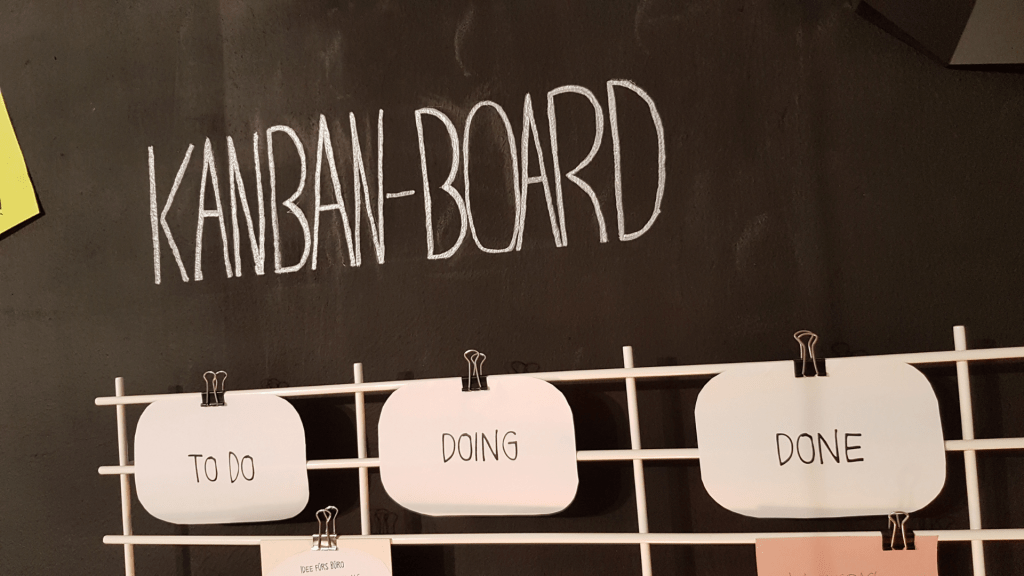
My favorite methodology for business development teams is Kanban.
Kanban emphasizes visualizing the workflow and managing work in progress (WIP) to optimize efficiency. Work items are represented as cards on a Kanban board, moving through different stages from “To Do” to “Done.” Teams pull new work items as they complete existing ones, ensuring a smooth flow of tasks. Kanban provides transparency and flexibility in managing priorities. A great resource to learn more about Kanban here: The official Kanban Guide. – Kanban Guides,

Lean is a great methodology for example for process or operations improvement initiatives, but also lean product management has become popular.
Lean methodology focuses on maximizing value while minimizing waste. It originated from the manufacturing industry and has been adapted widely for software development, too. Lean principles include eliminating unnecessary processes, reducing defects, empowering teams, and continuously improving the workflow. The goal is to create a streamlined and efficient process.
There are also several other popular methods, such as XP. Extreme Programming (XP) emphasizes close collaboration between developers, stakeholders, and customers. It emphasizes practices like continuous integration, test-driven development (TDD), pair programming, and frequent releases.
Ok, so these are commonly used agile methods, but how about continuous development, DevOps and other approaches linking to agile teams?
Different approaches for agile teams: Continuous development, DevOps & Agile project or program teams
In addition to methodology used, there is also the approach team has taken, such as Continuous development or Continuous improvement, DevOps, or other approaches linking to the ways of working.

A continuous development team is a group of individuals working together to deliver software or other outcomes in an iterative and continuous manner. This approach promotes fast and continuous delivery, enabling teams to respond quickly to changing requirements and market demands. Continuous development teams often utilize agile methodologies, automated testing, continuous integration and delivery pipelines, and collaborative tools to streamline the development process and ensure high-quality software releases.
Also business development may follow continuous development approach – developing, experimentation, collecting feedback, and further improving.

DevOps is a software development methodology that combines development (Dev) and operations (Ops) teams to streamline the software development and deployment process. It emphasizes collaboration, communication, and automation to achieve faster and more reliable software delivery. Learn more: “What Is DevOps? The Ultimate Guide”
From the development portfolio view point, DevOps team may be a bit challenging, as development and operations are combined seamlessly – how much are we investing into developing new and how much of the team work load is about keeping the business running?

In addition to continuous development teams or DevOps teams, also project or program teams may apply agile methodologies and ways of working. Based on a recent case study with 477 cross-industry projects, 52% of projects used a hybrid approach, including agile ways of working (Gemino et al, 2021).
So what is different in agile or hybrid projects?
In the traditional Waterfall project, the project triangle has fixed scope/features, time, and cost – and what would be variable – quality? The idea with agile or hybrid projects is to deliver a working solution within the given time, cost and with good enough quality. The number of features would be variable – and typically a recommended approach is to start with a delivery minimum viable project – a working solution with just the very basic functionalities.
But our team is unique – team topologies may help?
When discussing with different teams, there are many different types of teams. Of course, content is different, which is also reflecting to the way of working. One of my colleagues recommended to have a look at the Team topologies, I think this is useful to understand the nature of different types of teams:
- Stream aligned team – developing a product and services, applications
- Enabling teams – experts in certain area enabling work of other teams
- Complicated sub-systems team – deep skills and expertise for example for a niche technology
- Platform team – running platform as product and creating a great developer experience for other teams
If you are interested in team topologies, have a look at the short video: What are the core team types in Team Topologies? or navigate to the web pages https://teamtopologies.com/.
Scaling Agile in Enterprise Level – Frameworks

In many organizations, adoption of agile methodologies has grown organically – resulting in a rich variety of ways of working and also sometimes difficulties to collaborate across different teams. I will cover briefly two popular enterprise agile frameworks: Large Scale Scrum (LeSS) and Scaled Agile Framework (SAFe):
Large Scale Scrum (LeSS)
When having multiple scrum teams, organizations may need to consider how to get organized. Large Scale Scrum (LeSS) has been developed to help with this. For really big organizations, LeSS Huge offers support to scale up. Tons of great material available via the LeSS pages: https://less.works/.
In the LeSS teams have certain key characteristics: teams are self managing and cross-functional, team members are 100% dedicated for work, and teams are co-located in the same room, and optimally teams would stay together forever (= long-lived teams). Teams are also managing external dependencies and make their own decisions. Team members are also multi-skilled, learning and adapting to changing needs. Read more about LeSS definition of team from here: link, also excellent recommended reading section provided.
Scaled Agile Framework – organizing around Value streams
Another popular framework to scale agile in enterprise is Scaled Agile Framework (SAFe). Scaled Agile Framework contains masses of good practices for different domains, and the trick would be to select the best ones fitting your organizations needs!
Within SAFe, there are also agile teams, and teams are organized as teams of agile teams, ARTs focusing on developing a value stream. What I especially like about SAFe, that also Lean portfolio management is included in the framework scope with many good practices. A SAFe portfolio is a collection of Value streams for specific business domain.
Conclusion & impact on development portfolios
Thank you for reaching to the end of such a long blog posting! Just final remarks: agile is not only about the methodologies, ways of working, frameworks and tools, even though these are also important, but about the mindset:
- Delivering value to customers fast and continuously
- Ability to respond to the change
- Focusing on continuous improvement
In the context of development portfolios, it is important to understand how different teams in the organization work, and create transparency on portfolio level. More about Hybrid development portfolios combining projects and agile via separate blog post!
If every agile team has its own ways of working, it may be difficult to create portfolio-level transparency on all the great achievements throughout the organization. Also, increasingly large budgets are spent on agile development, and having clear guardrails and lean governance is important.
References
https://www.agilealliance.org/glossary/team/
https://scrumguides.org/index.html
The official Kanban Guide. – Kanban Guides
Courtemanche, Meredith; Mell, Emily; Gills, Alexander S. “What Is DevOps? The Ultimate Guide”. TechTarget.
A. Gemino, B. H. Reich and P. M. Serrador, “Agile, Traditional, and Hybrid Approaches to Project Success: Is Hybrid a Poor Second Choice?,” Project Management Journal, vol. 52, no. 2, pp. 161-175, 2021.


 Strategic Portfolio Management
One thought on “What Do You Call Your Agile Teams?”