


Thank you to the network for the engaging discussions centered on service innovation and ideation over the past months. I have been looking deeper into the service innovation space, and I’ve come across some valuable insights from researchers to give food for thought!
What is service innovation?
The service innovation space refers to the activities related to developing and improving services. It involves applying innovative strategies, technologies, and processes to enhance the value, efficiency, and customer experience of service-based businesses.
Service innovation can take many forms and can be applied across a wide range of sectors, including finance, healthcare, retail, transportation, hospitality, and more. The aim is to create new or improved services that meet the evolving needs and expectations of customers while also create business growth and competitiveness.
In the service innovation space, organizations often adopt a customer-centric approach, putting the customer at the center of their innovation efforts. This involves understanding customer preferences, pain points, and aspirations to identify opportunities for service improvement and differentiation. Service innovation unfolds through multifaceted approaches:
- Co-creation: Involving customers and other stakeholders in the service design process to ensure that the final product meets their needs and desires.
- Digital transformation: Leveraging digital technologies such as Internet of Things, artificial intelligence, data analytics, automation, and mobile applications to enhance service delivery, personalization, and efficiency.
- Optimizing processes: Streamlining and improving internal processes to reduce costs, increase productivity, and deliver services more efficiently.
- Developing a Service ecosystem: Collaborating with partners and integrating complementary services to create a comprehensive ecosystem that delivers enhanced value to customers.
- Service management: Implementing processes to effectively address service failures or customer dissatisfaction, and turning negative experiences into positive ones and building customer loyalty.
- Continuous improvement: Establishing systematic way of working for feedback collection, analysis, and learning to identify areas for service enhancement and maintain a culture of innovation.
Food for thought: Do you you leverage all of these areas already now? Or would you have opportunities for example via improved service management, being more systematic with the continuous improvement feedback loops, or building the partnerships?
Framework for Service innovation space
Service innovation may take many forms, and I really liked the framework proposed by Bessant and Davies (2007) including four types of service innovations:
- Service offering innovation – changes in the actual offering or value proposition
- Process innovation – changes how services are created and delivered
- Position innovation – changes in the context of the service
- Paradigm innovation – a holistic change in the mental models underlying the business

Another aspect highlighted in the model by Bessant and Davies, was that the innovations can be radical or incremental – for each ‘innovation type’. If you are interested to learn more, check out the excellent article with examples included, too.
Food for thought: If you think about the innovative services from your organization context – to which category would do they belong to? Would you have opportunities to explore also other categories more? Furthermore, do have radical innovations or incremental innovations in your portfolio?
Service innovation activities
Another great article I would recommend is Daniel Kindström: Towards a service-based business model – Key aspects for future competitive advantage! Have a look at the article, but I will shortly share my key takeaways related to Service innovation activities here:
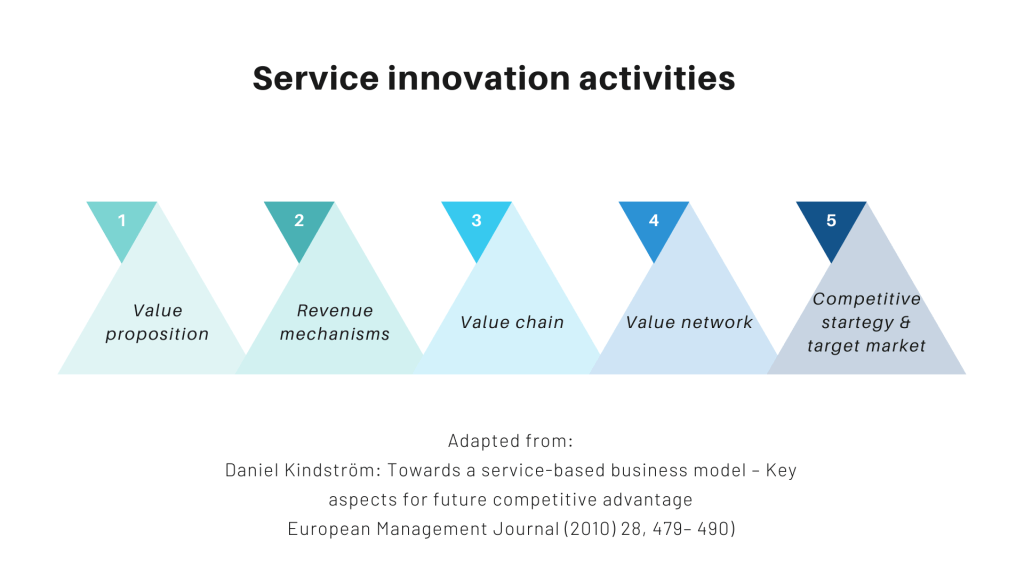
- Value proposition – starting from the customer value propositions and validating how is the innovative new service creating customer value.
- Revenue mechanisms – moving from cost plus pricing to value based pricing and finding the best pricing model fitting customer needs; finding advanced revenue schemes via partnerships.
- Value chain – developing the value chain from easy to address value parameters for sales, designing service development process and supporting organizational roles.
- Value network – identifying the opportunities to expand value proposition via the value network, involving both customers, partners and suppliers to enable best service delivery; taking the coordination role within the value network
- Competitive strategy and target market – developing service strategy for differentiation, and identifying target customer segments, and customer roles based on the value created.
Food for thought: Are these service innovation activities inbuilt into your service development processes, or would benefit taking a closer look into some of these items? I would consider all of these aspects critical, when working with new innovative service concepts.
The service innovation space is constantly evolving, driven by changing customer expectations, technological advancements, and competitive pressures. Organizations that embrace service innovation and adapt to the evolving landscape are better positioned to succeed creating differentiation from the competition. For me, developing services is balancing between continuous improvement of existing services, but also developing new innovative service concepts!
I hope you got some inspiration from the blog, and let’s exchange thoughts, if the topic is close to your heart!
References
Bessant, J. and Davies, A. (2007) Managing service innovation. Innovation in Services (DTI Occasional Paper No. 9). Department of Trade and Industry, UK.
Daniel Kindström: Towards a service-based business model – Key aspects for future competitive advantage European Management Journal (2010) 28, 479– 490)
 Strategic Portfolio Management
One thought on “Exploring Service Innovation Space – Are you utilizing all opportunities?”