

New business strategy, big organizational or operating model change, or merge of companies may lead to a need to redesign the development portfolio structure. Also, the introduction of Lean and Agile ways of working may impact portfolio design. Let’s check out different options for Enterprise level designs, and also some key topics to consider when planning the setup:
Portfolio structure based on business units and functions
A common way to get organized around development portfolios is to organize development into development portfolios owned by different business units and functions. This has been also a traditional ways within project portfolios – different units manage their own development portfolios taking business unit strategy into action. With large businesses, portfolios may be also slit to sub portfolios owned and managed by different departments, as the development content may vary a lot. Within business portfolios, development may be organized around projects, Programs, strategic initiatives, such as Must win battles.
Also global functions, such as HR and Finance often have own development portfolios, developing cross business capabilities. When the development is organized based on the ownership of work, also R&D and IT have their own development portfolios.
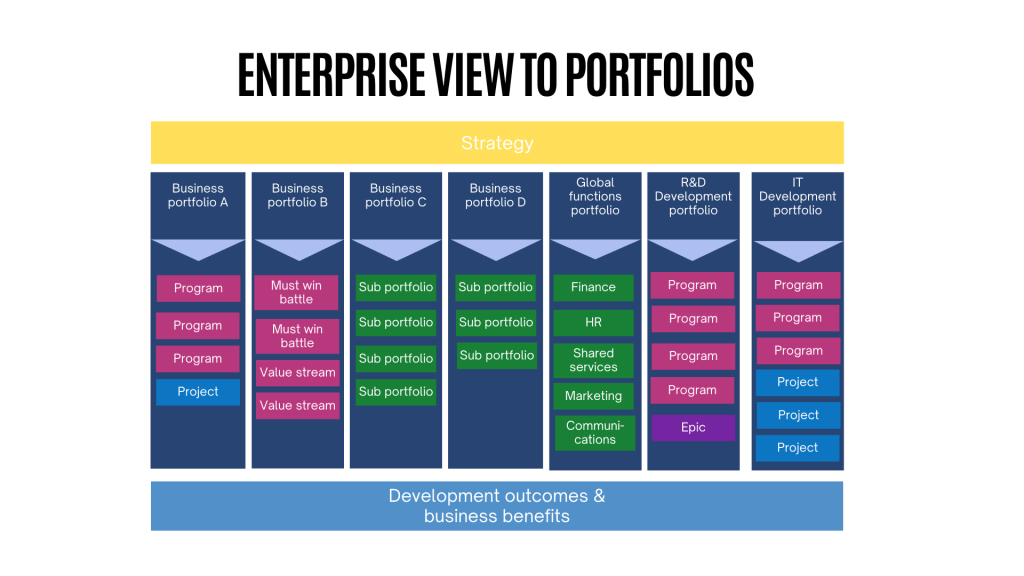
The model where development is organized around units works well, when each unit have clear roles and responsibilities in the strategy implementation, and development content does not typically requiring work from many other units.
Key points to consider in the enterprise portfolio level: is development happening across different unit portfolios aligned to take the strategy action optimally? Is there enterprise level transparency on key initiatives? How do you follow up on strategy implementation?
Let’s check out also other ways to get organized!
Cross organization transformation programs
When developing content which requires contribution from many different units and teams, there is no single clear owner in the organization and development outcomes impact the whole company, a common approach is to get organized around cross organizational transformation programs. Typical examples of such implementations may be for example ERP or CRM implementations impacting business processes, operating model and IT solutions for many different units.
Setting up governance, resourcing and way of working for such transformation programs require a lot of alignment – how are each unit contributing with the resourcing, who makes the decisions, who has the budgets? Do you have an enterprise level portfolio for these strategic transformations, or is one of global organizations owning the initiatives?
Key points to consider in the enterprise portfolio level: are several large transformative initiatives ongoing at the same time, and could the initiatives be sequences to ensure success of critical ones? How do you manage the governance to make transformation successful?
Value stream based portfolio structure
Today more and more development is organized via agile development. I happed to check out Scaled Agile Framework 6.0 last weekend, and there was a really nice Portfolio site added to the framework: Portfolio – Scaled Agile Framework. In the Scaled Agile Portfolios, development is organized around Development Value streams, and portfolios are organized around value. I like the thinking, to optimize the flow – however, this is a big change in thinking from the traditional way of organizing development into unit or function development portfolios. There are great examples, among others of business unit, regional or innovation portfolios within the sites, so check it out, if this is useful for you.
Key points to consider in the enterprise portfolio level: how is agile development visible in your development portfolios? Are you organized around value or around functions?
Optimizing the use of capacity
One of the key challenges for many professional development organizations, such as IT teams and R&D is how to optimize the use of capacity. Especially in the models, where IT development is distributed in many different business unit organizations, there may hundreds of projects ongoing with different types or resourcing needs from the same teams – and the there are typically few experts who’s contribution would be needed in many projects at the same time. How can a resource manager make the decision which initiative should get the results? Is it based on who shouts loudest?
Key points to consider in the enterprise portfolio level: how do you create transparency and prioritize work from different portfolios? Do you have too many smileys in the pipeline, considering the expert resources you have?
Managing cross portfolio dependencies
When development is happening in multiple development portfolios simultaneously, there is a danger of developing simultaneously similar solutions without alignment – leading to waste. There may be also complex dependencies between different initiatives, via common enablers, shared technical components or key resources. Creating transparency and alignment may require sharing sessions, discussions and sometimes also common portfolio management tools may also help.
Also enterprise architecture team plays a key role here – when the development is becoming more and more complex, someone needs to look into the solutions at the company level – to find synergies, to use common building blocks, and to avoid sub optimal solutions.
What does enterprise architecture have to do with enterprise level portfolios? Well, today, when development content has become increasingly complex,
Key points to consider in the enterprise portfolio level: Are development portfolio dependencies managed actively to see synergies between different initiatives? Is enterprise architecture team looking across all development portfolios to ensure smart decisions for the whole organization are made when developing IT and digital solutions?
Recommended reading
Portfolio – Scaled Agile Framework
You might be also interested in one of the previous blogs:
Development Portfolios In Large Companies – What Is Your Viewpoint?
Finding The Balance – Centralized vs. Decentralized Portfolio Management
 Strategic Portfolio Management
One thought on “Designing Development Portfolios in Enterprise Level – What is your approach?”