

You may be familiar with the Technology Readiness Level (TRL) model originally developed by NASA in the 1970s, today used by many R&D and research organizations. I had wonderful discussions with our R&D and product management colleagues a couple of weeks ago and started to think of how to apply this thinking to new service development, too. After all, it is crucial to understand how ready service concept, commercial model, processes, and organization are for high volume scale-up. Have a look at what I learned about Service Readiness Levels (SRLs)!
Technology Readiness Level for New Product Development
The Technology Readiness Levels (TRLs) defined by NASA [1] have been taken widely into use also in EU-funded Horizon research programs [2]. In the early phases of research on new technology, TRLs 1-3 focus on research of new technology principles, technology concepts and creating a proof of concept – at this point, there is no product. In TRL levels 4-6 technology is further validated in lab environment, validated and later also demonstrated in industrially relevant environments. When moving to TRL 7-9, we start to develop product prototypes, develop a full system scope and have product available in operational environment. Also, sometimes TRL 10 has been identified as a phase, where operations are proven [3].
In practical terms, even when moving forward from TRL 10, there may be different levels of standardization or productization – e.g. is product customized case by case for each customer or is there a standard productized scope with predefined options.
How to evaluate readiness of the service product?
In addition to TRL, also Service Readiness Levels (SRL) have been defined. I found couple of quite interesting sources, while studying the topic [4][5]. I adapted the service readiness levels defined by Whitehouse and Lange [5] to meet my experience in the context of B2B business services:
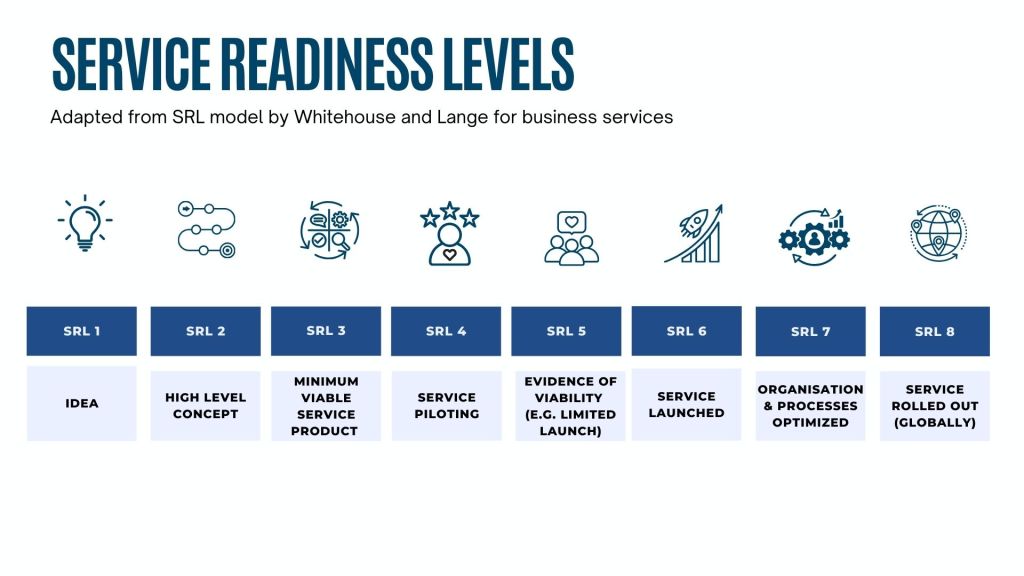
- SRL 1. Service idea is defined
- SRL 2. High level concept for service defined
- SRL 3. Minimum Viable ‘Service Product’ defined including among others draft value propositions, concept definition, high level processes
- SRL 4. Service is piloted to collect feedback – enabling customer feedback to improve the service product further
- SRL 5. Evidence of service viability is received, e.g. via limited launched for a specific group of customers: are customers willing to pay for service, what feedback do we receive to further improve the service, is the service ‘sellable’?
- SRL 6. Service is Launched for a wider group of customers – this is where the hard work with scaling up starts!
- SRL 7. Organization, processes and supporting tools are optimized to deliver the service – for example optimizing how different supporting IT tools work may require quite some effort!
- SRL 8. Service is rolled out – in large global companies, this may take quite some time to have full global reach!
Typically new service development is highly iterative, and especially in large global companies with regional differences and supply chains, journey from SRL 1 to SRL 8 may take a long time. And in the end, SRL 8 will be the start of continuous development journey to further improve the service based on customer needs and feedback from the organization.
Your organization may have a bit different definitions for service readiness levels, but I think it is a great approach to agree a common way to communicate about service readiness. Using the SRL model, it is possible to map and communicate towards stakeholders of different services in your new service development pipeline. For example visual management via a new service development pipeline may be helpful.
If you have a well managed SRL based pipeline (or still think how to formulate), I would love hear about your experiences!
References
[1] Technology Readiness Levels – NASA Technology Readiness Levels – NASA
[2] EU HORIZON 2020 General annexes – h2020-wp1415-annex-g-trl_en.pdf
[3] Straub, J.: In search of technology readiness level (TRL) 10. In search of technology readiness level (TRL) 10
[4] Gustafson, S.: Service Readiness Levels (SRL)
[5] Whitehouse, D., Lange M.: A Services Readiness Levels Stage Model: A Roadmap, Health Management, Volume 22, Issue 2, 2022.
 Strategic Portfolio Management