

The goal of productisation is to create a product that is easy to sell, deliver, and scale. Easier said than done, right? I will summarize some of my own learnings from the development of digital solutions, hardware-based products, and service concepts, and include insights from the literature as well.
Starting with WHY…
It is always good to look at the benefits first, as productisation work requires time and effort. Here are few commonly identified benefits as a food for thought:

Scalability & Revenue Growth: Productised offerings are easier to scale to meet increasing demand and can open new revenue streams through higher volumes.
Efficiency of Operations: Repeatable processes reduce hassle and shorten lead times for sales, delivery, and operations.
Marketability: A well-defined productised offering with clear value propositions is easier to brand and promote.
Consistency via Standardization: Standardized products ensure consistent quality and customer experience, which can enhance customer satisfaction.
Competitive Advantage via Differentiation: A clearly defined productised offering can help differentiate from the competition.
What would be the benefits in your context?
What do you mean? We have done productisation for years…
The term “productisation” can have various meanings depending on the context. Therefore, it is beneficial to begin discussions by clarifying what each participant considers a productized solution – and what would be the desired level of productisation for this specific product. This is a good topic to discuss with the group of stakeholders also when you are updating the product strategy next time!
If the scale is from fully customized to fully standardized, where is your product in the following scale? Where would you like to be in the future?
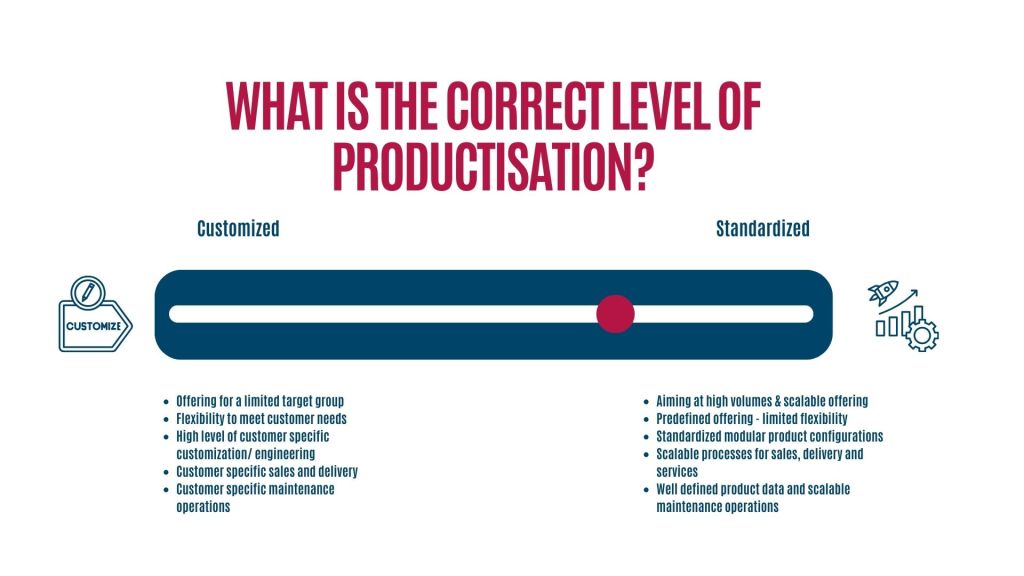
When the offering is targeted at a specific niche customer group and there is no aim to scale the product to high volumes, a lower level of productisation may be sufficient. On the other hand, if you are aiming for a high-volume product, well-defined and scalable sales, delivery, and service processes will create significant value over time.
Another dimension to consider is the flexibility of offering options. For high-volume products, well-defined offering packages create clarity for customers and stakeholder groups. In a hardware-intensive environment, do you allow customer-specific engineering, or do you have predefined options? On the other hand, if you are working with consultancy services, offering packages may have high-level definitions, and the content needs to be customized based on customer needs. For standardized offerings, well-defined product data structures and maintenance processes also enable efficiency during the lifecycle phase.
Here are a few questions to help you identify the correct level of productisation:
- What volume levels are you targeting with this product?
- What level of flexibility are your customers expecting in terms of offering options?
- How much time, effort, and money are you willing to invest to productise the solution?
- What is the correct time to invest in productisation work in your case?
- Do you have good documentation in different areas to support the rest of the organization (technical, commercial, process documentation)?
- Do you need tool support and product data improvements, such as sales tools development and product data processes?
Productising services or servitizing products?
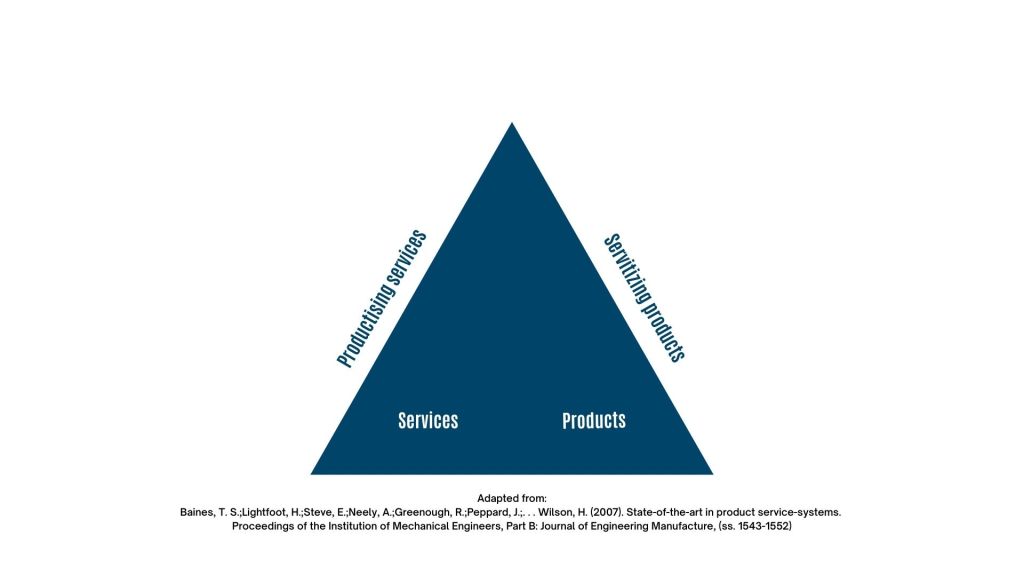
If you are working with physical products, productisation efforts may be quite different than if you are working with services. I like the triangle model adapted from article by Baines et al. (2007), visualising the need to servitize products and productise services.
For productising services, I have found useful the idea of developing service concepts, which have well defined processes, commercial models and the same service concept can be scaled up across different product and offering areas. If there processes for each service is different, services remain difficult to scale up, and productising of each service require a lot of time and effort.
For the product based offering with long life time, sometimes even decades, it is important to also develop the life cycle services, and servitise the product to ensure smooth operations, maintenance and possibility to upgrade the product. The work related to servitisation takes time and effort, and it is good to start to build service readiness in the early phases of development.
Hey, we are working with Software products…
Hopefully somewhat clear for physical products and service, but how about software products?
If you are working with software products, here are few supporting statements for evaluating the level of your productisation:
- Software can be easily deployed and maintained
- In addition to software, also installation guides, user manuals, and service support models are in place
- Consistent product brand with product naming, logo, marketing materials have been created
- Pricing strategy is reflecting the product value has been validated with the customers and well documented to support the sales
- Support models for software updates are in place, including processes for bug fixes and introduction of new features
- Software product is scalable for higher volumes enabled by sound architecture design
- There is a systematic feedback loop with the customers to continuously improve the product
What is your approach for productisation?
The next time you look into product strategy updates, would it make sense to have a discussion on productisation as well?
As always, I would be happy to get your feedback and thoughts for example via LinkedIn!
If you are interested, here is a list of good reading…
Armstrong, E. (2020). Productize: The Ultimate Guide to Turning Professional Services into Scalable Products. Productize Press.
Baines, T. S.; Lightfoot, H.; Steve, E.; Neely, A.; Greenough, R.; Peppard, J.;. . . Wilson, H. (2007). State-of-the-art in product service-systems. Proceedings of the Institution of Mechanical Engineers, Part B: Journal of Engineering Manufacture
Cagan, M. (2017). Inspired: How To Create Products Customers Love. Wiley.
Mironov, R. (2008). The Art of Product Management: Lessons from a Silicon Valley Innovator. Booksurge Publishing.
Olsen, D. (2015). The Lean Product Playbook: How to Innovate with Minimum Viable Products and Rapid Customer Feedback. Wiley.
Banfield, R., Eriksson, M., & Walkingshaw, N. (2017). Product Leadership: How Top Product Managers Launch Awesome Products and Build Successful Teams. O’Reilly Media.
 Strategic Portfolio Management