

This blog post is from November 2020, when I completed my MBA thesis related to Digital servitization framework, but I think it is still valid, and added also here! During the spring 2023, Helsinki is hosting also The Spring Servitization Conference, and it is good time to review some old notes now.
Servitization is not a new phenomenon, and many manufacturing companies have already experienced servitization in the context of repair and maintenance services. Servitization was described by Vandermerwe & Rada (1988, p. 314) as “increased offering of fuller market packages or ‘bundles’ of customer focused combinations of goods, services, support, self-service and knowledge in order to add value to core product offerings.” In this early article, servitization was considered as a key strategy for organizations to adapt to a new kind of economy, where services play a key role in value propositions.
Another definition by Baines et al. (2009) highlights the importance of organizational capabilities and processes: “Servitization is the innovation of an organization’s capabilities and processes to better create mutual value through shift from selling products to selling Product-Service Systems.”
Developing digital services vs. digital servitization
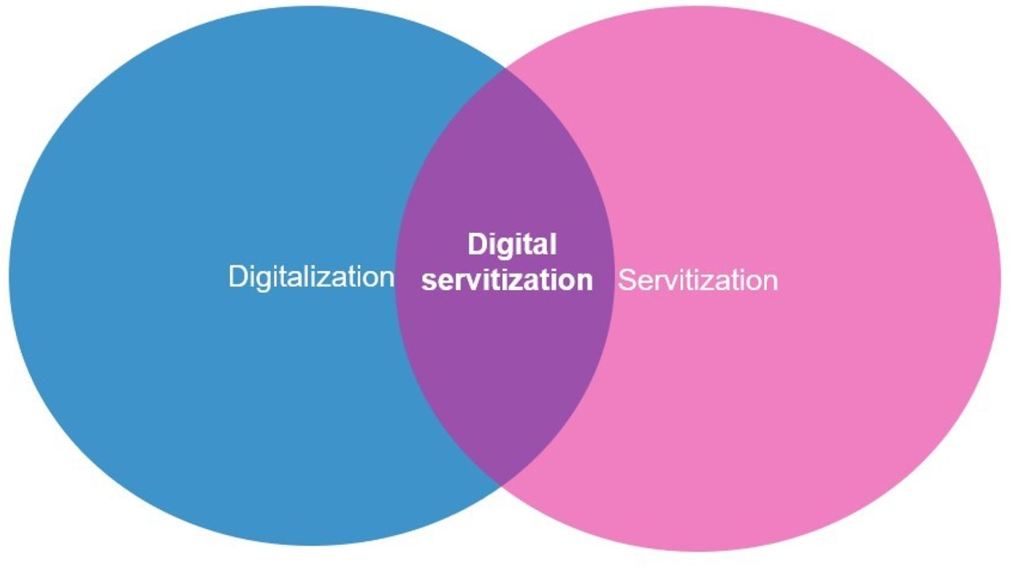
Digitalization brings also a new view point to servitization: “Digital servitization is viewed as the use of digital technologies to create an appropriate value from product-service offerings; thus, digital servitization is understood as the interplay between digitalization and servitization” (Kohtamäki et al., 2020).
Research indicates that digitalization of manufacturing without servitization capabilities can lead to negative returns, i.e. digitalization paradox – thus, servitization is needed to create positive financial performance from digitalization (Kohtamäki et al., 2020). That is, even though you would have fantastic digital service product, without servitization activities it may be difficult to bring a new solution to markets successfully.
The digital servitization journey may not always be straightforward, due to many transformations needed in the technologies and commercial models, in different business lines and functions, across country organizations, operating model processes, roles, data and IT tools, and supply chain.
Combining physical and digital – productizing services vs. servitizing products?
One of the biggest challenges for the manufacturing companies in the digital servitization journey may be to combine physical hardware and digital services and setup up seamless end-to-end processes for running the services.
There may be complex dependencies between the physical hardware components and digital services. Also, in in the world of existing installed based, customers may have a large number of different types of hardware setups. Furthermore, when considering end-users using for example mobile apps, the variety of different types of end user devices may be huge.
If approaching digital servitization from the traditional hardware product view point, commercial model could be to servitize the product, e.g. introduce value added services to offer increased value towards customers. If approaching the phenomenon from the service offering view point, approach could be to productize the service – implement great commercial models and robust processes for the digital services. Both viewpoints are needed, and this is the fun part!
In practice, digital servitization may be seen as a journey to implement digital services and solutions into end-to-end processes: development, deployment and run phase of the digital services needs to be systematically managed.
Focus on customer value – but who is your customer?
For companies working with traditional B2B setup, digital services may introduce completely new type of customer groups. Digital services may be sold for different customer roles and decision making process may vary from the familiar ways. Also the end-user groups may be completely new with new type of support needs.
In order for customers to invest in digital services, clear customer value should be continuously delivered. Understanding the customer need and use cases, validating the customer value and also ensuring customer success plays a key role.
How to make it easier?
The recommendation from my MBA study is to develop company methods, practices, processes, tools and governance to enable fast, but systematic digital service development, deployment and a run phase with continuous improvement loop. The process was seen iterative by nature, and digital product, commercial models and end-to-end processes should evolve over time.
As introducing digital services may require changes in many different areas, there is no easy way. However, defining a simple framework including a set of templates and examples may help new teams, while working with commercialization and end-to-end processes. Also creating a common service concept and business model for a group of services, may help with the implementation and ramp up of the services.
In addition to a global view point, also service deployment and localization in the country organizations is extremely important. One model does not fit all, and thus optimizing go-to-market activities in the country is critical. When introducing new digital services, almost all roles in the organization need to be aware of the new offering, many roles are significantly impacted and new capabilities are needed.
Perhaps the most important thing, based on my opinion, is to build new collaboration between different teams, business lines, solution and offering areas and end-to-end process steps. This is not always easy as different functions may have different ways of working, but absolutely necessary and offers incredible learning opportunities!
References:
Baines, T.;Lightfoot, H.;Benedettini, O.;& Kay, J. (2009). The servitization of manufacturing: A review of literature and reflection on future challenges. Journal of Manufacturing Technology Management, 547-567.
Kohtamäki, M.;Perida, V.;Patel, P. C.;& Gebauer, H. (2020). The relationship between digitalization and servitization: The role of servitization in capturing the financial potential of digitalization. Technological Forecasting and Social Change.
Vandermerwe, S.;& Rada, J. (1989). Servitization of business: Adding value by adding services. European Management Journal, 314-324.
 Strategic Portfolio Management