Do You Hear Laughter? Tips for Creating Psychological Safety for Development Teams

Project work and developing new products and solutions require a lot from the teams – there may be complex problems to be solved, challenges to get started with the new initiative, stretched timelines to meet, and different types of needs coming from many different stakeholder groups. But even though development work is often very demanding – the best teams still manage to have fun together and achieve a lot!

I am part of my workplace Grow training this autumn and got inspired by the psychological safety theme – here are some reflections on how psychological safety can help Development portfolios perform better!

Making things happen – and having fun in the team level

I am a big fun of Amy Edmondson – and her Creating a Fearless Organization. Based on Amy Edmondson, Psychological safety is not about being nice, avoiding conflicts or an excuse to complain, but creating an environment where development teams have high performance standards, but still feeling safe enough to speak up about mistakes and concerns – and being unafraid to bring up also ideas and questions.

Based on my experience, best performing teams make things happen, but also still manage to have fun. For me, it is always a good sign, when I hear laughter from the development team. When the team has fun together, is also easier to bring up difficult topics, and also find the solutions. Best teams have also fierce debates, as the aim is to find the best solutions. And not to forget wild ideas, which can be enhanced and enriched together as a team.

Inviting to participation – across the organization
When developing complex solutions impacting the work of different business units and end-to-end processes, a significant amount of communication and alignment across the organization is needed. Does the development team feel safe when introducing new ideas and concepts with the stakeholders? How is the feedback given and received?

As a lead of a strategic initiative, there may be many stakeholders groups to be alignment with – and a need to build new connections between the units, which have not been earlier collaborating actively. The way of working, terminology and tools used may differ, and there is a big risk of misunderstanding. Here it is important to keep the big picture, but also actively align with different stakeholder groups, listen and use the feedbacks actively to improve the final outcomes. Are your workshops safe environment to give feedback, bring up ideas and debate?

As a stakeholder of a strategic initiative, it is important to offer support for the development team, even though topic might be new to you, and you may feel uncomfortable to certain extend. Listening actively, and trying to connect the development vision to your own area of expertise is important – and to avoid starting with your own agenda first. Also, bringing up the potential development needs is important, as the development team may not have all the needed knowledge for end-to-end value chain. Are you giving the feedback in a constructive way, which are easy to take into consideration and invite to dive deeper into the topic together?

One of the clear trends I have seen in many companies, is to reduce the amount of steering meetings, and increase the amount of sharing via other means. Great practice widely used by agile teams is to organize demos and reviews – seeing concretely what has been developed helps everyone to understand the content, and bring up also development needs.

Psychological safety in portfolio level decision making
When I was quite fresh from the university, I was working for a large transformation program which had been ongoing for several years. The planned go-live was closing and many team members were really worried about the performance of the solution – as after go-live, the new system could risk the company continuity. When the performance issues were discussed, an experienced management consultant gave an advice: “Senior managers are like sheep, you don’t want to scare them off.

Well, after all these years I still disagree with that – teams should feel comfortable bringing up also concerns and senior management deserves to get objective and data based understanding. In the end for that specific project, company internal controls worked as they should, and the performance challenges were addressed before the go-live. Oh, what a learning it was for all the stakeholders involved, and big emotions also involved!

Another big ERP implementation project, where I worked, faced a big challenge with technical environments one month prior to go-live. As a program lead, this was not an easy news to bring up, but as a team, we got the full support from the management and all the vendors involved, and the year end schedule was kept thanks to good team work. I think here psychological safety played a key role in that case – discussing openly about the challenge enabled also finding the solutions with all parties.

Here are few tips for portfolio managers and senior management to help the teams:

  • Encourage teams to share, organize demos and reviews with the rest of the organization – this helps to create alignment and get feedbacks early. Seeing is believing! Participate, sponsor and create a positive and encouraging atmosphere to these events!
  • No news is not always good news – encourage teams to share openly about their progress and seek for alignment – not only within gate approvals, then it might be too late.
  • Build flexibility into the decision making – can teams bring up key topics to decision making forum to inform senior management or when guidance is needed?
  • Don’t kill the messenger – when something goes wrong, don’t find who to blame, but think ways to support to solve the challenge!
  • Hearing laughter during team meetings is usually a good sign – the best teams have fun and also achieve a lot together!

More blog posts related to portfolio governance available here: Development Portfolio Governance.

References

Amy Edmondson – Creating a Fearless Organization – Youtube video
5 + 5 + 5 Tips for making better portfolio decisions

Portfolio governance meetings have often tight agenda’s – there may be many decisions to be made, and complex topics. Smooth decision making requires systematical work – good preparation, discipline and focus during the meetings and also systematical follow up work after the meetings. To help different roles shine, here are 5 tips for facilitators, 5 tips for presenters and 5 tips for steering group participants. Have a look!

5 Tips for the Facilitator – Helping The Presenters Shine!

  1. Prepare presentations and materials with the presenters – communicate clearly when the materials need to be ready, review and coach also the presenters, so that they can shine during the meeting and the flow of decisions will be smooth!
  2. Send out agenda and prereading material 48 hours before the meeting. This is especially important, if you have big decisions on agenda.
  3. Keep the meeting schedule – be clear on time slot planned for each presentation and politely also remind of the slots. It is fair to give all presenter’s their slot.
  4. Summarize the decisions and key conclusions and share the meeting minutes within 24 hours after the meeting – it is good practice to share the meeting minutes when the participants still have fresh memories on the discussions.
  5. Follow up on action points systematically after the meeting. I think this might be the trickiest part, but also perhaps most important one!

5 Tips for Presenters – Prepare well, present clearly

  1. Provide the prereading material on time. Often, a good practice is to provide the materials 48 hours before the meeting – so align on the schedule and meeting practices with the meeting facilitator.
  2. Be clear with your decision proposal – are you looking for a decision, guidance or support – or is your presentation an update?
  3. Keep your presentation time slot – if you have 10 min presentation slot, do not come to the meeting with 20 slides! You can always have backup or additional prereading materials, as needed.
  4. You can ask kindly to take the questions at the end of the presentation, so that you can go through the material without interruptions
  5. If you are unclear with the decision – be brave and ask for clarification. Usually if you did not get a clear decision, other participants have the same challenge.

5 Tips for Steering Group Members – Give your full focus

  1. Read the prereading materials in advance, and collect also feedback from your organizations as needed
  2. Give your full focus on topic – join on time, focus fully on presentations and don’t multitask
  3. Be an active participant – Ask questions, and give your guidance and comments, but also listen to other view points and presentation carefully
  4. Support decision making – help facilitator and presenter to reach to a conclusion
  5. After the meeting check the meeting minutes and your action points, and communicate the decisions with your own organization.

Further reading

Principles of Good Portfolio Governance – blog post

Principles of Good Portfolio Governance

Development portfolio governance is one of the areas, which might cause headache in in many organizations. I wanted to have a look at the what standards say about the good governance, and reviewed briefly ISO 37000 – Governance of organizations standard focusing on governance principles. The standard may be applied for any type of organizations, and I think the guiding principles are also good food four thought for portfolio governance.

Primary governance principle – Purpose

Primary governance principle in ISO 37000 is the Purpose – there needs to be a clear purpose why organization exists and the same applies also for development portfolios. What is the purpose of the portfolio? What is the reason of existence from different perspectives?

Clear purpose statement defines, specifies and communicates the value the portfolio intends to generate for specified stakeholders. Clear purpose is really important: to be able to communicate the purpose & WHY portfolio exists.

Supporting questions:

  • Have you defined a purpose for your development portfolio?
  • Have you communicated about the purpose with different stakeholder groups?

4 Foundational Principles – Value Generation, Strategy, Accountability and Oversight

Next, standard defines 4 Foundational Principles. Let’s look into those, too.

Value Model – the elements comprising value creation and value generation which are required to fulfil purpose. Value generation model provides basis for innovation and also for collaboration with the stakeholders.

Supporting questions:

  • What value is the development [portfolio] creating to customers, business, organization, and even in a wider context to other stakeholders?

Strategic development portfolios should be by definition, strategy driven. One of the foundational principles for governance is Strategy – engaging strategies in accordance with the value model.

Supporting question:

  • Is your portfolio strategy driven or loosely linked to strategic goals?
  • What does the company strategy mean in practice for your development portfolio?

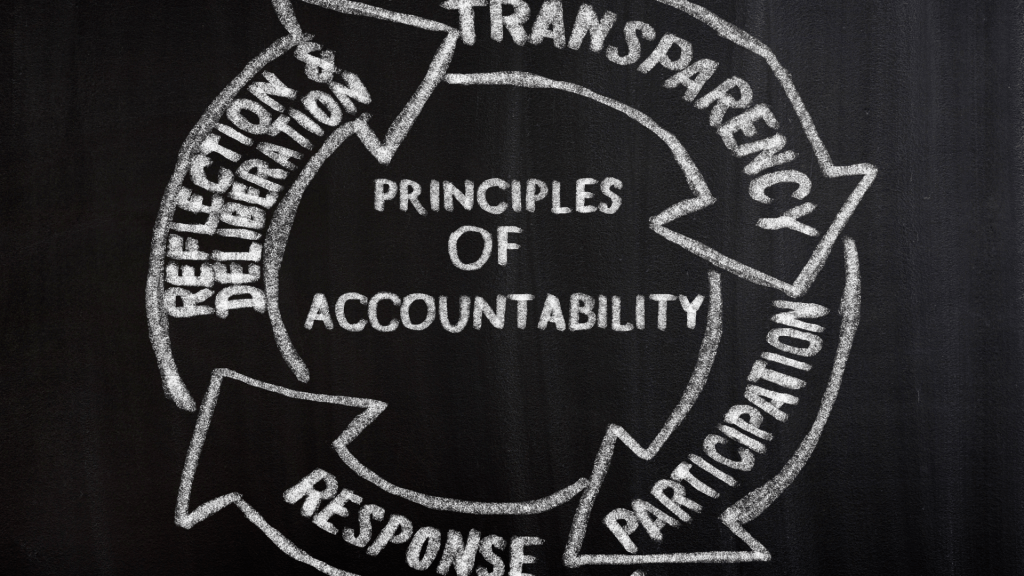
Accountability – Accountability engenders trust and legitimacy, which leads to improved outcomes. Those responsible for managing the portfolio must be held accountable for their actions and decisions. This includes ensuring that there are clear lines of responsibility and authority, as well as systems for monitoring and evaluating performance.

Supporting question:

  • Are the roles defined clearly for your portfolio, so that accountable members know their responsibilities?
  • Do you systematically create transparency across the stakeholders on your development portfolio progress and plans?
  • Do you actively engage stakeholders?
  • Do you collect feedback and improve ways of working systematically?

The Fourth Foundational Principle Oversight is important to ensure the governance is appropriately designed and operating as needed. This principle is overseeing portfolio performance and enduring portfolio is fulfilling the expectations. As a good practice, there is an internal control system implemented for oversight.

Supporting questions:

  • Do you have a definition for your portfolio governance model available for different stakeholders?
  • Are the stakeholders aware of your governance model?
  • Are you following up, that governance model is used in practice? What happens, if there is an exception?
  • Do you have clearly defined guardrails for financial decision making and internal control system it is followed?

6 Enabling Governance Principles

ISO 37000 standard includes also 6 Enabling Governance principles: Stakeholder engagement, Leadership, Data and decisions, Risk Governance, and Social Responsibility. I will review also these in the context of development portfolios!

Stakeholder engagement – Member, reference, and relevant stakeholder engagement are key. Transparency is a key element of effective governance, and stakeholders must have access to information about the organization’s goals, strategies, and performance.

Supporting questions:

  • Who are your development portfolio key stakeholders?
  • How do you engage with the different stakeholder groups?
  • Do you create transparency on development portfolio plans, progress and outcomes?
  • Are you meeting the expectations of different stakeholder groups?

Leadership – The governing body should lead by example to create a positive values-based culture, set the tone for others, and engender trust and mutual cooperation with the organization’s stakeholders. Effective governance requires strong leadership, with clear roles and responsibilities defined for all stakeholders involved.

Supporting questions:

  • Are you leading by example?
  • Is the portfolio decision making ethical?
  • Is the portfolio decision making efficient?
  • Are you creating an positive environment, building trust and good cooperation with the stakeholders?
  • Are you following company leadership principles also in the context of the development portfolio?

Data and decisions – The governing body should ensure that the organization identifies, manages, monitors and communicates the nature and extent of its use of data.

Supporting questions:

  • Is your portfolio data up-to-date, e.g. the project schedules, approved budgets and business cases?
  • Do you use actively data in the portfolio decision making?
  • Do you maintain presentation materials and meeting minutes for the portfolio governance body?

One of the goals of portfolio management it to maximize the portfolio value – this also requires taking some risks. Governance is not just about compliance. It is about managing risk in a way that ensures the long-term success of the organization.

Risk governance – Value is generated when appropriate risk is taken, transferred or shared in a timely manner. This happens when the governing body balances risk effectively.

Supporting questions:

  • Are you reviewing portfolio risks regularly?
  • Do you have clear practices, for mitigating risks and reporting risks?
  • Are you balancing the risks?

The guidance explains what good governance looks like across eleven mission critical topics:

Social responsibility – The organization should proactively contribute to sustainable development by generating value in a manner that meets the needs of the present without compromising the ability of future generations to meet their own needs.

Supporting questions:

  • Are the decisions made ethical and considering also the social responsibility?

Viability and performance over time – portfolio should ensure viability over the time without compromising current and future generations.

Supporting questions:

  • Are the decision made today enabling also the future success?
  • Is portfolio balanced across time horizons?

By following these principles, development portfolios can enhance decision-making processes, manage risk more effectively, and achieve long-term success.

References

ISO 37000 – Governance of organizations standard

Finding The Balance – Centralized vs. Decentralized Portfolio Management

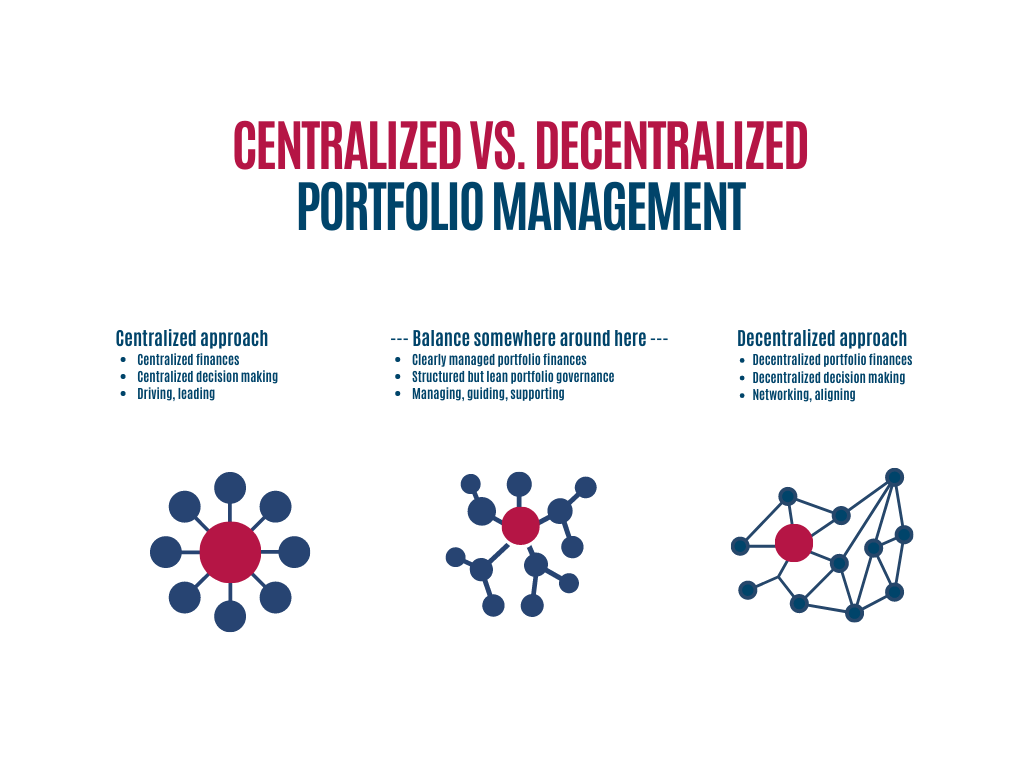
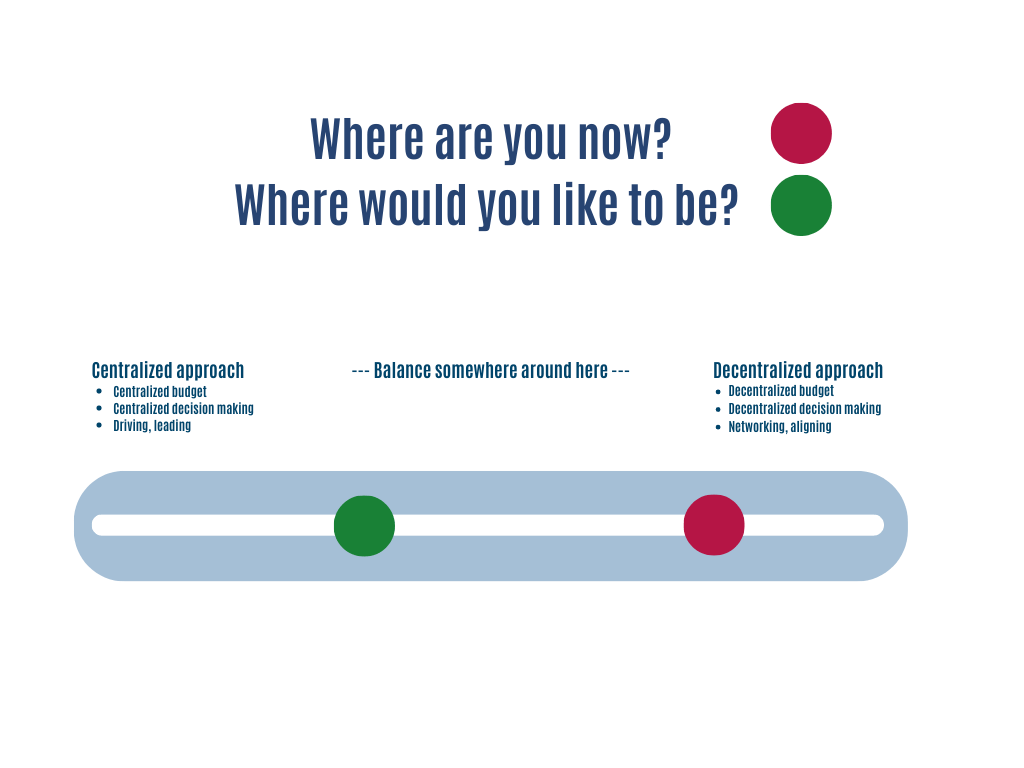
The role of portfolio management differs a lot based on how development is organized within the company. If development funding is centrally managed, the role of portfolio management is to drive decision-making. If development funding is fully decentralized across the organization, and development budgets are managed within different units and departments, the role of portfolio management is more about creating alignment and networking across the organization.

Sometimes organizations also move from one end to another – first centralized approach may seem too heavy and a bit bureaucratic, and to bring decision making closer to business, portfolio management is decentralized. This blog is reviewing the different approaches and where could be the balance – and also some thinking related to agile ways of working in the portfolio context provided.

Ultimately, the choice between centralized and decentralized development portfolio management depends on the organization’s specific needs. Each organization is unique, and perhaps something between fully centralized and completely distributed may be a good spot – finding the balance, and enjoying the benefits of lean but powerful governance, but also managing portfolio dependencies well across the company.

Centralized development portfolio approach

When development funding is centralized, portfolio governance is typically managing investment decisions, and driving development roadmaps. In a decentralized approach, portfolio management is focusing more on creating alignment, networking across organizations and coaching. Let’s review a bit more what could be potential benefits and challenges for fully centralized portfolio management approach:

Potential benefits

  • Driving development based on strategic priorities in enterprise level
  • Prioritization of development across different business areas and business units
  • Common governance model, standardized processes and ways of working

Potential challenges

  • Decision making may be far away from the business units or teams
  • May feel bureaucratic, and slow; lack of agility in decision making

Decentralized development portfolio approach

On the other hand, if development funding is fully decentralized across different departments and cost centers, decision-making is typically close to the business, but seeing the big picture in business or in enterprise may be challenging. Let’s review the potential benefits and challenges:

Potential benefits

  • Increased agility and responsiveness to the change
  • Possibility to find ways of working, which work well in a specific business unit or function
  • Decision making is close to the business teams

Potential challenges

  • Lack of transparency in enterprise level & across untis
  • Sub optimization in enterprise level due to optimization in units and functions
  • Lack of common ways of working due to the freedom and autonomy
  • Challenges to manage common resources across different portfolios

How is agile development impacting portfolio management?

Also lean and agile ways of working are changing the role of portfolio management – instead of driving decision making via project gates approvals, agile teams typically have own budget frames or guardrails, and decision making for development priorities is happening within the team and stakeholders.

Tip! For organizations using Scaled Agile Framework, a good read for evolution of Lean Agile Center of Excellence: https://scaledagile.com/blog/how-to-start-and-grow-lean-agile-center-of-excellence/

What would be optimal in your organization?

How do you see your organization – where are you now in the scale from a fully centralized vs. fully decentralized approach? Is everything working smoothly, or could there be some actions to find a better balance? Where would you like to be within a 3-year time frame?

Do you want to get the latest blog updates to email?

Processing…
Success! You're on the list.

From Idea to Value: Leveraging Business Technology Standard in Portfolio Management

Have you heard about the Business Technology Standard?

Many large companies and organizations in Finland are applying the framework to support demand, development, and service management, especially within the business IT context. Over the last ten years, the standard has significantly influenced my thinking—I tend to see its structure everywhere I go!

I had a wonderful sparring discussion with Business Technology Forum Executive Tia Jähi, and we agreed, that even though standard is originated from the business IT, the same principles would apply also for other contexts, such as our life cycle business and offering development!

Demand

First, we need to start with the demand portfolio. New ideas or development needs come from many different sources, and we need to create a systematic way to process, analyze, and prioritize this demand.

Development

Next, we move to the development portfolio. Development can occur through projects or programs, as well as continuous improvement activities. The Business Technology Standard framework can be applied to both traditional project portfolios and agile setups, which is fantastic!

Services

Last but not least, the service portfolio. This is the phase where we start to realize business benefits—when our new IT system is operational or our offering is sold and used by our customers. Having well-defined service management processes helps development teams focus on new demand and development and ensure good care of the customers and end users.

Governance

Creating clear governance over the entire end-to-end chain helps to create transparency, smooth decision-making, and a focus on value and strategic objectives. This includes well defined roles and responsibilities and also clear prioritization of demand, development and also service management activities.

Have you been applying the standard successfully? What are your key takeaways?

If interested to learn more, have a look: https://www.managebt.org/