

Sometimes, when discussing with development teams and other stakeholders, value of portfolio management is not fully acknowledged. Portfolio management may be considered as additional bureaucracy with no value add – budgeting, steering meetings and requests to update data.
However, if portfolio management is not efficient, people start to notice something is not quite right: too many initiatives ongoing at the same time, parallel projects ongoing in different departments with the same content, and development seem to be overall a bit chaotic.
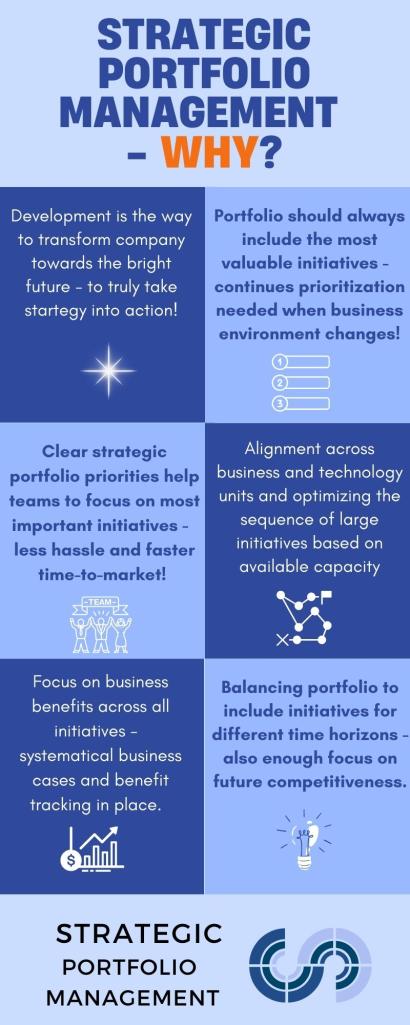
This blog is dedicated to why strategic portfolio management is important – six key WHYs highlighted. I would also love to hear your thoughts via comments to understand different viewpoints – do you agree?
First of all, development is the way to transform company towards the bright future – to truly take strategy into action! If development portfolio is not aligned with strategic goals, strategy implementation is not likely to be successful.
Portfolio management should always be a continuous activity, and prioritization should not be one-time-activity during the budgeting season. Portfolio should always include the most valuable initiatives – continuous prioritization needed when business environment changes. Also sometimes we start a super promising project, but notice our assumptions were not right – project should be killed or rethought.
Smart people tend to contribute to a large amount of great development ideas – one of the key challenges of portfolio management is to select the best of best ideas. Development ideas may come from many different stakeholder groups – business teams, product development, operations, sales teams or from customers – and they may be small and large ones. Portfolio management may help to solve this challenge – setting up portfolio funnel to systematically collect, evaluate, experiment and prioritize development ideas.
Many teams struggle with having a lot of work coming from many different directions – if teams do not know key priorities, they may spend most of their valuable time on activities, which are not high priority. Also having too much to do starts to be very stressful in long run. Clear strategic portfolio priorities help teams to focus on most important initiatives – less hassle and faster time to market!
Also in the company level, there may be too many large transformations ongoing – money may be one limitation, but also time of best professionals and organization’s ability to adapt to change may be limited. Alignment across business and technology units and optimizing the sequence of large initiatives based on available capacity is important. Brave leadership is needed to prioritize and sequence large initiatives – but this really pays off.
Defining business cases and finding great KPIs to follow benefit realization is never easy – however, if this part is missing, how would we know if we are investing in correct initiatives? Strategic portfolio management has focus on business benefits across all initiatives – systematical benefit tracking is in place.
Last but not least – it is easy to say yes to quick wins – developing existing process or tool, where you see the benefits almost immediately. Continuous development is super important, but there should be a balance: balancing portfolio to including initiatives for different time horizons – also enough focus on future competitiveness.
One extra: one of the areas creating a lot of headache in many organizations is governance – some organizations have too many or too large steering groups and unclear roles, where as some other organizations lack of key governance structures to enable smooth decision making. One of the key goals of portfolio management is to create clarity on decision making – there should be simple but powerful governance, empowering also teams.
What is your WHY – why is portfolio management important to you or your organization?
Here is a summary – I hope it helps!
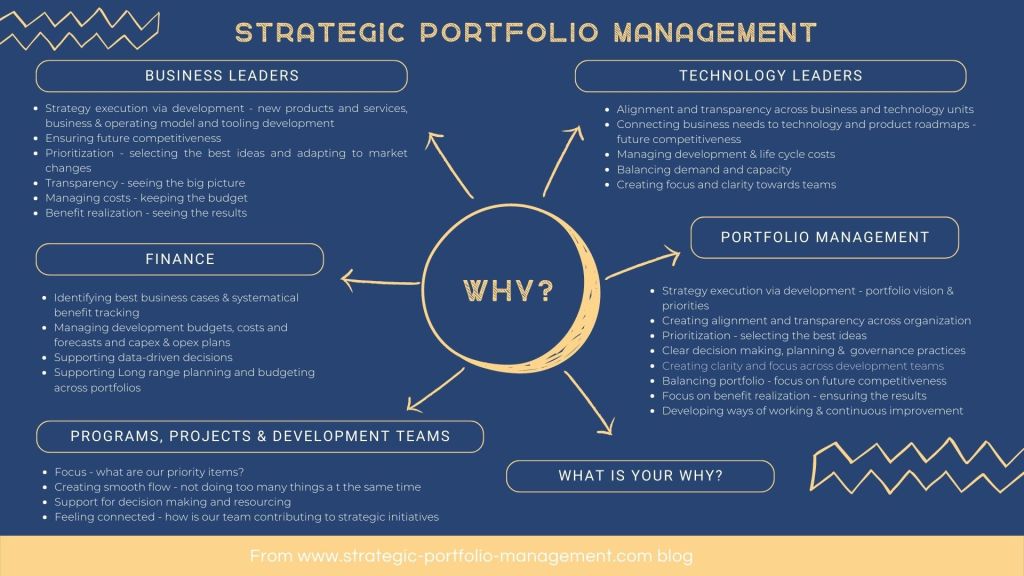
Different roles and stakeholders – why?
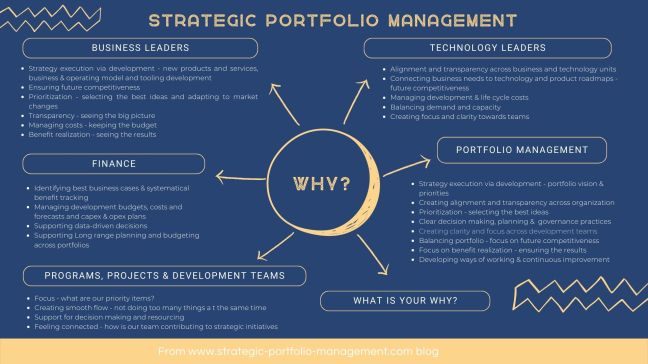
When discussing with different stakeholder groups in large organizations, each of the stakeholder group have different needs and expectations in terms of portfolio management. When you are discussing portfolio management with different stakeholders, it is good to discuss what is the why for them – this is how you can also support different stakeholder groups. Here is a summary of WHY for couple of key stakeholder groups:
Check out a short video for further inspiration!
Strategic portfolio management – WHY? Video for inspiration
I would love to hear your thoughts!
Each organization and portfolio are unique, and have different flavors. Is your why included, or did I miss it? Why is portfolio management important for your stakeholders.

 Strategic Portfolio Management