Time for A Quarterly Portfolio Review?

Autumn is a busy time in many organizations due to yearly planning. However, development plans tend to change, and typically already in January some parts of the yearly plan require updates. One of the good practices I would recommend for any development portfolio is quarterly reviews.

Quarterly cycles work well in many organizations, as typically financial processes are quarterly based. A quarter is already a long enough time period to see progress happening within portfolio, but it is still possible to also take action, if progress is too slow in some areas or key results are not met. Furthermore, if operational portfolio governance is monthly based, quarterly cycle works well for tactical or strategic portfolio reviews.

In addition to portfolio level governance, quarterly cycles work well for hybrid portfolios including projects and agile work. Agile teams have often quarterly planning practices, and there may be needs to support planning with portfolio level decisions and prioritization.

Quarterly portfolio review – WHY?

Here is a list of why quarterly portfolio reviews may be helpful – but also a checklist for you to think for your own context:

Transparency and visibility

  • Reviewing roadmaps & progress – how are we doing?
  • Reviewing portfolio funnel of new ideas – what is new in the pipeline?
  • Managing dependencies and alignment across initiatives
  • Communication towards larger stakeholder group – creating transparency among the stakeholders
  • How are we doing with portfolio finances?

Optimizing portfolio

  • Optimizing and balancing portfolio content – is current portfolio reflecting strategy, and support future competitiviness?
  • Feedback loops to business case updates & following up on benefit realization
  • Killing projects or putting projects on hold if needed

Adapting to changes

  • Adapting to changes in market environment
  • Prioritization of new initiatives
  • Allocation and reallocation of frames
  • People side of the change – identifying focus areas and portfolio level impacts

Planning capacity

  • Sequencing & prioritization of large initiatives to enable good resourcing
  • Scaling capacity as needed based on future demand
  • Ensuring resourcing for cross unit/function development initiatives
  • Leaders supporting teams removing obstacles and ensuring resourcing

Continuous improvement

  • Sharing key learnings from the portfolio – key takeaways from projects or programs
  • Sharing good practices & ways of working
  • Feedback loop to improve portfolio practices – where to focus on, what to end, what to keep doing

Quarterly portfolio review + quarterly planning for teams

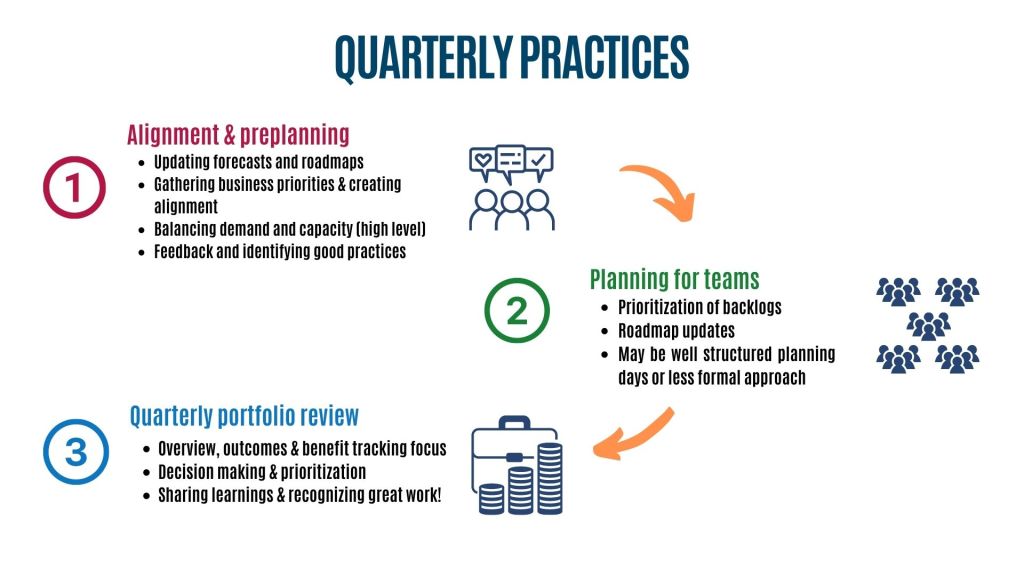
Quarterly cycles are great also for development teams to look into roadmaps, aligning on priorities and balancing demand and capacity. Many agile teams also have quarterly planning practices to prioritize back log and to plan for the next quarter development work.

If teams have quarterly planning practices, good steps may include 1) Preplanning, 2) Planning with teams, 3) Quarterly portfolio review. Sometimes the order or portfolio review may be before the teams planning – what would be the best order for you?
Focus areas & agenda for quarterly review?

Quarterly review agenda may be planned based on the yearly portfolio clock. For many organizations, Q2 review could be focusing on long range planning, whereas Q4 review could be celebrating current year successes and next year plans. It is also important to keep benefit realization in the agenda, so that could be a focus area for Q3 and Q1 reviews.

All portfolios are unique – for a large and complex portfolio quarterly process may include many meetings to clarify plans and align with the stakeholders, as well as own meeting focusing on decision making. For smaller portfolio, review may be also much lighter checkup – are we reaching our key results, how are with benefit realization, and do we need to change priorities. Here is an idea, what your agenda could look like for portfolio review:

I would love to hear also what works for you – let’s get in touch!

Additional reading

Scaled Agile Lean Portfolio Management – Strategic portfolio review practice as a reference!
From project portfolios to hybrid portfolios – combining projects and agile work

Hybrid development portfolio combining traditional projects and agile work

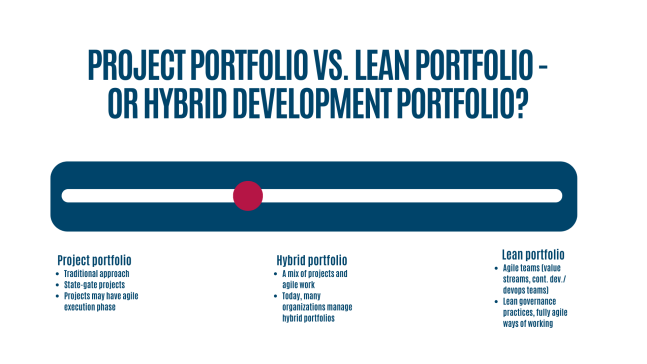
Many companies have well established practices for managing project portfolios. Projects are followed up and governed based on the stage-gate model – and portfolio may include for example a collection of projects, programs, and other activities. There is an own standard for project portfolio management (PPM), which has been taken widely into use.

On the other hand, agile practices and continuous development teams have become more and more common. Popular Scaled agile framework (SAFe) has introduced a great set of practices for Lean portfolio management (LPM) – in SAFe development is organized via value streams and executed fully in agile mode.

However, most of the organizations are somewhere between – having still plenty of projects (often with agile execution), but also continuous development executed by the agile teams, continuous improvement or devops teams. Where is your organization now, somewhere in between? Where would you like to be in the future?

Scale from traditional project portfolios to hybrid portfolios combining projects and agile to lean portfolios – Where are you now, and where would you like to be in the future?

Typical challenges for hybrid portfolios including projects and agile work

Managing a hybrid portfolio including projects and agile work is not completely straight forward – there are typically several challenges from the development portfolio view point:

  • Transparency – project portfolio includes projects, but continuous development may lack visibility in terms of development roadmap, outputs, outcomes and benefit tracking
  • Finance – Stage gate projects have gate approvals for financing decisions, where as agile teams have other means for prioritization and allocation of finances; also company budgeting and cycles may be sometimes conflicting with lean budgets and guardrails
  • Governance – practices are quite different in traditional project steerings, when compared to quarterly practices many agile teams are committed to
  • Ways of working – Different units within company may have different ways of working, e.g. some units have adopted agile ways of working, where as others are still working with project models – also project may need work from many continuous development teams

I will go through some practices, which have been helpful when managing hybrid portfolios:

Building MVP with a project and ramping up continuous development capabilities

When developing something completely new, for example a new IT solution or getting started with a new innovative product or service, there may not be a continuous development team available, who could take the lead on development. In these cases, it has been a good practice to build Minimum Viable Product (MVP) and capabilities to start continuous development during the project phase – project resourcing is helping, as it may take some time to define the concept, hire team members, select technology and make needed decisions. This works especially for hybrid portfolios, where both models are actively used.

Project may be a great way to develop Minimum Viable Product (MVP) for a new solution and ramp up continuous development capabilities

Another case, where projects have been helpful are complex process or technology changes, where development is needed from many different teams and there is a lot of integrations or changes in business processes, and project may be combining business and technology development across different areas together. Also, if the people side of the change is significant, and the there is need for deployment within the units, rollout project with systematical change management approach may help a lot.

Creating transparency to continuous development

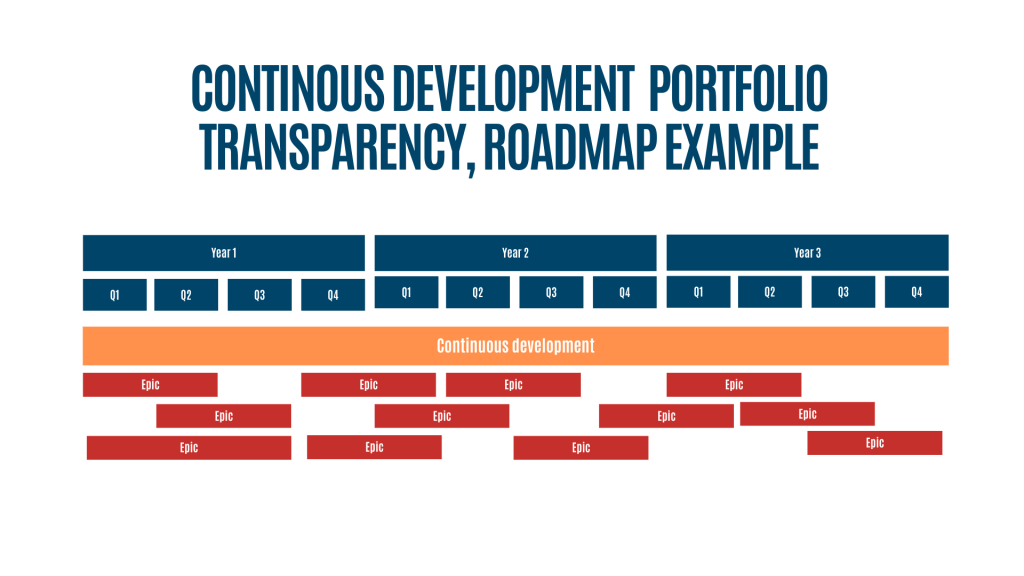
Even though continuous development teams prioritize content via backlogs or Kanban boards, there is a need to communicate towards a wider group of stakeholders what are the key themes or epics continuous development team is focusing on. This is especially important for teams serving many business units, to create trust and transparency. One option is to create high level transparency to continuous development roadmap also in the portfolio level – without going to too detailed level.

Creating transparency on continuous development roadmap in portfolio level – Epic term from Scaled agile framework may be useful

Great Lean portfolio management practices for hybrid portfolios

Scaled agile (SAFe) includes an extensive framework of practices for lean portfolio management. Here are couple of practices, which I feel work very well even for hybrid portfolios, have a look!

If you have good tips to share for managing hybrid portfolios, I would love to hear from you!