

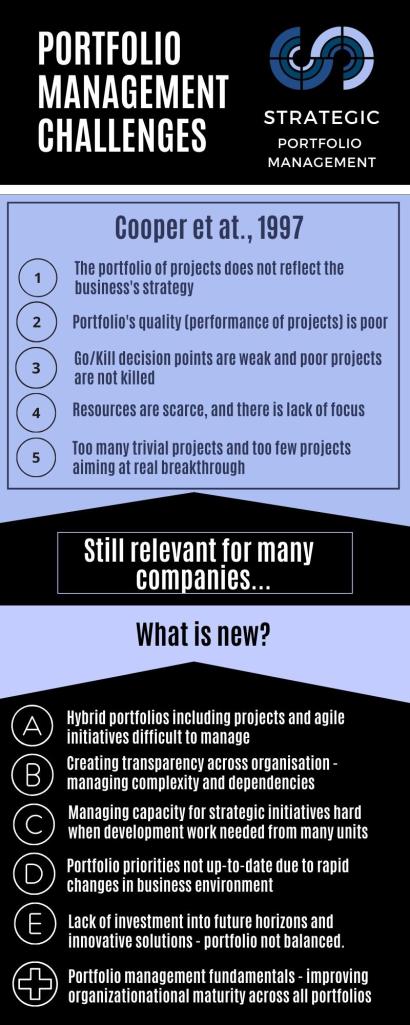
One of the classic portfolio management articles (Cooper et. al, 1997) analyzed portfolio management challenges many companies struggled with. Here is the top 5 challenges identified:
- The portfolio of projects does not reflect the business’s strategy
- Portfolio’s quality (performance of projects) is poor
- Go/Kill decision points are weak and Poor projects are not killed
- Resources are scarce, and there is lack of focus
- Too many trivial projects and too few projects aiming at real breakthrough
After 25 years, these challenges are still relevant for many organizations. It is still difficult to prioritize portfolio based on the strategy, portfolios still tend to have bad projects or agile initiatives, it is still extremely hard to kill projects, it is still difficult to prioritize and it is still easy to select quick wins over initiatives to build future competitiveness. Good food for thought for any practitioner!
What are the key challenges today?
During my interviews with experienced portfolio management professionals, classic challenges mentioned above were highlighted many times. But also many things have changed since 1997. Here is a collection of challenges many organizations may identify today:
A. Hybrid portfolios including projects and agile initiatives are difficult to manage – instead of managing traditional project portfolio, portfolio may include a mix of projects and agile initiatives with different ways of working. Many organizations have traditional planning, budgeting and governance processes, but part of the organization is rapidly transitioning towards Lean and agile ways of working. (Read more via dedicated blog post: From project portfolios to hybrid development portfolios combining projects and agile.)
B. Creating transparency across organization – managing dependencies and complexity. When products and services, processes and tools have become more and more complex, managing development and deployment of complex hardware-software-services solution requires a lot of alignment and communications across the organization.
C. Managing capacity for strategic initiatives hard, when development work needed from many units. Within large organizations, strategic transformation initiatives my require work from many units: different business units, R&D units, IT teams, global functions, sales organizations, and operations.
D. Portfolio priorities not up-to-date due to rapid changes in business environment. During the past years, business environment has changed rapidly for many companies. If portfolio priorities are not regularly reviewed and updated as needed, development portfolio may have
E. Lack of investment into future horizons and innovative solutions – portfolio not balanced. As development is the way to build the bright future and meet strategic targets, enough development capacity should be allocated to build future horizon competitiveness, not only focus on quick wins. (Read more via dedicated blog post: Is Your Development Portfolio Balanced Across Time Horizons?)
And then one more bonus challenge, which is also relevant for many organizations:
Bonus: Portfolio management fundamentals – improving organizational maturity across all portfolios. Good portfolio management practices help organization to make data-based decisions and created transparency and focus – if fundamentals such as processes, governance, discipline, communication and common tools are not in place, or each unit has different practices, managing portfolios may become difficult. (Read more via blog post: Developing Strategic Portfolio Management Maturity Step by Step)
Do you relate to these, or do you have other challenges?
References
Cooper, Robert G., Scott J. Edgett, and Elko J. Kleinschmidt. “Portfolio management in new product development: Lessons from the leaders—I.” Research-Technology Management 40.5 (1997): 16-28.
 Strategic Portfolio Management