Hybrid development portfolio combining traditional projects and agile work
Many companies have well established practices for managing project portfolios. Projects are followed up and governed based on the stage-gate model – and portfolio may include for example a collection of projects, programs, and other activities. There is an own standard for project portfolio management (PPM), which has been taken widely into use.
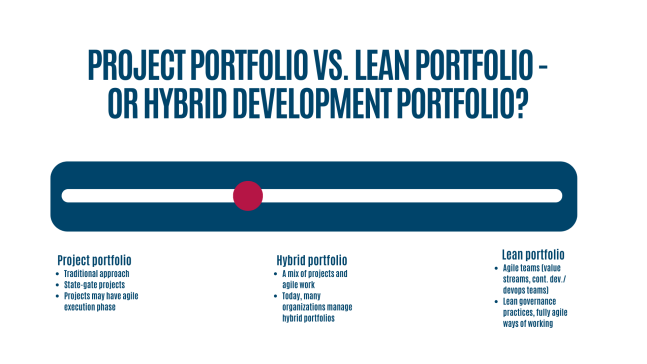
On the other hand, agile practices and continuous development teams have become more and more common. Popular Scaled agile framework (SAFe) has introduced a great set of practices for Lean portfolio management (LPM) – in SAFe development is organized via value streams and executed fully in agile mode.
However, most of the organizations are somewhere between – having still plenty of projects (often with agile execution), but also continuous development executed by the agile teams, continuous improvement or devops teams. Where is your organization now, somewhere in between? Where would you like to be in the future?
Scale from traditional project portfolios to hybrid portfolios combining projects and agile to lean portfolios – Where are you now, and where would you like to be in the future?
Typical challenges for hybrid portfolios including projects and agile work
Managing a hybrid portfolio including projects and agile work is not completely straight forward – there are typically several challenges from the development portfolio view point:
Transparency – project portfolio includes projects, but continuous development may lack visibility in terms of development roadmap, outputs, outcomes and benefit tracking
Finance – Stage gate projects have gate approvals for financing decisions, where as agile teams have other means for prioritization and allocation of finances; also company budgeting and cycles may be sometimes conflicting with lean budgets and guardrails
Governance – practices are quite different in traditional project steerings, when compared to quarterly practices many agile teams are committed to
Ways of working – Different units within company may have different ways of working, e.g. some units have adopted agile ways of working, where as others are still working with project models – also project may need work from many continuous development teams
I will go through some practices, which have been helpful when managing hybrid portfolios:
Building MVP with a project and ramping up continuous development capabilities
When developing something completely new, for example a new IT solution or getting started with a new innovative product or service, there may not be a continuous development team available, who could take the lead on development. In these cases, it has been a good practice to build Minimum Viable Product (MVP) and capabilities to start continuous development during the project phase – project resourcing is helping, as it may take some time to define the concept, hire team members, select technology and make needed decisions. This works especially for hybrid portfolios, where both models are actively used.
Project may be a great way to develop Minimum Viable Product (MVP) for a new solution and ramp up continuous development capabilities
Another case, where projects have been helpful are complex process or technology changes, where development is needed from many different teams and there is a lot of integrations or changes in business processes, and project may be combining business and technology development across different areas together. Also, if the people side of the change is significant, and the there is need for deployment within the units, rollout project with systematical change management approach may help a lot.
Creating transparency to continuous development
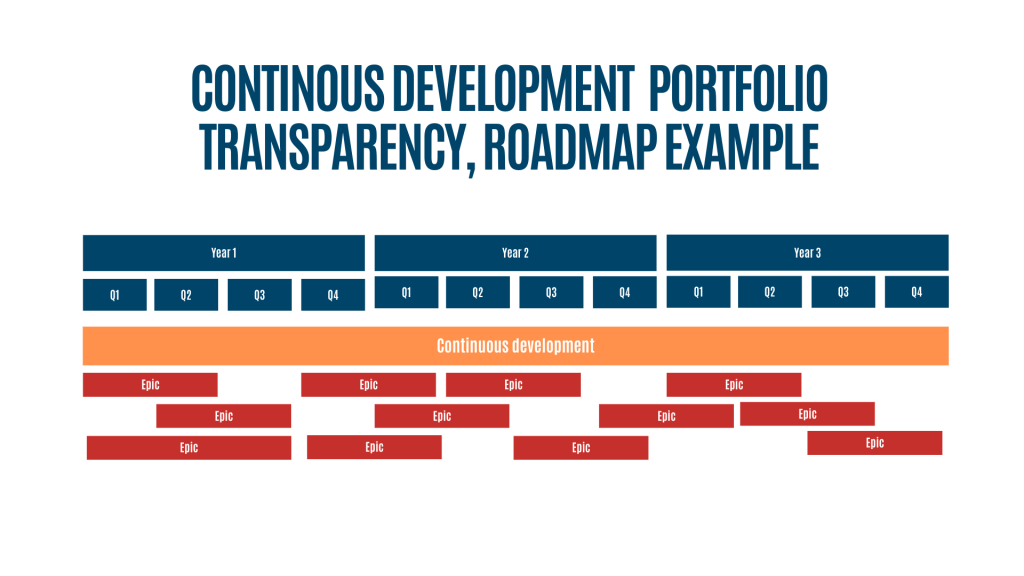
Even though continuous development teams prioritize content via backlogs or Kanban boards, there is a need to communicate towards a wider group of stakeholders what are the key themes or epics continuous development team is focusing on. This is especially important for teams serving many business units, to create trust and transparency. One option is to create high level transparency to continuous development roadmap also in the portfolio level – without going to too detailed level.
Creating transparency on continuous development roadmap in portfolio level – Epic term from Scaled agile framework may be useful
Great Lean portfolio management practices for hybrid portfolios
Scaled agile (SAFe) includes an extensive framework of practices for lean portfolio management. Here are couple of practices, which I feel work very well even for hybrid portfolios, have a look!
When discussing about development portfolios, there are many different viewpoints and expectations among the stakeholders – which leads often to misunderstandings. I will try to open up some of the most common viewpoints here: strategic portfolios, project, and hybrid portfolios, work portfolios from the unit perspective, enterprise view to portfolios, and also other portfolios which are connected to development!
Expectations and interests vary based on the role of the stakeholder. Here are some themes, which are often discussed in this context:
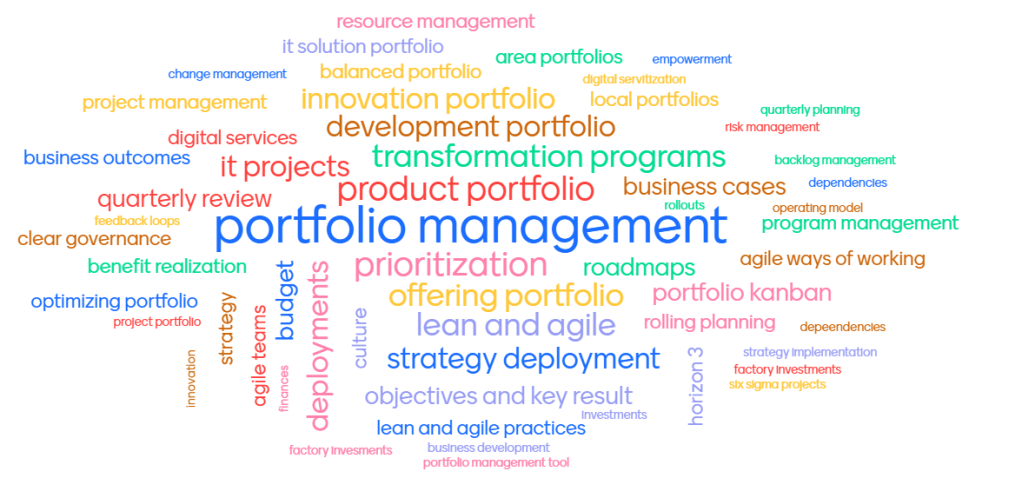
What people think when discussing about development portfolio management?
Strategic portfolio – transforming company towards the bright future
In many companies, strategic development portfolios are the vehicle to transform company towards the bright future and implement strategy in practice. Strategic portfolios may be inventing new business models, building new products and offerings, transforming organization, implementing changes to operating model, developing IT tools and capabilities or improving business processes, sales and operations. Portfolios may be organized around sub portfolios for different business functions or directly into transformation programs, strategic initiatives, projects, epics, value streams or must win battles for example.
Managing a strategic portfolio is challenging! How to select the best ideas for implementation? How to ensure portfolio is balanced – there is enough focus also to future horizons? How to follow up systematically business case and benefit realization? One strategic transformation program may include work from many different organizational units, such as business development teams, R&D and IT units, marketing and finance functions. Even though strategic portfolios are usually business driven, many other organizational units are working hard to make strategic initiatives happen!
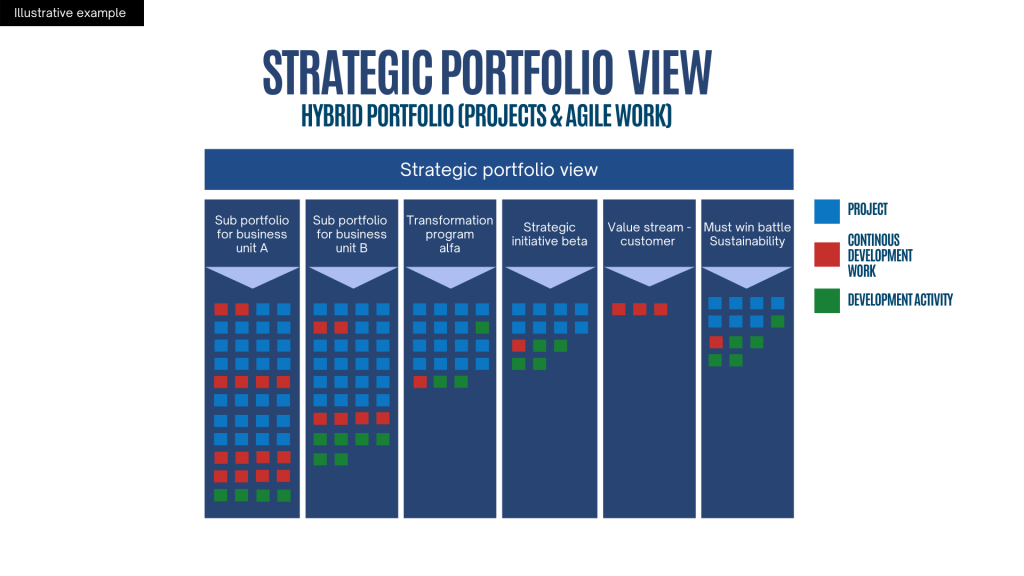
Strategic portfolio view – Strategic portfolios may include sub portfolios for different business units, but also transformation programs, strategic initiatives, value streams, projects or for example must win battles.
From project portfolios to hybrid portfolios
Many companies have long traditions of managing project portfolios. Project portfolios include typically a collection of individual projects. Portfolio decisions are managed via gates and also financing is usually linked to gate decisions. Projects have been traditionally implemented with a waterfall based development model, but today, many companies execute development with agile ways of working. The project portfolio is often looking into projects of one unit, for example, a business unit, R&D, or IT unit. Project portfolio management creates great structure and visibility, and is still a relevant approach in many cases.
Today, in addition to development projects, agile initiatives and continuous development teams have become more and more popular. Quite often, project is developing and new IT solution and ramping up continuous development capabilities. After the project has delivered and deployed the new solution across organization, continuous development will take place. Portfolio including projects and agile work & continuous development may be considered a hybrid. Sometimes it is tricky to manage a hybrid portfolio, when ways of working, financial practices and governance varies in projects and agile work. More about hybrid portfolios via the blog post: From project portfolios to hybrid portfolios combining projects and agile work!
Hybrid portfolios may include traditional projects and also agile work, such as work from continuous development teams or value streams.
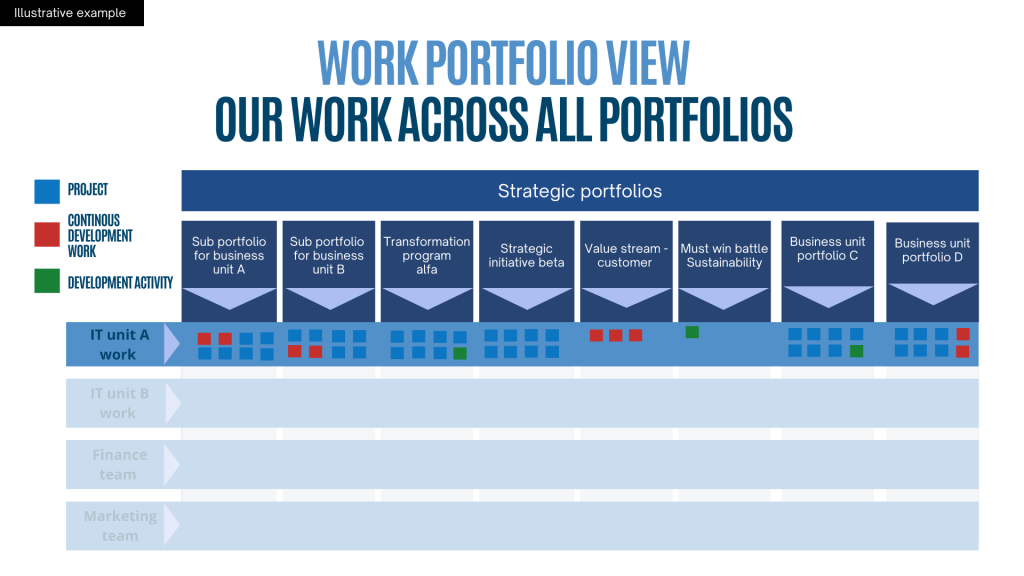
Work portfolio view – unit view to all projects, continuous development and other large activities
Many global functions, such as marketing, R&D, IT, or finance may be struggling, when demand is coming from different business units, portfolios, and transformation programs at the same time. One solution is to create a work portfolio view – a collection of projects, continuous development work, and other larger activities delivered by the unit. Some units create visibility to their work items via portfolio management tool roadmaps, and some may prefer Kanban or backlog management tools for visual management.
Work portfolio view may be really helpful, when organization needs transparency and prioritization on all work coming from many different strategic initiatives and business units. Work portfolio transparency may also help business portfolios in many ways – business teams are able to see what type of IT developments are happening in other business units and may find synergies. Transparency is helpful when prioritization is needed – is it possible to sequence work, manage dependencies and do work creating most value first?
Strategic portfolio and work portfolio views are not in conflict with each other – they are just different view to the same work to create transparency. If priorities are clear in strategic portfolios, it is easy to prioritize the work portfolio also. Also teams and team members love it, when there are clear priorities and focus – less hassle and faster time to market for the priority items!
Work portfolio view – Projects, continuous development work, and larger activities unit is responsible for – work items may belong to different strategic portfolios.
Enterprise level view – how is our strategy implementation progressing?
Many companies want to follow up on strategy progress happening across different portfolios – are we taking strategy into action across the company? Sometimes it is also good to look across all strategic portfolios to optimize strategic initiatives – how do we best deliver value to the customers, are there synergies or major dependencies? Should we sequence some of the largest initiatives, to ensure the organization is able to adapt to the change? Also, common planning and budgeting processes, and cross-portfolio reviews may help to manage dependencies across global portfolios.
In many cases, it may be difficult to create a holistic view across all portfolios. Different portfolios may have different tools and practices, and consolidation in the enterprise level may take a lot of time.
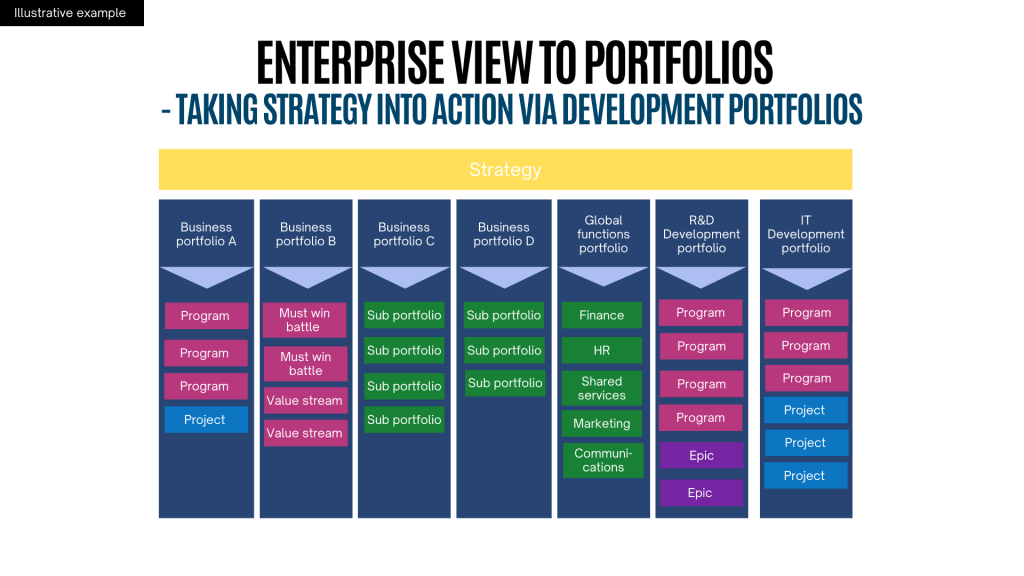
Enterprise view to portfolios – how is our strategy implementation progressing? Portfolio structure vary from company to company.
From projects to products – offering and product portfolio & application portfolio
Today, many teams have moved from developing via projects to developing products. Also in the context of scientific literature, new product portfolio management is an own field of study. Product development teams are introducing new products, features, and functionalities via regular product releases – there may be physical hardware components, software, and services included. The product portfolio is also linked to product life cycle management – new products are introduced and old ones are retired. In parallel to product portfolio, business teams are also looking into offering portfolios – how to price, sell, package, and servitize products. Both viewpoints are closely interlinked – even though you would have a great product, it will not be successful without systematical commercialization work!
In the context of IT, also application portfolio is an important outcome of development portfolios. Large companies may have hundreds of applications, and application portfolio may be growing all the time – creating also additional run costs and also capacity needed to further develop and maintain these solutions. Continuous development teams may also be extremely important contributors to strategic initiatives – sales tooling solution team could for example enable a new pricing model for upcoming offering launch! Even though each continuous development team manages their backlog, creating visibility to big ticket items or epics continuous development teams are working focusing on relevant also in portfolio level.
I will still list some other important portfolios linked to development very shortly:
Even though customer deliveries are not directly development focused, sometimes special customer cases may also require product, supply, or operations development. The customer delivery portfolio has also a close linkage to product development – new features, solutions or services need to work with high quality for first customer deliveries.
Factory units are managing portfolios of investment projects. Large transformations programs or new product development may also require physical investments, such as factory or property investments.
Technology and patent portfolios are also linking closely to R&D and IT development.
New innovations may be managed as a part of strategic portfolios, or as a dedicated innovation portfolio looking into future horizons.
Also when working with strategic partners or building a partner ecosystem, partner portfolio plays a key role.
Sourcing teams are managing vendor portfolios.
Six sigma project portfolio – super valuable development ideas for development portfolios!
Lean portfolio management – fully aligned approach with agile ways of working has been successfully implemented also in many organizations. If you have experiences on how this works in practice, I would love to hear about your practices!
Last but not least, in addition to global development portfolios, also local units may need to manage their own local project portfolios – there may be local developments and global rollouts happening.
No wonder there is a lot of confusion among the stakeholders, as there are so many development related portfolios and different viewpoints.
I would love to hear, what viewpoints are relevant for you? Did I miss something critical? Do you use completely other terminology for some of these viewpoints?





 Strategic Portfolio Management