


In many organizations, customer journey management (CJM) is still treated as a CX, service design, or marketing initiative. Journey maps are created, workshops are run, and insights are generated – yet impact at scale often remains limited.
One clear message from academic research and industrial case studies is this:
B2B customer journeys are not operational details.
They are strategic assets – and should be managed as such.
This post summarizes 10 key lessons learned from B2B customer journey research, drawing directly from MBA thesis work and recent literature, and translates them into strategic portfolio implications.

1. Customers don’t experience touchpoints – they experience journeys
Organizations often optimize individual interactions because they are measurable and owned by single functions. Customers, however, evaluate their experience cumulatively across the full journey.
Research shows that end‑to‑end journey satisfaction explains loyalty and growth better than isolated touchpoint KPIs. Improving one step does little if the journey breaks between steps.
Portfolio implication:
Strategic investments should be assessed based on journey impact, not local efficiency gains.
References: Rawson et al. (2013); Lemon & Verhoef (2016)
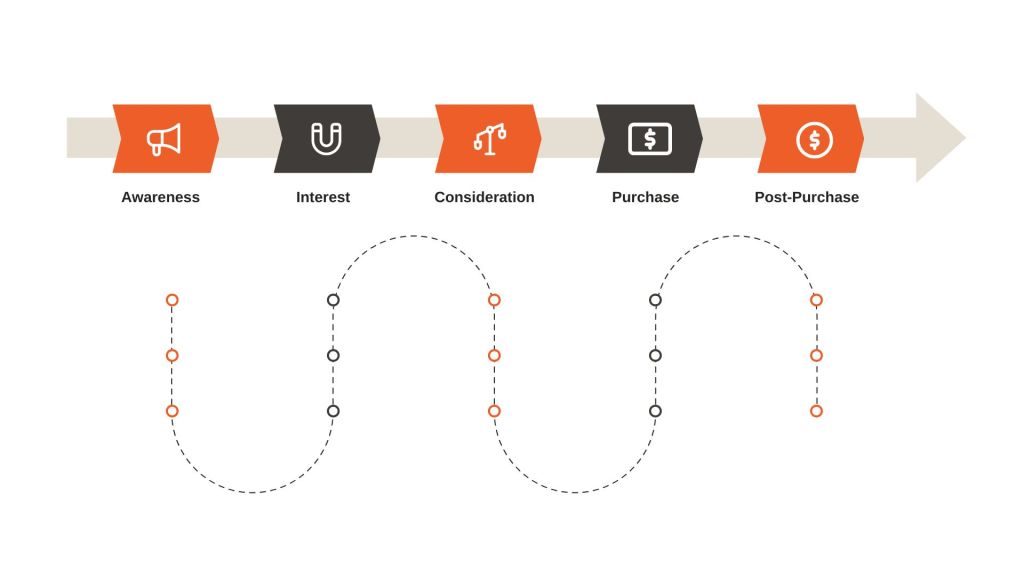
2. B2B journeys are long, complex, and non‑linear
B2B customer journeys differ fundamentally from consumer journeys. They typically:
- span months or years
- involve repeated lifecycle cycles (sales, delivery, service, renewal)
- include multiple stakeholders interacting at different phases
Linear funnel thinking does not hold.
Portfolio implication:
Strategic portfolios must support lifecycle thinking, not one‑off project logic.
References: De Keyser et al. (2025); Homburg & Tischer (2023)

3. One weak stakeholder journey can derail the entire relationship
In B2B, “the customer” is rarely one person. If a single key role – for example procurement, finance, or operations – experiences friction, the overall relationship suffers, even if others are satisfied.
Portfolio implication:
Journey investments must explicitly address all critical personas, not just the most visible ones.
References: De Keyser et al. (2025); Pruitt & Adlin (2006)

4. Journey mapping reveals problems organizations don’t see
Journey mapping research repeatedly uncovers:
- missing touchpoints
- unplanned detours
- handover failures between functions
Many of these issues remain invisible in traditional cost, productivity, or SLA metrics.
Portfolio implication:
Journey insights should inform where to invest, redesign, or stop initiatives, not just inspire workshops.
References: Halvorsrud et al. (2016); Følstad & Kvale (2018)

5. CJM works only when treated as an organizational capability
Successful companies treat CJM as a capability, not a project. Research identifies core dimensions such as:
- value anchoring of interactions
- consistency over time
- cross‑functional integration
- tailored control for different roles
These capabilities must be built and sustained.
Portfolio implication:
Some investments are capability‑building plays, not quick ROI cases – and should be evaluated accordingly.
Reference: Homburg & Tischer (2023)

6. Organizational silos are the number one obstacle
Most CJM initiatives fail not due to lack of tools, but due to:
- fragmented ownership
- disconnected data
- local optimization incentives
Journeys cut across organizational boundaries by definition.
Portfolio implication:
Portfolio governance must address cross‑functional ownership, not reinforce silos.
References: Rawson et al. (2013); Dhebar (2013)

7. Leadership and governance determine success
CJM research consistently highlights the role of leadership. Without:
- executive sponsorship
- clear journey ownership
- aligned metrics and incentives
journey initiatives stall or remain local experiments.
Portfolio implication:
Customer journeys are a leadership agenda item, comparable to major transformation themes.
References: Rawson et al. (2013); Homburg & Tischer (2023)

8. Data shows what happens – journeys explain why
Analytics identifies where customers drop off or struggle. Qualitative methods explain the reasons behind the numbers. Neither is sufficient alone.
The strongest CJM combines journey analytics with human‑centered insight.
Portfolio implication:
Investments in data platforms should be paired with investments in interpretation and sense‑making.
References: Halvorsrud et al. (2016); Davenport & Klahr (2018); Salminen et al. (2018)

9. Journey‑level metrics outperform touchpoint KPIs
Traditional KPIs often hide the real customer experience. Journey‑level measures, such as end‑to‑end satisfaction, are more predictive of churn, loyalty, and growth.
Portfolio implication:
Decision‑making should be informed by journey outcomes, not only functional metrics.
References: Rawson et al. (2013); Dixon et al. (2013)

10. CJM pays off – but it must be managed consciously
Research confirms that strong CJM capability improves customer loyalty and financial performance. At the same time, it can increase coordination effort and short‑term complexity.
The benefits are real – but not accidental.
Portfolio implication:
Customer journey investments need explicit prioritization, trade‑off decisions, and governance, like any strategic asset.
Reference: Homburg & Tischer (2023)
Final reflection
B2B customer journeys are not something to optimize at the edges. They are something to manage deliberately – at portfolio level.
When journeys are treated as strategic assets, organizations stop asking:
“How do we improve this touchpoint?”
And start asking:
“Which journeys matter most – and where should we invest, simplify, or stop investing?”
Selected references
- Homburg, C., & Tischer, M. (2023). Customer journey management capability in business‑to‑business markets. Journal of the Academy of Marketing Science.
- De Keyser, A., et al. (2025). Understanding the B2B customer experience and journey. Journal of Business Research.
- Rawson, A., Duncan, E., & Jones, C. (2013). The truth about customer experience. Harvard Business Review.
- Lemon, K. N., & Verhoef, P. C. (2016). Understanding customer experience throughout the customer journey. Journal of Marketing.

