Product Strategy Demystified: How to get it Right?

Why do so many products fail despite great ideas? Often, the missing link is a clear, actionable product strategy. A good strategy isn’t just a roadmap – it’s a set of choices that connect vision to customer value and business outcomes. But how do you get it right? I will summarize both my own practical learnings and also add plenty of inspiring additional reading links below! As always, I hope this is helpful, and I would love to hear your thoughts, too!

Building ambitious and inspiring product vision

The first mindset shift needed is moving from day‑to‑day operational or tactical thinking toward a more strategic perspective – starting with your product vision. Ask yourself: Do you already have an ambitious product vision? Has it been created together with your team and aligned with management?

Below are a few practical tools that can help you define and strengthen your vision:

Whichever method you choose, define an ambitious and inspiring product vision—one that energizes your teams and guides strategic decisions.

Objectives and Key Results – Step-by-Step Path Towards Product Vision
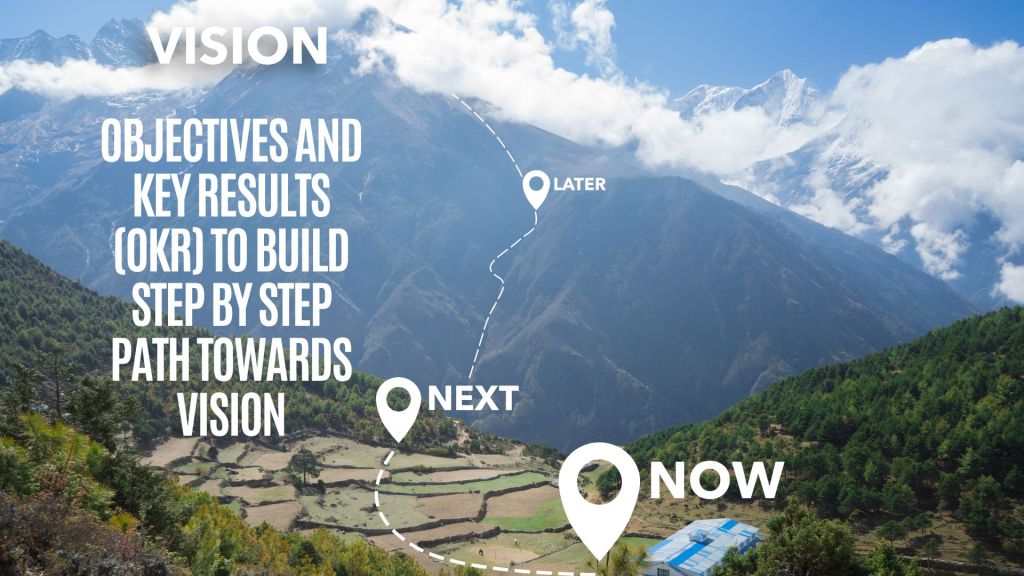
One of my favorite tools for goal-oriented management is the Objectives and Key Results (OKR). It integrates well into a product strategy approach by helping you to set clear, step-by-step objectives and measurable key results that lead you toward your future vision.

The idea with OKRs is simple: we define inspiring objectives and concrete measurable key results. Sounds easy, but defining great OKRs requires some work and typically a few iterations with the team and key stakeholders. Over time, OKRs become better and better!

For more on OKRs, here’s an earlier blog post with helpful links:
https://strategic-portfolio-management.com/category/objectives-and-key-results/

Where to Win and How to Play?

When you are developing your product strategy, DO NOT FORGET YOUR CUSTOMER!

Product strategy must be grounded in customer insights – understanding the real needs of customers.

  • Based on customer feedback, what insights do you have for the future needs of the customers?
  • Are you actively ideating with customers and validating new ideas with the customers?
  • What is your product’s key value proposition towards customers? Can you summarize shortly how your product creates value for customers?
  • Do you know your key customer segments – where do you want to focus efforts?
  • How are markets evolving? What alternatives or competition do you have in the markets?
  • How is your global supply chain looking like considering different geographical locations? Do you have different customer needs in different regions?
  • How is the regulation changing? Do you have some compliancy requirements to consider?
  • How about the strategy for the company or business unit? Do you receive new direction regarding the product focus areas from this strategy?

This is one of those topics, which for sure would deserve fully dedicated blog post…

Building an Outcome-Based Strategic Roadmap with Different Time Horizons
What is the first thought when you think about product strategies? For many of us, it may be a product roadmap illustrating where we are heading with the product and what developments are ongoing.

I have seen many wonderful product roadmaps, and here are a few options to consider:

  • Build an outcome-based roadmap – instead of showing project stages or milestones, show what the tangible concrete outcomes of development activities are.
  • Show different time horizons – build your roadmap utilizing different time horizons. For example, you could have a detailed roadmap for the next quarter or year, but less detailed business epics for the next five years.
  • Build your roadmap based on strategic themes – group development activities based on strategic themes, to link the work to company or business unit strategy implementation.
  • Utilize common roadmap templates – check with your colleagues, if they already have great templates or examples, you could utilize for your product roadmaps. If every product manager in a company builds the roadmap in a different way, think about the headache for senior management trying to see the big picture.
  • Utilize company portfolio management tools – portfolio management tools today offer possibilities to create different types of views and visualization based on the entered data. If you have a tool available, could you utilize that to create portfolio level transparency?
  • Share your roadmaps with the stakeholders – If you do not have common tools, would you have a common location where to store and share product roadmaps? If your product roadmaps cannot be openly shared across wider group of stakeholders, do you have regular meetings where you share the updated roadmaps with the management?

Building a great product roadmap typically requires several iterations – you may need to collect feedback from different development teams and numerous stakeholder groups – and based on all of the feedback received, you can improve your product roadmap. Just remember to utilize your product roadmap actively as a part of day-to-day work when you meet different stakeholder groups!

What is the lifecycle phase of your product?
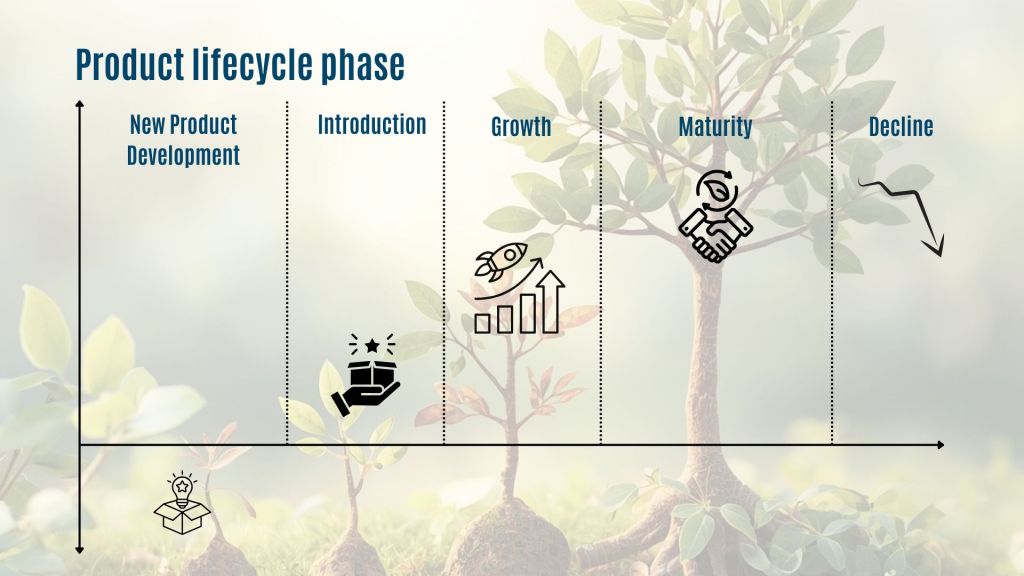
Product strategy depends a lot on the lifecycle phase of your product. I have noticed that for a wider group of stakeholders, it is not necessarily clear that everyone shares the same understanding of the stage. Sometimes, a product may still be in pilot as part of New Product Development, but there is an expectation of already reaching growing volumes. Your organization may have its own categorization for product portfolio management, but here is a generic one with phases: 1) New Product Development, 2) Introduction, 3) Growth, 4) Maturity, 5) Decline.

Here are few topics to analyse:

  • In which lifecycle phase is your product currently? You can also use volumes and sales statistics to analyze this if it is not fully clear, and have an open discussion with the team and stakeholders.
  • Are you moving towards next phase and do you need to take actions to prepare for the next phase? For example if you are moving from New product introduction to Growth phase, do you have scalable service processes in place to support growing volumes?
  • If you are looking at the product portfolio, how does the overall status of different products look like? Do you have gaps in your portfolio?
  • Are you familiar with Strategyzer’s Explore and Exploit portfolio? Good content piece to check out available here: https://www.strategyzer.com/library/business-model-evolution-using-the-portfolio-map

Share your product strategy to build alignment and feedback loop
If you create a great product strategy, but only a few people know about it – product strategy creates little value. So be brave and share your product strategy with the stakeholders – it may feel very uncomfortable especially during the first rounds, but it gets easier over time.

  • Implement feedback loops – product strategy should evolve with market shifts, technology changes, and based on customer feedback. What is the good cadence for you to look into product strategy? Quarterly? Bi-yearly? This depends a lot on what type of product you are working with.
  • Our teams have had good experiences with product strategy days with the key stakeholders and strategy communication towards larger audience.
  • Customize communications content based on the audience – Sometimes it is a good to remind myself, that not everyone is deeply involved in our product development, and you may need to have communications materials with different abstraction levels. If you have a master comms materials, pick and choose relevant content to meet the needs of your audience.

What are your pro tips? I would love to hear what has been working well for you!

For more inspiration – additional reading

There is a lot of really good content about product strategies, here are few examples I have felt were inspiring:

Aha! (2025). Product strategy: How a clear one leads to success. https://www.aha.io/roadmapping/guide/product-strategy

Amplitude. (2024). What is a product strategy? Framework, template, and examples. https://amplitude.com/blog/product-strategy-framework

Atlassian. (2025). What is a product strategy? Definition, best practices & how to build one. https://www.atlassian.com/agile/product-management/product-strategy

Design2Market. (2024). Product strategy demystified – No MBA required. https://www.design2market.co.uk/academy/product-strategy-a-step-by-step-guide/

ProductPlan. (2024). What is a product strategy? https://www.productplan.com/glossary/product-strategy/

Remote Sparks. (2025). 10 essential product strategy frameworks for 2025. https://www.remotesparks.com/product-strategy-frameworks/

Scrum.org. (2025). What is product strategy? How to think and act strategically as a product leader. https://www.scrum.org/resources/blog/what-product-strategy-how-think-and-act-strategically-product-leader

Walker, S. M. (2024). Product strategy guide — Templates/Frameworks (2023 Edition). https://productstrategy.co/the-ultimate-guide-to-product-strategy/
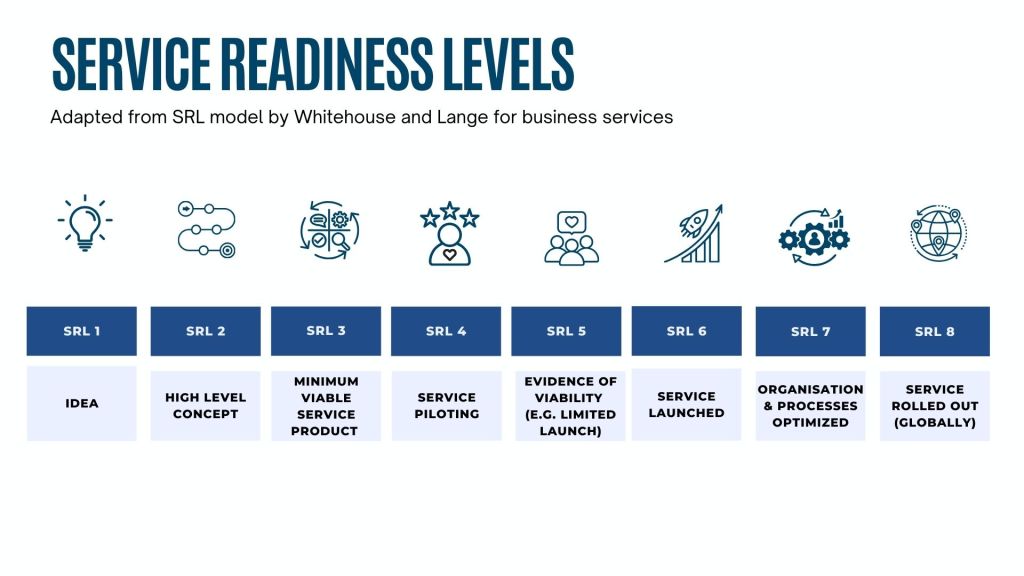
What are the Service Readiness Levels of your new services?

You may be familiar with the Technology Readiness Level (TRL) model originally developed by NASA in the 1970s, today used by many R&D and research organizations. I had wonderful discussions with our R&D and product management colleagues a couple of weeks ago and started to think of how to apply this thinking to new service development, too. After all, it is crucial to understand how ready service concept, commercial model, processes, and organization are for high volume scale-up. Have a look at what I learned about Service Readiness Levels (SRLs)!

Technology Readiness Level for New Product Development

The Technology Readiness Levels (TRLs) defined by NASA [1] have been taken widely into use also in EU-funded Horizon research programs [2]. In the early phases of research on new technology, TRLs 1-3 focus on research of new technology principles, technology concepts and creating a proof of concept – at this point, there is no product. In TRL levels 4-6 technology is further validated in lab environment, validated and later also demonstrated in industrially relevant environments. When moving to TRL 7-9, we start to develop product prototypes, develop a full system scope and have product available in operational environment. Also, sometimes TRL 10 has been identified as a phase, where operations are proven [3].

In practical terms, even when moving forward from TRL 10, there may be different levels of standardization or productization – e.g. is product customized case by case for each customer or is there a standard productized scope with predefined options.

How to evaluate readiness of the service product?

In addition to TRL, also Service Readiness Levels (SRL) have been defined. I found couple of quite interesting sources, while studying the topic [4][5]. I adapted the service readiness levels defined by Whitehouse and Lange [5] to meet my experience in the context of B2B business services:

  • SRL 1. Service idea is defined
  • SRL 2. High level concept for service defined
  • SRL 3. Minimum Viable ‘Service Product’ defined including among others draft value propositions, concept definition, high level processes
  • SRL 4. Service is piloted to collect feedback – enabling customer feedback to improve the service product further
  • SRL 5. Evidence of service viability is received, e.g. via limited launched for a specific group of customers: are customers willing to pay for service, what feedback do we receive to further improve the service, is the service ‘sellable’?
  • SRL 6. Service is Launched for a wider group of customers – this is where the hard work with scaling up starts!
  • SRL 7. Organization, processes and supporting tools are optimized to deliver the service – for example optimizing how different supporting IT tools work may require quite some effort!
  • SRL 8. Service is rolled out – in large global companies, this may take quite some time to have full global reach!

Typically new service development is highly iterative, and especially in large global companies with regional differences and supply chains, journey from SRL 1 to SRL 8 may take a long time. And in the end, SRL 8 will be the start of continuous development journey to further improve the service based on customer needs and feedback from the organization.

Your organization may have a bit different definitions for service readiness levels, but I think it is a great approach to agree a common way to communicate about service readiness. Using the SRL model, it is possible to map and communicate towards stakeholders of different services in your new service development pipeline. For example visual management via a new service development pipeline may be helpful.

If you have a well managed SRL based pipeline (or still think how to formulate), I would love hear about your experiences!

References

[1] Technology Readiness Levels – NASA Technology Readiness Levels – NASA

[2] EU HORIZON 2020 General annexes – h2020-wp1415-annex-g-trl_en.pdf

[3] Straub, J.: In search of technology readiness level (TRL) 10. In search of technology readiness level (TRL) 10

[4] Gustafson, S.: Service Readiness Levels (SRL)

[5] Whitehouse, D., Lange M.: A Services Readiness Levels Stage Model: A Roadmap, Health Management, Volume 22, Issue 2, 2022.

Managing offering portfolio – boosting existing offering or develop new offering – or both?

I have had great discussions with peers in different companies related to service offering portfolios, and I have noticed there are truly many viewpoints to offering portfolios.

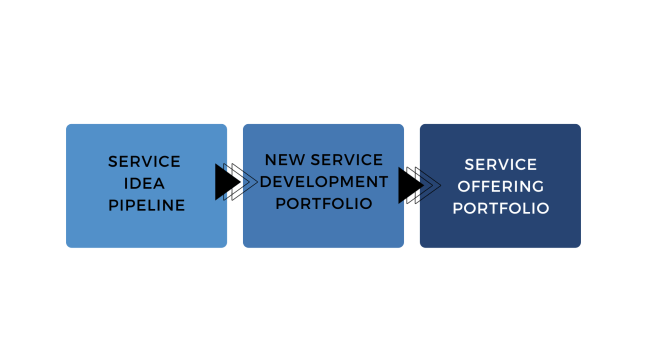
Teams focusing on development usually think more about the New Offering Development Portfolio – what are the new offering development initiatives teams are focusing on? Also there are brilliant development ideas from many different sources in the Idea pipeline to develop new service concepts or to further improve current offering with new features. When discussing with the sales and operations people, focus is naturally on available customer offering portfolio: what can we sell for different customers segments and in different geographical areas? How do we bundle offering – what to sell together?

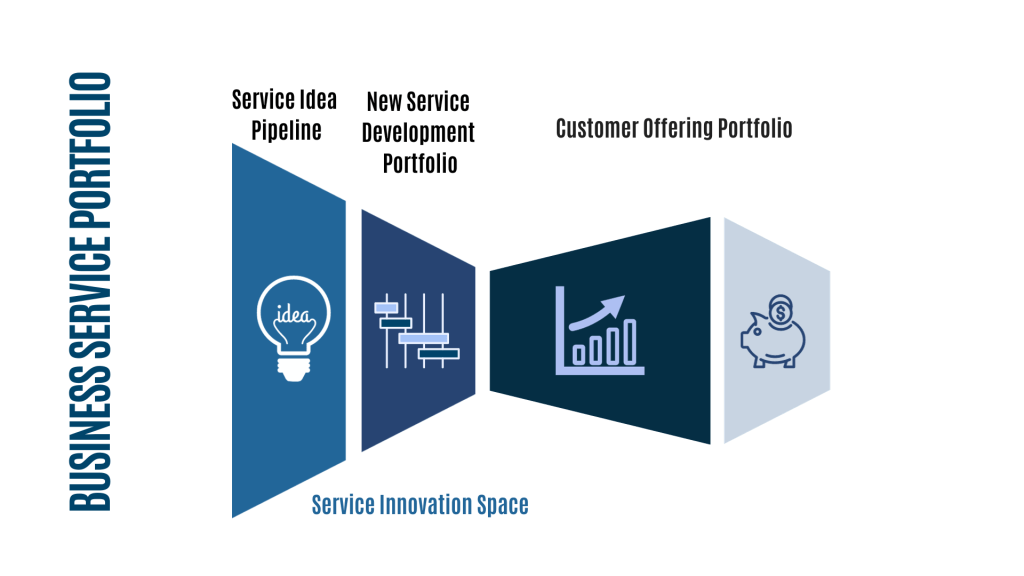
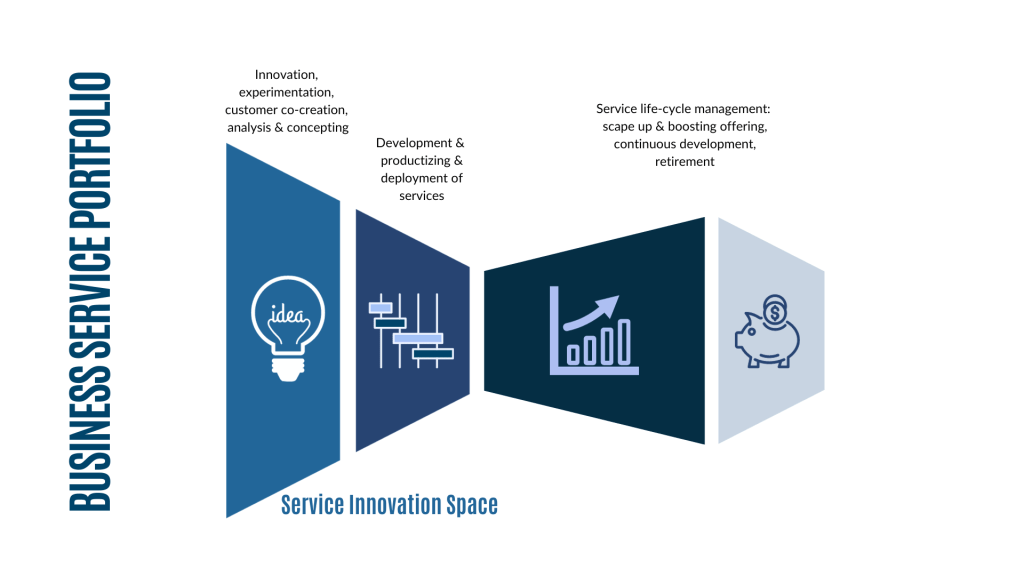
Here is how I have structured this portfolio funnel based on the literature, but also based on practical experience:

Service Idea Pipeline

Service innovation space was already covered in detail in the previous blog post: Exploring Service Innovation Space.

Based on the studies, the ideas for new service offerings may be originated form many different sources: from customer co-creation and feedbacks, from the sales teams actively meeting the customers, from the operations delivering the service, or any other internal stakeholder groups, partners or even from regulation or legislation. To capture systematically these ideas is critical – otherwise your next 1 billion opportunity may be lost.

Capturing the idea into innovation tool or backlog is not enough – the idea requires analysis – do we have be business case, is the idea aligned with the strategy, and how the idea could potentially be implemented? Here are few good practices, which are

  • Collect actively development ideas from many different sources: customers, partners, service delivery organization and operations, sales, R&D and other stakeholder groups.
  • Consider both incremental development ideas of existing services, but also new innovative ideas which could lead to new service concepts within your organization.
  • Create a funnel for development ideas to see in which phase idea is – this is really important to manage the expectations – you don’t one anyone to start to sell something, when idea is still just an idea.
  • Be willing to kill your darlings – one easily falls in love with the idea team has worked hard on – however, if you cannot find business case or strategy fit – idea should be killed or parked to be consider in the future.

New Service Development Portfolio

Within New Service Development Portfolio, we should see all service development initiatives, which are under development. There may be large development initiatives, such as development programs requiring work from many different teams and units, but also smaller incremental development activities to improve the existing services.

Good practices:

  • Create transparency on service development activities. Projectize the service development, as you would do for new product development. In many organizations, service development is incremental and not fully visible in development portfolios. Projectized approach helps to create transparency within the organization on status and readiness of service development. If you develop services via continuous development teams, that is equally ok – create transparency via portfolio epics or other means.
  • Also services require systematical productization and commercialization – in order to develop a scalable service, one needs to carefully understand customer value proposition, define the processes and way of working for the service, train the organization, and often also develop supporting IT tooling. Usually this is more work than anyone anticipated, when kick starting the project!
  • New Service Development differs from the New product development – fine tune your service development process to enable iterative learning, customer engagement and flexibility in decision making. Read more here: Developing new products and services – are there differences?
  • Don’t forget deployment – when you have invested so much on service development, make sure you pay enough attention on engaging the whole organization, so that the sales is capable to sell new services, delivery organizations knows how to manage delivery and commissioning and operations have smooth processes for running the services. Create feedback loops to improve the services based on the learnings!
  • Check out also tips for go-to-market: 5 ways to improve go-to-market of new offering.

Customer offering portfolio

In customer offering portfolio, we may have a wide range of available offerings towards customers, depending on the size of your portfolio.

Here are few topics to consider for the existing offering portfolio:

  • Creating clarity towards customers and sales on available offering is critical. There are many ways for creating the transparency, and sometimes also multiple viewpoints may be need. Read more of offering portfolio dimensions in a previous blog post: Ideas To Build Offering Portfolio – Which Offering Portfolio Dimensions Are Relevant For Your Organization?
  • Do you have offerings you are still scaling up within the organization? Systematic post-launch follow up is absolutely critical. And not only to passively follow up, but gather feedback from customers, own organization, partners and competition to truly optimize your results.
  • Can you create transparency on performance of the offering portfolio? Do you get easily numbers, or would you need to take some actions to improve the performance management across all offerings?
  • Do you have retiring offerings in your portfolio? Make also bold decisions to retire offerings, which are not performing as expected or are replaced by a new offering. Maintaining too many services simultaneously requires a lot from the whole organization.

Do you manage a funnel or a tunnel?

One of my most read blog posts has been about managing the portfolio funnel (Do you manage a Portfolio funnel, or Portfolio tunnel?). The same principles apply to the service offering portfolio as for any other portfolio – it is important to look into the different phases of the portfolio funnel, prioritize and create transparency, and not to just focus on one specific part. For me this illustration has helped a lot when we have had a confusion offerings in different phases of the funnel:

As always, I hope this helps! And happy to hear your reflections, both if you agree or disagree on certain parts!

Exploring Service Innovation Space – Are you utilizing all opportunities?

Thank you to the network for the engaging discussions centered on service innovation and ideation over the past months. I have been looking deeper into the service innovation space, and I’ve come across some valuable insights from researchers to give food for thought!

What is service innovation?

The service innovation space refers to the activities related to developing and improving services. It involves applying innovative strategies, technologies, and processes to enhance the value, efficiency, and customer experience of service-based businesses.

Service innovation can take many forms and can be applied across a wide range of sectors, including finance, healthcare, retail, transportation, hospitality, and more. The aim is to create new or improved services that meet the evolving needs and expectations of customers while also create business growth and competitiveness.

In the service innovation space, organizations often adopt a customer-centric approach, putting the customer at the center of their innovation efforts. This involves understanding customer preferences, pain points, and aspirations to identify opportunities for service improvement and differentiation. Service innovation unfolds through multifaceted approaches:

  • Co-creation: Involving customers and other stakeholders in the service design process to ensure that the final product meets their needs and desires.
  • Digital transformation: Leveraging digital technologies such as Internet of Things, artificial intelligence, data analytics, automation, and mobile applications to enhance service delivery, personalization, and efficiency.
  • Optimizing processes: Streamlining and improving internal processes to reduce costs, increase productivity, and deliver services more efficiently.
  • Developing a Service ecosystem: Collaborating with partners and integrating complementary services to create a comprehensive ecosystem that delivers enhanced value to customers.
  • Service management: Implementing processes to effectively address service failures or customer dissatisfaction, and turning negative experiences into positive ones and building customer loyalty.
  • Continuous improvement: Establishing systematic way of working for feedback collection, analysis, and learning to identify areas for service enhancement and maintain a culture of innovation.

Food for thought: Do you you leverage all of these areas already now? Or would you have opportunities for example via improved service management, being more systematic with the continuous improvement feedback loops, or building the partnerships?

Framework for Service innovation space

Service innovation may take many forms, and I really liked the framework proposed by Bessant and Davies (2007) including four types of service innovations:

  • Service offering innovation – changes in the actual offering or value proposition
  • Process innovation – changes how services are created and delivered
  • Position innovation – changes in the context of the service
  • Paradigm innovation – a holistic change in the mental models underlying the business

Another aspect highlighted in the model by Bessant and Davies, was that the innovations can be radical or incremental – for each ‘innovation type’. If you are interested to learn more, check out the excellent article with examples included, too.

Food for thought: If you think about the innovative services from your organization context – to which category would do they belong to? Would you have opportunities to explore also other categories more? Furthermore, do have radical innovations or incremental innovations in your portfolio?

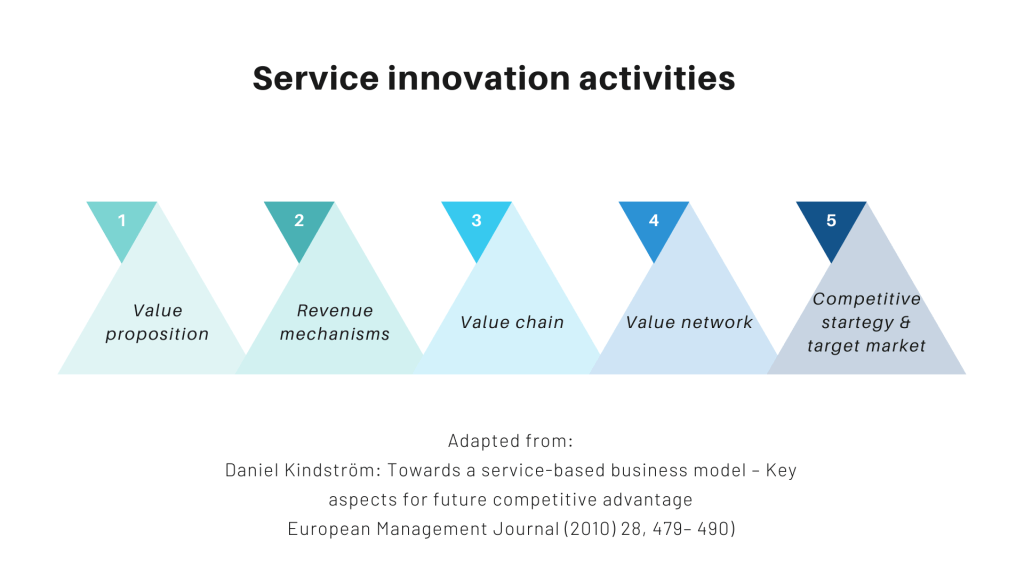
Service innovation activities

Another great article I would recommend is Daniel Kindström: Towards a service-based business model – Key aspects for future competitive advantage! Have a look at the article, but I will shortly share my key takeaways related to Service innovation activities here:

  1. Value proposition – starting from the customer value propositions and validating how is the innovative new service creating customer value.
  2. Revenue mechanisms – moving from cost plus pricing to value based pricing and finding the best pricing model fitting customer needs; finding advanced revenue schemes via partnerships.
  3. Value chain – developing the value chain from easy to address value parameters for sales, designing service development process and supporting organizational roles.
  4. Value network – identifying the opportunities to expand value proposition via the value network, involving both customers, partners and suppliers to enable best service delivery; taking the coordination role within the value network
  5. Competitive strategy and target market – developing service strategy for differentiation, and identifying target customer segments, and customer roles based on the value created.

Food for thought: Are these service innovation activities inbuilt into your service development processes, or would benefit taking a closer look into some of these items? I would consider all of these aspects critical, when working with new innovative service concepts.

The service innovation space is constantly evolving, driven by changing customer expectations, technological advancements, and competitive pressures. Organizations that embrace service innovation and adapt to the evolving landscape are better positioned to succeed creating differentiation from the competition. For me, developing services is balancing between continuous improvement of existing services, but also developing new innovative service concepts!

I hope you got some inspiration from the blog, and let’s exchange thoughts, if the topic is close to your heart!

References

Bessant, J. and Davies, A. (2007) Managing service innovation. Innovation in Services (DTI Occasional Paper No. 9). Department of Trade and Industry, UK.

Daniel Kindström: Towards a service-based business model – Key aspects for future competitive advantage European Management Journal (2010) 28, 479– 490)

Building a modular offering portfolio – just a dream?

Is your offering portfolio well organized or do you have a big number of individual offerings? What I am hearing a lot, not all companies have well structured offering portfolios, due to large range of product families and a big number of solutions and services.

I love the idea of modular offering portfolio, where products and services may be bundled into offering packages based on the customer needs and preferences. Modular design is an important principle in product design and IT architectures, but the same idea applies well also for offering design. Let’s review different approaches to build modularity into offering portfolio!

Offering bundling of product based solutions and services

Today, many products and solutions have become more and more complex, including physical hardware products or components, as well as software and sometimes even digital services. The terminology varies from company to company, but often solution layer is often used to combine products and services as solution, which is helping to solve a customer problem and creates customer value.

In addition to a solution itself, there may be additional services, such as delivery, installation and commissioning as well as training and technical support completing the solution itself. The solution and complementing service are often delivered as one-time transactional offering package.

There are many types of services, such as core services (basic maintenance and repair services) or advanced services (e.g. complex digital services), and different service elements may be bundled into the same offering package. Sometimes also services are referred as products or service products.

To summarize, offering can be a combination of products/components/solutions and services, with the common value propositions offered as a package towards customers. Do you have a common definitions in your organization for what is meant by offering, products, solutions and services? Without to go to too academic discussions, it is good to have

Bundling offering packages based on modular products, and services to support different customer needs

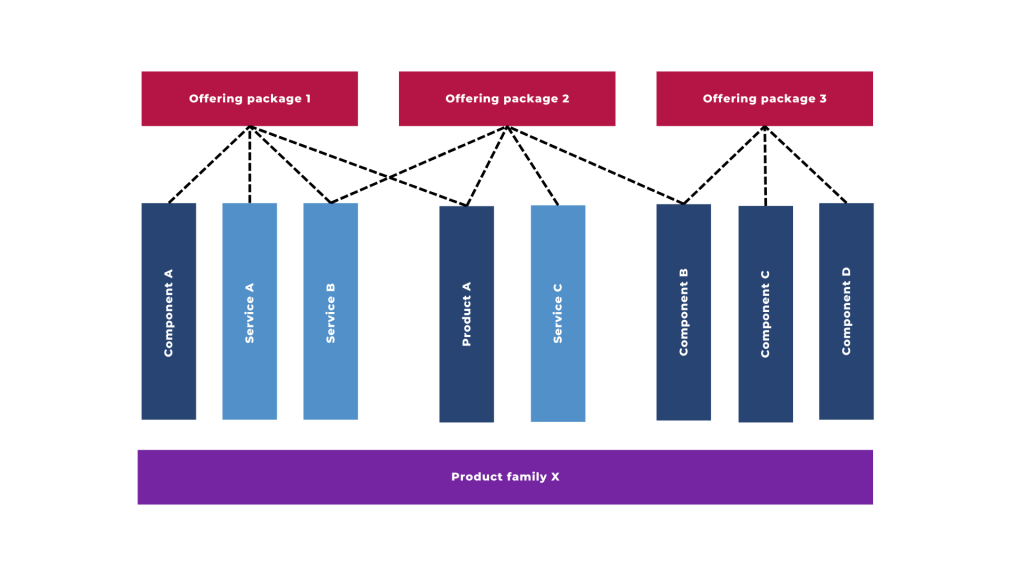
When thinking about modular offering, offering is composed of different independent modules, such as products and services. The same product or service may be included in many different offering packages, which may be designed to meet different needs of the customers. Modularity of offering may for example enable different types of service levels for different customers or tailored offering packages for different customer segments with differentiated value propositions.

Same services may be bundled based on the business model customers preferences

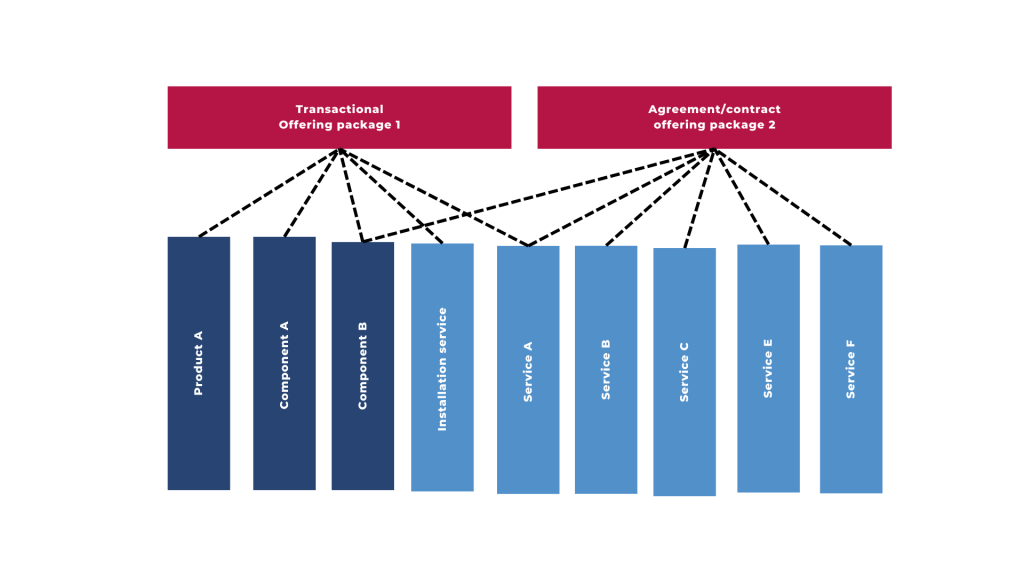
Customer may prefer different business models during the different life cycle phases, and some customers may prefer transactional purchasing, where as other prefer more predictable agreement based models. With the modular offering portfolio, same service elements may be packaged in a different ways based on the customer preferences.

Further reading:

Check out also previous post, which might be interesting: Ideas To Build Offering Portfolio – Which Offering Portfolio Dimensions Are Relevant For Your Organization? – Strategic Portfolio Management (strategic-portfolio-management.com)

Developing new products and services – are there differences?

How does the development of physical products differ from development of services – or does it differ? In the context of New Product Development (NPD), portfolio management has been studied a lot during the past decades in order to optimize the product portfolio. However, I was interested in learning more about New Service Development (NSD), and noticed, that this area has been studied less.

I found an amazing article by Aas, Breunig and Hydle: Exploring new service portfolio management (International Journal of Innovation Management,2017) and wanted to reflect on the key insights via the blog! Based on the literature summarized by Aas et al., there are indeed some clear differences:

  • New Service Development processes are often more incremental, informal and ad-hoc than New Product Development processes
  • A higher number of stakeholders are involved from different units and functions during the new service development, than in NPD processes
  • The effects of NSD on business performance have more intangible, strategic, long term and qualitative nature than the effects of NPD

Let’s have a look in more detail, what were the key lessons learned from the case study:

Many sources of ideas for new service concepts

Typically for new services, ideas come from a big number of different sources, such as customers, own employees from different units and functions, suppliers, competitors, and sometimes also from government. The ideas may be of different sizes, and of different nature ranging from development of new digital services to improvement of operational service process steps or compliancy to regulation or improvement of existing service offering. In the portfolio level, prioritizing such a wide range of different types of ideas from different sources is not always easy – how to compare ideas with can range from operational improvement to completely new service concepts?

Lessons learned 1: The recommendation from the article by Aas et al. (2017) was to exploit different sources of ideas and base New Service Development portfolio decisions on both strategic alignment and value criteria. This helps to create a balanced portfolio, and not to focus too much on just one type of ideas, e.g. ideas improving internal efficiency.

New Service Development is often hidden and based on small changes – creating transparency via NSD portfolio

New product development (NPD) has been traditionally executed via stage-gate projects ensuring all the needed steps to develop high quality products. Based on the study by Nijssen et el. (2006) New Service Development (NSD) is often ad-hoc and hidden – not clearly visible in the development portfolios. Continuous improvement is extremely valuable – however when developing a completely new type of service concepts or radical innovations, development work requires typically a lot of work across the organization and extensive resourcing.

Lesson learned: Accelerating new service development by transforming ideas into formal New Service Development projects, in the early phases of the development. Based on my own experience, a projectized approach often helps to create awareness in the organization, supports with the resourcing and systematic decision making. If development is happening via agile teams without projects, for a new service development, I have learned, that it is a good practice to have certain check points, to ensure end-to-end quality and readiness before Launch decisions. Creating overall transparency on ongoing NSD initiatives and their progress is also important in large organizations.

Flexibility in development process and decision making needed

In the study, one finding was, that NSD projects were often incremental by nature, and smaller than typical new product development projects. Larger NSD projects required also typically several decision gates, before Launch readiness, and project model was close to Cooper’s ‘state-gate-lite’. Also the NSD projects had a high level of heterogeneity, as the development ideas varied a lot, and one process did not fit all the different cases.

When developing new services, there may be changes in parallel in service concepts, technology, organization and processes. For example, when working with new digital services development projects, there has been a need to introduce new roles and processes to support the service management of the new services.

Lesson learned: The NSD portfolio process requires flexibility to successfully support the high heterogeneity in the new service development projects – one way does not fit all types of projects.

Involving many stakeholders

When developing new service concepts, support and participation from many different units and departments are needed. New service development often impacts long end-to-end value and process chains, and the alignment between different teams is important to create a successful concept. Based on the study, also in the decision making, representatives from different functions and units were involved in the NSD portfolio steerings.

Lesson learned from the study: NSD portfolio decisions need to be taken in collaboration by a group of managers representing different functional areas. I would also add, that involving stakeholders from different units during the project, creating alignment and awareness across different teams is super important, not only in the managerial level.

Developing a combination of products and services?

I have also worked with combination of products and services, for example solutions where a physical hardware is supporting a digital service. In these product-service-software solutions, complexity of both worlds are combined: there needs to be systematical way of working to support developing a high quality product, but the development process should also support iterative learning required in service development processes! These interesting product-software-service solutions would deserve an own blog!

References

Aas, Breunig, and Hydle: Exploring New Service Portfolio Management. International Journal of Innovation Management, 2017.

Nijssen, EJ, B Hillebrand, P Vermeulen and RGM Kemp (2006). Exploring product and service innovation similarities and differences. Research in Marketing, 23, 241–251.

Fuglsang, L and F Sørensen (2011). The balance between bricolage and innovation: Management dilemmas in sustainable public innovation. The Service Industries Journal, 31(4), 581–595.

8 Key Reasons for Moving Towards Service Oriented Business Models and 5 steps to get there!

This autumn, the blog theme has been service offering development and this week’s blog is focusing on transition from product orientation to service orientation. From the strategic portfolio management viewpoint, building a solid service offering portfolio truly makes sense – let’s review key reasons why (especially) manufacturing companies are shifting more and more towards services and also the most important steps how to get there:

8 Key Reasons for Moving Towards Service Oriented Business models

Revenue generation – from one time product sales to continuous revenue streams

Service business is typically good business – instead of relying on one-time transactional product sales, services may provide steady and growing revenue streams through service contracts, subscriptions and additional transactional service offerings. The recurring revenue models provide also more stability and predictability when compared to the traditional product-based models.

Building competitive advantage – and avoiding commodity trap

Today, markets are highly competitive, and manufacturing companies are looking ways to differentiate. New types of value adding services are often helping to differentiate from competitors competing with lower prices. Services built into the operating model of the company are not as easy to imitate or copy, as the the traditional production of hardware based components.

Value adding services for unique customer experiences

Offering value-added services alongside their products allows them to stand out and provide unique customer experiences. Additional value may be created in many different ways, for example:

  • Via highly reliable delivery and installation
  • Integrations between the company core systems
  • Easy to deal with service concepts
  • Providing new type of data based services with insights
  • Digital services with new unique features built on top of physical products

Value adding services help to build stronger relationships with customers and creates a competitive advantage that is not solely based on the physical product.

Increasing customer satisfaction and retention

By offering services complementing the products, manufacturing companies can enhance customer satisfaction. Services such as installation, maintenance, repair, and training can improve the overall customer experience and ensure that the products perform optimally throughout their lifecycle.

This, in turn, leads to higher customer loyalty, repeat business, and also to positive word-of-mouth recommendations.

Adapting to changing Market Demands

Many customers today prefer outcomes and solutions rather than simply buying products. By offering services that address specific customer needs and challenges, manufacturing companies can align themselves with market demands and provide comprehensive solutions that go beyond the product itself.

Supporting customer sustainability targets

Service-oriented approaches often contribute to a more sustainable business model for manufacturing companies. For example extending the lifecycle of products through life-cycle services such as repair and refurbishment or product upgrades, may reduce significantly environmental impact. Also for example selling as service business model may help to offset the financial costs of implementing more sustainable solutions

Leveraging opportunities enabled by technology

Today, technology enables new solutions including for example predictive maintenance, remote monitoring and other proactive services, which can help to optimize product performance and efficiency and also minimize downtown. Key enablers for such services may be the Internet of Things (IoT), sensors based solutions increasing the availability of data, connectivity solutions, and different types of integrations and interfaces. Also Artificial Intelligence enable more automation and value adding insights.

Value via Ecosystems and Networks

Ecosystems and value networks play a crucial role in the service orientation of manufacturing companies. By participating in ecosystems and building value networks or even leading one, manufacturing companies can leverage the expertise and capabilities of other entities within the network creating value add to customers.

5 steps when moving from product orientation to service orientation

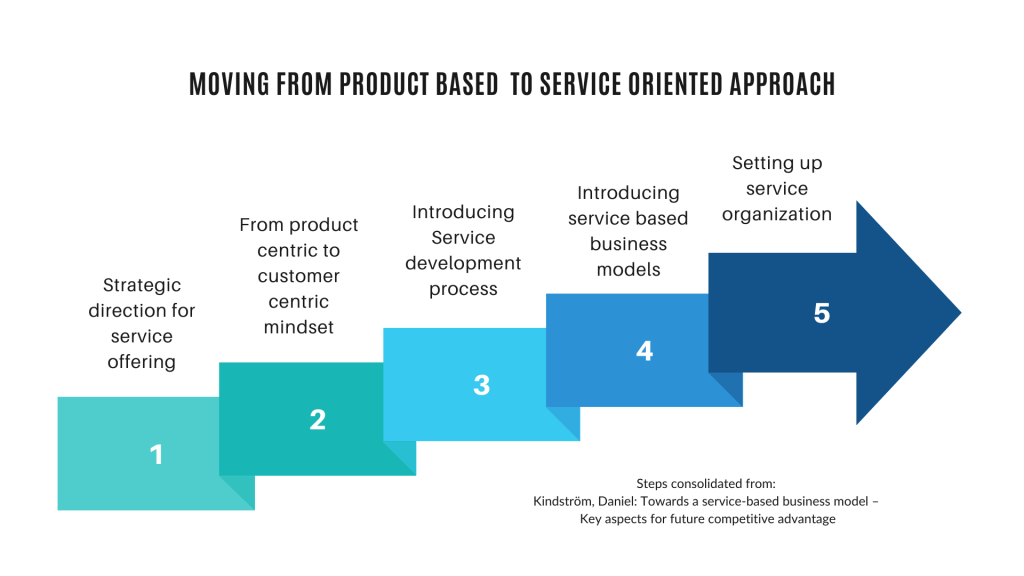
When transition from product orientation to service orientation, there are significant impacts also in the strategic development portfolio, operations, way of working and even in organizational setup. I would recommend to get familiar with a super good article written by Daniel Kindström: Towards a service-based business model – Key aspects for future competitive advantage. Here are some key takeaways I picked up from the article to support moving from product based to service oriented approach:

  1. First of all, strategic direction for service offering is required – are you complement the product based offering, creating completely new type of digital services, or what type of services and customer value do want to focus on?
  2. The mindset shift from product centric to customer centric approach is required when working with new service offering concepts solving customer problems. This may be a long journey for many organizations with long traditions of building world class hardware products.
  3. The service development process differs from product development process – what is your process to develop services? Do you need to develop both product based offering and services together?
  4. Introducing service based business models – what is it for customers, what are the value propositions and how is the revenue created? Is the model transactional, agreement based, selling as a service / subscription based, or is the value created via the partner ecosystem…?
  5. Setting up service organization – who is delivering the service? For example, do you need to setup new processes and roles, when supporting new digital services? Do you need to create a network of partners and vendors to support your services?

Overall, the move towards a service orientation allows manufacturing companies to go beyond the traditional transactional model and build long-term relationships with customers. Services provide opportunities for revenue growth, customer satisfaction, and adaptation to evolving market dynamics, ultimately leading to a more competitive and sustainable business.

However, also new capabilities, ways of working, business models and even organizational structures are required – introducing a new service offering may require development and change management in many different levels. The service-based business models would deserve an own blog post, so stay in the loop!

References

Kindström, Daniel: Towards a service-based business model – Key aspects for future competitive advantage. European Management Journal (2010) 28, 479-490.

From Idea to Value: Leveraging Business Technology Standard in Portfolio Management

Have you heard about the Business Technology Standard?

Many large companies and organizations in Finland are applying the framework to support demand, development, and service management, especially within the business IT context. Over the last ten years, the standard has significantly influenced my thinking—I tend to see its structure everywhere I go!

I had a wonderful sparring discussion with Business Technology Forum Executive Tia Jähi, and we agreed, that even though standard is originated from the business IT, the same principles would apply also for other contexts, such as our life cycle business and offering development!

Demand

First, we need to start with the demand portfolio. New ideas or development needs come from many different sources, and we need to create a systematic way to process, analyze, and prioritize this demand.

Development

Next, we move to the development portfolio. Development can occur through projects or programs, as well as continuous improvement activities. The Business Technology Standard framework can be applied to both traditional project portfolios and agile setups, which is fantastic!

Services

Last but not least, the service portfolio. This is the phase where we start to realize business benefits—when our new IT system is operational or our offering is sold and used by our customers. Having well-defined service management processes helps development teams focus on new demand and development and ensure good care of the customers and end users.

Governance

Creating clear governance over the entire end-to-end chain helps to create transparency, smooth decision-making, and a focus on value and strategic objectives. This includes well defined roles and responsibilities and also clear prioritization of demand, development and also service management activities.

Have you been applying the standard successfully? What are your key takeaways?

If interested to learn more, have a look: https://www.managebt.org/