It is time to wrap up the year 2023 – and thank all the readers of the blog and experts joining the online courses and events during the year!
Dadaa, here is the top three from the blog with most views globally:
3rd place: Developing Strategic Portfolio Management Practices step by step
This is one of the articles, where I receive most contacts from the experts around the world. How to develop Strategic Portfolio Management Practices step by step?
No wonder this post has become popular – portfolio management is challenging by nature, as it is dealing with future events and opportunities – check out the 4 key goals of portfolio management from the blog:
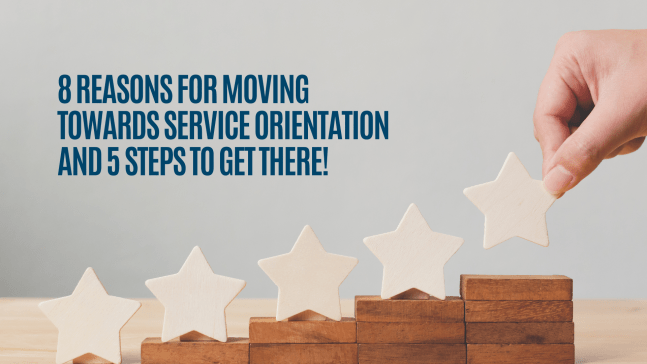
This autumn, the blog theme has been service offering development and this week’s blog is focusing on transition from product orientation to service orientation. From the strategic portfolio management viewpoint, building a solid service offering portfolio truly makes sense – let’s review key reasons why (especially) manufacturing companies are shifting more and more towards services and also the most important steps how to get there:
8 Key Reasons for Moving Towards Service Oriented Business models
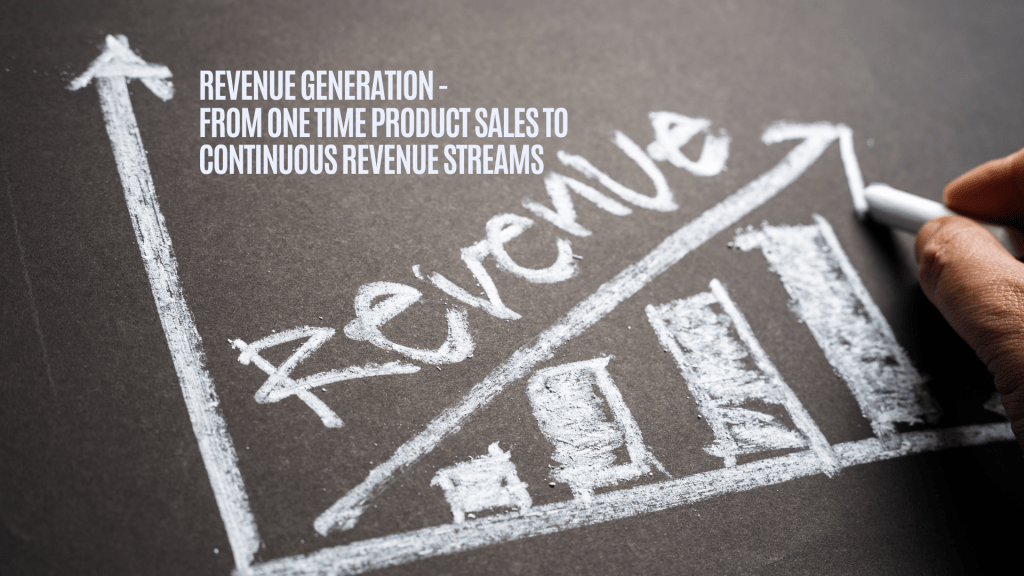
Revenue generation – from one time product sales to continuous revenue streams
Service business is typically good business – instead of relying on one-time transactional product sales, services may provide steady and growing revenue streams through service contracts, subscriptions and additional transactional service offerings. The recurring revenue models provide also more stability and predictability when compared to the traditional product-based models.
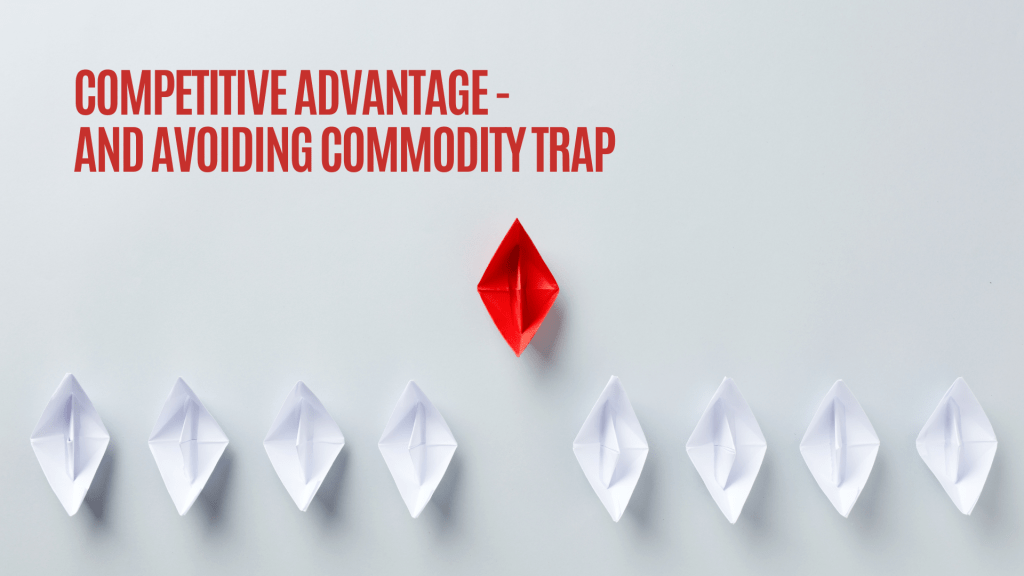
Building competitive advantage – and avoiding commodity trap
Today, markets are highly competitive, and manufacturing companies are looking ways to differentiate. New types of value adding services are often helping to differentiate from competitors competing with lower prices. Services built into the operating model of the company are not as easy to imitate or copy, as the the traditional production of hardware based components.
Value adding services for unique customer experiences
Offering value-added services alongside their products allows them to stand out and provide unique customer experiences. Additional value may be created in many different ways, for example:
Via highly reliable delivery and installation
Integrations between the company core systems
Easy to deal with service concepts
Providing new type of data based services with insights
Digital services with new unique features built on top of physical products
Value adding services help to build stronger relationships with customers and creates a competitive advantage that is not solely based on the physical product.
Increasing customer satisfaction and retention
By offering services complementing the products, manufacturing companies can enhance customer satisfaction. Services such as installation, maintenance, repair, and training can improve the overall customer experience and ensure that the products perform optimally throughout their lifecycle.
This, in turn, leads to higher customer loyalty, repeat business, and also to positive word-of-mouth recommendations.
Adapting to changing Market Demands
Many customers today prefer outcomes and solutions rather than simply buying products. By offering services that address specific customer needs and challenges, manufacturing companies can align themselves with market demands and provide comprehensive solutions that go beyond the product itself.
Supporting customer sustainability targets
Service-oriented approaches often contribute to a more sustainable business model for manufacturing companies. For example extending the lifecycle of products through life-cycle services such as repair and refurbishment or product upgrades, may reduce significantly environmental impact. Also for example selling as service business model may help to offset the financial costs of implementing more sustainable solutions
Leveraging opportunities enabled by technology
Today, technology enables new solutions including for example predictive maintenance, remote monitoring and other proactive services, which can help to optimize product performance and efficiency and also minimize downtown. Key enablers for such services may be the Internet of Things (IoT), sensors based solutions increasing the availability of data, connectivity solutions, and different types of integrations and interfaces. Also Artificial Intelligence enable more automation and value adding insights.
Value via Ecosystems and Networks
Ecosystems and value networks play a crucial role in the service orientation of manufacturing companies. By participating in ecosystems and building value networks or even leading one, manufacturing companies can leverage the expertise and capabilities of other entities within the network creating value add to customers.
5 steps when moving from product orientation to service orientation
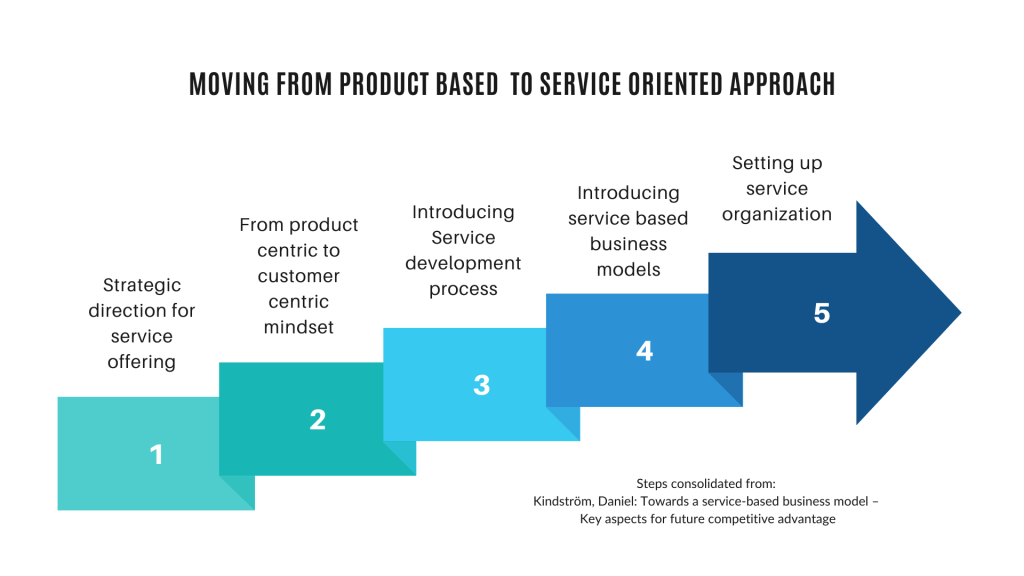
When transition from product orientation to service orientation, there are significant impacts also in the strategic development portfolio, operations, way of working and even in organizational setup. I would recommend to get familiar with a super good article written by Daniel Kindström: Towards a service-based business model – Key aspects for future competitive advantage. Here are some key takeaways I picked up from the article to support moving from product based to service oriented approach:
First of all, strategic direction for service offering is required – are you complement the product based offering, creating completely new type of digital services, or what type of services and customer value do want to focus on?
The mindset shift from product centric to customer centric approach is required when working with new service offering concepts solving customer problems. This may be a long journey for many organizations with long traditions of building world class hardware products.
The service development process differs from product development process – what is your process to develop services? Do you need to develop both product based offering and services together?
Introducing service based business models – what is it for customers, what are the value propositions and how is the revenue created? Is the model transactional, agreement based, selling as a service / subscription based, or is the value created via the partner ecosystem…?
Setting up service organization – who is delivering the service? For example, do you need to setup new processes and roles, when supporting new digital services? Do you need to create a network of partners and vendors to support your services?
Overall, the move towards a service orientation allows manufacturing companies to go beyond the traditional transactional model and build long-term relationships with customers. Services provide opportunities for revenue growth, customer satisfaction, and adaptation to evolving market dynamics, ultimately leading to a more competitive and sustainable business.
However, also new capabilities, ways of working, business models and even organizational structures are required – introducing a new service offering may require development and change management in many different levels. The service-based business models would deserve an own blog post, so stay in the loop!
Strategic portfolios are looking into opportunities related to Mergers and Acquisitions (M&A). Big Mergers & Acquisitions may have significant impacts on development portfolios – even redoing the development plans totally. M&As tend to come as a surprise, as there are strict regulations on how to handle such sensitive information. Let’s review some of the common M&A scenarios from the development portfolio view point.
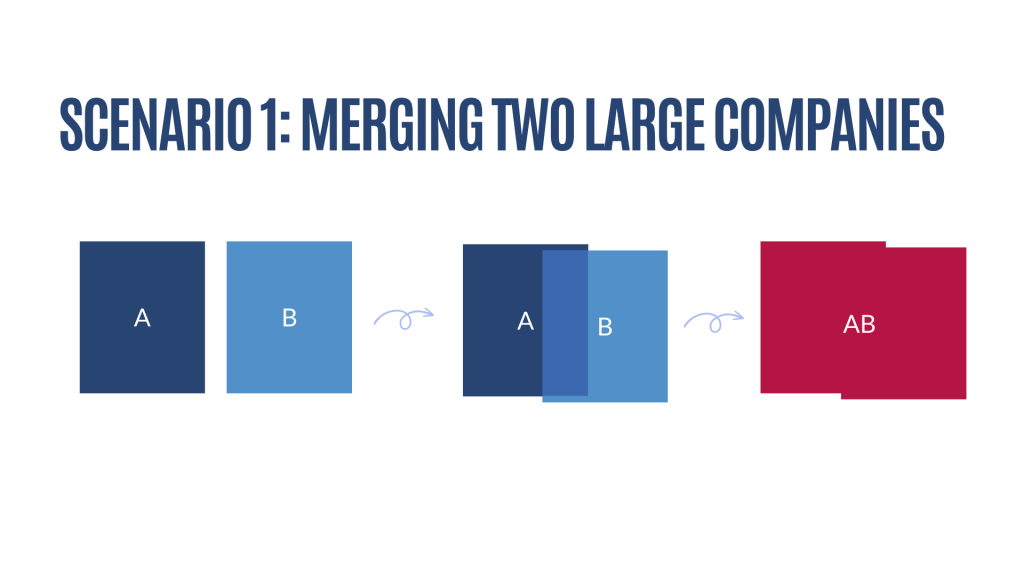
Scenario 1: Merging two large companies
This is a really big deal! Merging two big companies has huge impacts on development portfolio plans and structure, data, and tools, organization, ways of working, and even company culture. Also completing the merge may take even several years, if there is a lot of overlap.
Here are a few things to consider from a development portfolio viewpoint:
Uniting development portfolios over time, or keeping separate portfolios?
Keeping different brands or uniting the brands?
Selecting which product lines to continue, and which should be ramped down over time – not an easy task, especially, if some of the product lines are overlapping.
Are customers and customer segments overlapping, or creating synergies – are there new opportunities to create end-to-end value towards customers? How about business models and way to sell towards customers?
Business processes and operating model – area with endless opportunities, but also a lot of complexity due to differences in the businesses.
Finding synergies from IT tools, migrating data, ramping down parallel systems, and integrating systems and processes. Big companies may have thousands of applications, and even this IT stream may be a really big thing!
Ways of working – a significant change management and training may be required, if companies have different ways of working, for example the use of lean and agile vs. traditional ways of working.
Scenario 2: Merging a smaller company
A common scenario familiar to many – a bigger company buys a smaller company to acquire new products or services, technology, or other capabilities.
Here are a few things to consider from the development portfolio viewpoint:
M&A is often a must-to-do – do we need to change priorities in our development plan to support M&A activities?
Are there overlapping products, services, and offerings?
How closely should the smaller company be integrated? If there is a strong company way operating model, deployment of the common processes, tools, and way of working may require a lot of effort for example from IT units, but also from the business process view point.
There may be a need to rollout also corporate ICT and core solutions, such as ERP and CRM for the unit.
Building a roadmap for all needed changes may be required.
Will the newly purchased business unit have its an own development portfolio, or will development be part of one of the existing portfolios?
Scenario 3: Integrating a new unit fully into the main business
This scenario may happen years after the original M&A. Business has grown, and opportunities to bring the acquired business unit closer to volume businesses may require full integration of operating model, ways of working, and also different systems and tools.
Topics to consider:
Requires full integration of organization, processes, ICT, and IT solutions, as well as products, services, and offerings – maybe even a dedicated transformation program to ensure smooth change management.
Merging also development portfolios together, and aligning ways of working and priorities.
How to keep the strengths of the unit to be integrated, while also getting the benefits of closer integration? Should something change also in the main businesses?
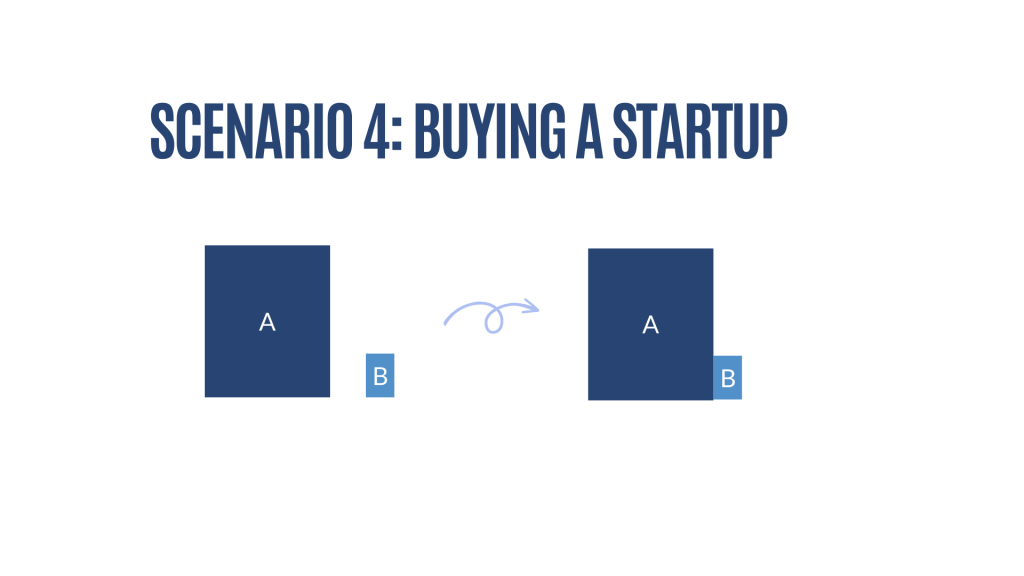
Scenario 4: Buying a promising start-up
Buying a start-up is a great way to get new competencies to the company. Often also start-up strength is the agility and possibility to pivot different types of opportunities quickly, whereas established companies have their scalable processes and ways of working.
Things to consider for development portfolios:
What is the end goal for the start-up – integrating into the main company and scaling the offerings, or continuing as a start-up within a corporation?
If the start-up approach is selected, the start-up may continue to manage development portfolios as previously, with strategic alignment on corporate development portfolios. There may be a conflicts between the cultures, and ways of working.
In a long run, when scaling up is required, there may be a need to integrate the start-up closer to the corporation and also merge development portfolios.
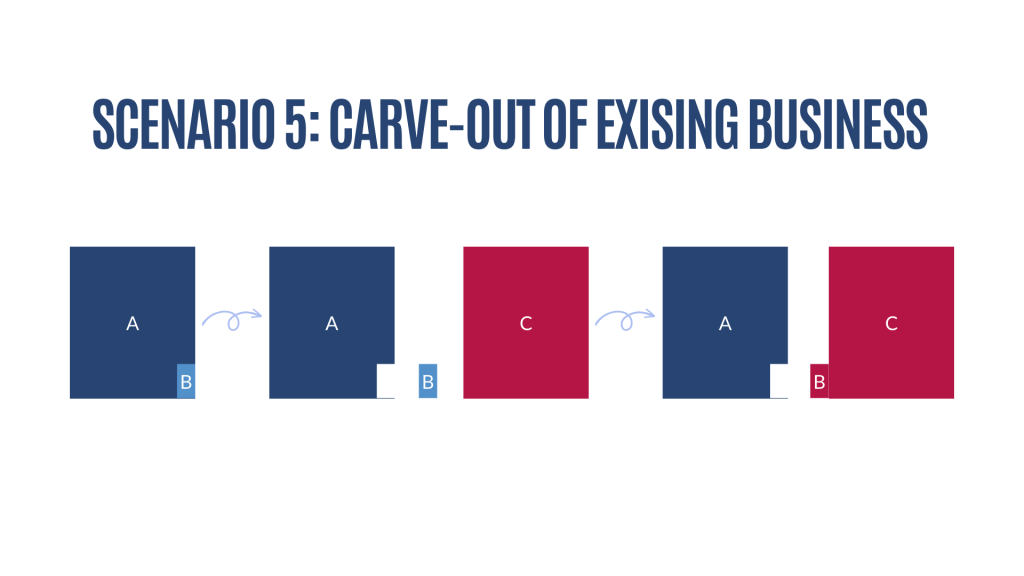
Scenario 5: Carve out of existing business
This is also a rather common scenario – part of the business no longer fits well to company strategic targets, and there is another company, which is looking for such a business opportunity! Optimally, this is a win-win situation for all parties!
When one of the business units or parts of the business is sold out, there are impacts on the development side too.
Organization – a big change for the people impacted!
Data, ICT & IT systems – the transition of all IT to the buyer and cleaning up also the data from the corporate systems – may be a big and complex effort.
Is the change impacting also development portfolio priorities?
This is again one of those areas, where I would love to learn more! If you have good learnings to share, I love to catch up!
Strategic portfolios are looking into opportunities related to Mergers and Acquisitions (M&A). Big Mergers & Acquisitions may have significant impacts on development portfolios – even redoing the development plans totally. M&As tend to come as a surprise, as there are strict regulations on how to handle such sensitive information. Let’s review some of the common M&A scenarios from the development portfolio view point.
Scenario 1: Merging two large companies
This is a really big deal! Merging two big companies has huge impacts on development portfolio plans and structure, data, and tools, organization, ways of working, and even company culture. Also completing the merge may take even several years, if there is a lot of overlap.
Here are a few things to consider from a development portfolio viewpoint:
Uniting development portfolios over time, or keeping separate portfolios?
Keeping different brands or uniting the brands?
Selecting which product lines to continue, and which should be ramped down over time – not an easy task, especially, if some of the product lines are overlapping.
Are customers and customer segments overlapping, or creating synergies – are there new opportunities to create end-to-end value towards customers? How about business models and way to sell towards customers?
Business processes and operating model – area with endless opportunities, but also a lot of complexity due to differences in the businesses.
Finding synergies from IT tools, migrating data, ramping down parallel systems, and integrating systems and processes. Big companies may have thousands of applications, and even this IT stream may be a really big thing!
Ways of working – a significant change management and training may be required, if companies have different ways of working, for example the use of lean and agile vs. traditional ways of working.
Scenario 2: Merging a smaller company
A common scenario familiar to many – a bigger company buys a smaller company to acquire new products or services, technology, or other capabilities.
Here are a few things to consider from the development portfolio viewpoint:
M&A is often a must-to-do – do we need to change priorities in our development plan to support M&A activities?
Are there overlapping products, services, and offerings?
How closely should the smaller company be integrated? If there is a strong company way operating model, deployment of the common processes, tools, and way of working may require a lot of effort for example from IT units, but also from the business process view point.
There may be a need to rollout also corporate ICT and core solutions, such as ERP and CRM for the unit.
Building a roadmap for all needed changes may be required.
Will the newly purchased business unit have its an own development portfolio, or will development be part of one of the existing portfolios?
Scenario 3: Integrating a new unit fully into the main business
This scenario may happen years after the original M&A. Business has grown, and opportunities to bring the acquired business unit closer to volume businesses may require full integration of operating model, ways of working, and also different systems and tools.
Topics to consider:
Requires full integration of organization, processes, ICT, and IT solutions, as well as products, services, and offerings – maybe even a dedicated transformation program to ensure smooth change management.
Merging also development portfolios together, and aligning ways of working and priorities.
How to keep the strengths of the unit to be integrated, while also getting the benefits of closer integration? Should something change also in the main businesses?
Scenario 4: Buying a promising start-up
Buying a start-up is a great way to get new competencies to the company. Often also start-up strength is the agility and possibility to pivot different types of opportunities quickly, whereas established companies have their scalable processes and ways of working.
Things to consider for development portfolios:
What is the end goal for the start-up – integrating into the main company and scaling the offerings, or continuing as a start-up within a corporation?
If the start-up approach is selected, the start-up may continue to manage development portfolios as previously, with strategic alignment on corporate development portfolios. There may be a conflicts between the cultures, and ways of working.
In a long run, when scaling up is required, there may be a need to integrate the start-up closer to the corporation and also merge development portfolios.
Scenario 5: Carve out of existing business
This is also a rather common scenario – part of the business no longer fits well to company strategic targets, and there is another company, which is looking for such a business opportunity! Optimally, this is a win-win situation for all parties!
When one of the business units or parts of the business is sold out, there are impacts on the development side too.
Organization – a big change for the people impacted!
Data, ICT & IT systems – the transition of all IT to the buyer and cleaning up also the data from the corporate systems – may be a big and complex effort.
Is the change impacting also development portfolio priorities?
This is again one of those areas, where I would love to learn more! If you have good learnings to share, I love to catch up!
One of the key portfolio management goals is to maximize the value of the development portfolio – I reviewed some methods to achieve this during my previous post (See 4 Goals of Portfolio Management). After this post, I have had great discussions about maximizing value. Again, this is a tricky topic, and I share some of my learnings while studying this a bit.
Let’s look into value creation from a strategic initiative viewpoint, taking step by step approach.
Step 1: Identify The Value
One of the great articles I would recommend for you is Deloitte’s Linking Strategy to Value Published in Journal Of Business Strategy 2012, if you are not yet familiar with the thinking. The article introduces a a clear framework to map Shareholder value, but also liking Strategic Vision, Objectives and Initiatives to value created.
The article provides also model to map strategic initiatives to business capabilities, enabling IT capabilities, applications, technology and to organization. I think this approach may be helpful for example for IT organizations struggling to connect enabling IT development to strategy.
Strategic initiatives may create different type of value for different stakeholder groups, and not everything can be easily measured with financial numbers. The traditional approach is to look into increased business profits or decreased costs – what is the financial value of the initiative? This is important – development should create tangible benefits. However, there may be also other type of value, not only ‘hard financial numbers’.
How is the value created?
It is not always easy to describe the value created from complex initiatives. Here are a few questions to ask, if you struggle with defining the value of your development initiative:
Are you solving customer challenges? Creating financial value to customers?
Are you exploration of new ideas and opportunities? Investing into future horizons? Learning and exploring new customer opportunities, markets or segments? Learning about the new markets and opportunities is valuable as such, even though you would not yet have a perfect business case.
Are you moving towards long term vision & strategic goals? Building future competitiveness step by step?
Are you providing better service towards customers? Keeping existing customers or being able to sell more towards current customer base?
What is the value created towards different customer groups? Can you validate your value propositions with customers?
Are you enabling other strategic initiatives?
Increased quality of products or services? Enabling needed quality certification?
Leaning or automating business processes? Increasing productivity with improvements?
Reducing or mitigating risks? Enabling business continuity within x years time frame?
TIP! In my previous role, Development Management Office team had gamified the the definition of soft benefits – I think this is a really important topic to look into and also spend some time to think about.
Step 2: Prioritize development within initiative! What is your Minimum Viable Product (MVP)?
Next, once we have identified how our initiative is creating value, it is also good to look into the scope of the development, too. Within your initiative, what is creating value to the customers, end-users and other shareholders? I am a firm believer of developing first Minimum Viable Product (MVP) – a working solution, with just a bare minimum of functionalities.
Look critically also into you development initiative scope – is everything needed to create the value?
What is the absolute minimum, to create value to customers and end-users? Think about the scope from the customer or end-user use cases or process view point.
What you need at the beginning, what could be developed in the next releases? Do you have DLs to meet for example based on the yearly clock?
Don’t build something someone might need some day, perhaps. Be brave with prioritization, simple is beautiful!
Step 3: Deliver Value Incrementally
One of the typical challenges with large transformation programs is the long development time, followed by sometimes even longer deployment phases, resulting in a delay in creating value and delivering benefits. A risk with large and lengthy development programs is, that business, environment, and customer needs change over time, and finally, when going live, the solution built with great effort is already somewhat outdated.
One of the great approaches is to break down large initiatives into smaller pieces, which are easier to manage and start to receive benefits incrementally. Sometimes this requires also a bit of creativity. Here are few questions to consider:
Can you break down the large entity into meaningful smaller pieces? Can you find quick wins?
Can you test your concept with customers with a light back-end or even with manual processes?
Can you you start your ERP transformation/large initiative with the green field units to start to get benefits, and then move to more complex existing units?
Can you develop a long end-to-end business process piece by piece and start to get the befits for the first parts as soon as possible?
Can you lean the existing business process before starting the IT renewal?
Can you prioritize the work based on the urgency of the solutions, if you have critical timelines? Are there solutions, which could be implemented later?
For large transformation programs, there is a huge difference, if we start to receive value incrementally already at the early phases of the program, when compared to big bang approaches.
Step 4: Communicate about the value!
One of the areas, I admit I would need to focus more on, is to communicate about the value. WHY is this important? What is the value towards different stakeholder groups? What is the value towards customers?
This is so important for motivation. Many different stakeholder groups need to work hard to develop and deploy the new development initiative, and they have tons of other priorities, too. When we all understand the value, we are also more willing to give our full support! Here are few topics to consider:
Communicating the value towards development teams – we all get motivated when we understand why!
What is the value for different stakeholder groups?
Creating crisp marketing materials for new offerings to communicate about the value propositions
Creating great materials to support change management when deploying new solutions
To be able to communicate the value clearly requires typically a lot of hard thinking and also several iterations with the different stakeholders. If you struggle to communicate about the value, you might need to iterate with the step 1.
Step 5: Remember to measure!
Measuring the created value is often a really difficult topic, and requires also often several iterations to find the best approaches. How can we measure the value?
If you are introducing a new offering, can you setup a simple dashboard to see the sales ramp up? Can you measure the profitability of your first pilot cases? Can you get measurable the value towards customers?
Key Performance Indicators (KPIs) are a common approach to measure progress. In addition to lagging indicators looking into past progress, are you able to define and follow up on leading indicators – looking to future outcomes?
There are also tons of super good resources for product management KPIs. If you are developing new products or services, select the best ones fitting your area.
Follow up on your business case – how is the benefit realization progressing? One of the portfolio management tasks is to follow up on benefit realization, and value created, even after the project team might have moved to new projects.
So what is this strategic portfolio management? How is it different from project portfolio management? Let’s have a look!
Strategic Portfolio Management (SPM)
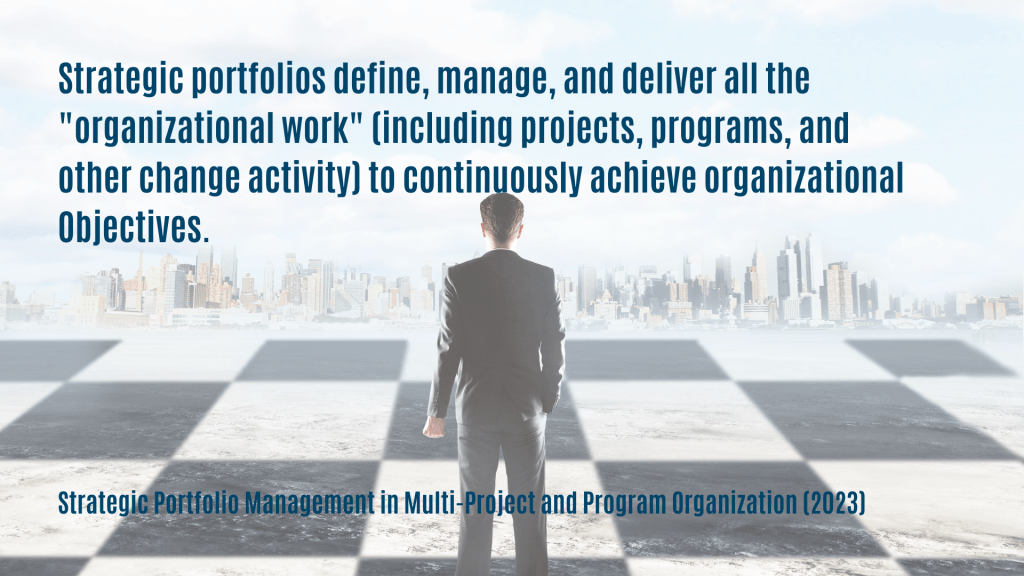
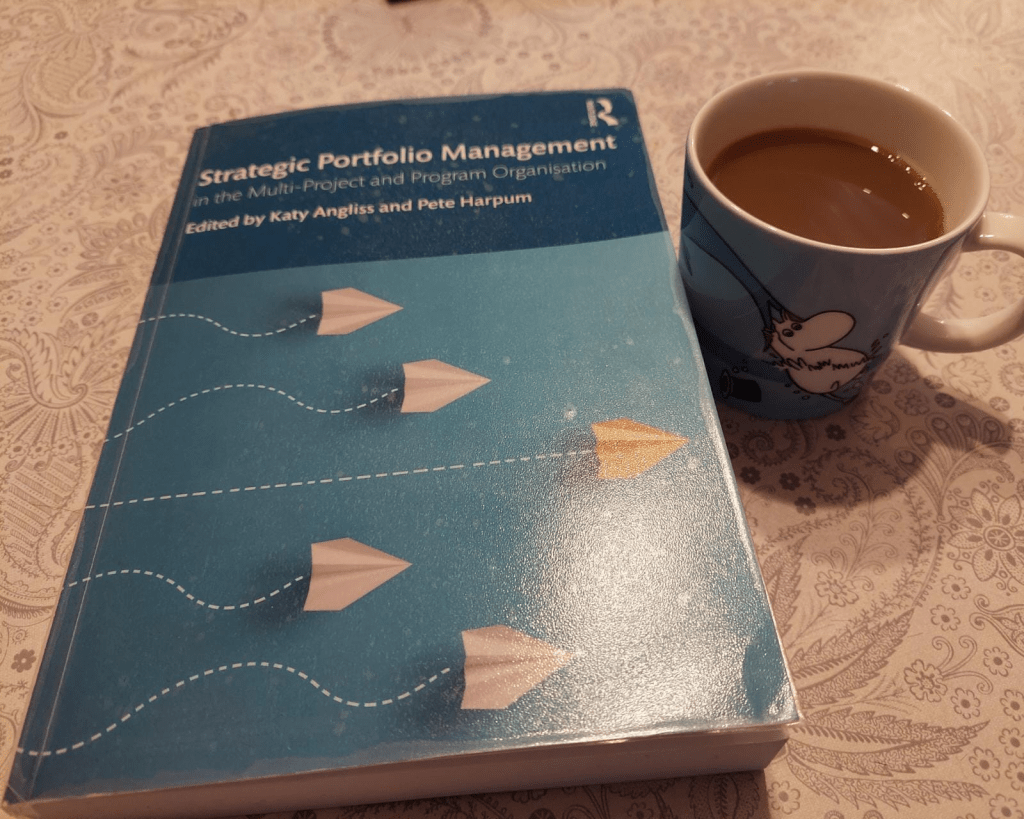
I have been reading through great articles related to Strategic Portfolio Management (SPM), and also a new book “Strategic Portfolio Management in the Multi-Project and Program Organization” was published in early spring 2023 bundled with the latest research. In the book, Strategic Portfolio Management (SPM), is understood as a collection of projects and programs delivering strategic objectives. Within strategic portfolio, there may be tactical portfolios, including programs, projects or sub portfolios. The definition for strategic portfolios takes even a wider approach of including all the “organizational work”, not only projectized development work:
I like this definition, as it is wide enough – development can happen today via projects and programs, but also via agile development or other work activities within the organization.
Taking Strategy to Action via Development Portfolios – Focus on Development outcomes and benefits
This is how I see it!
Strategic Development Portfolio is developing new products, services and offering, new or enhanced business models, transforming ways of working, enhancing processes, operations and IT tools and operating model, developing technology and platforms needed in future, and even impacting culture – moving the company towards strategic goals.
As a result of the development, development outcomes, such as new beautiful customer offerings are introduced to markets and deployed across the organization. Via the outcomes, such as enhanced business model or new offering or operating model, also business benefits are received. Development outcomes are contributing to the strategic targets, and transforming company towards the bright future – to wished to be state.
Strategic Portfolio View
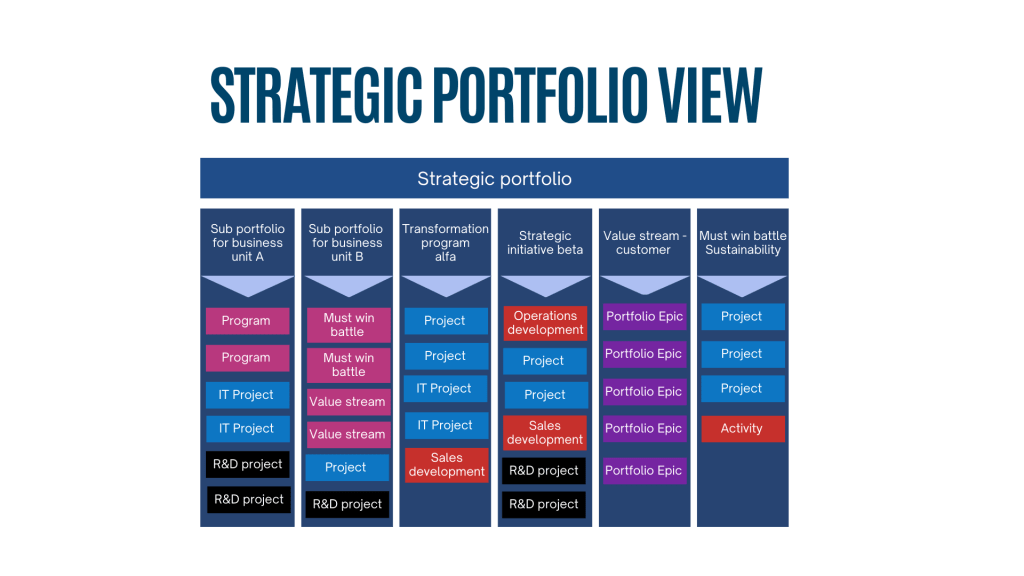
So let’s have an illustrative example, what strategic portfolio could look like. In the example, portfolio is grouped into two sub portfolios focusing on business unit A and B strategic initiatives.
Within strategic portfolios, there may for example transformation programs, must win battles, individual projects or other initiatives, and different type of other development activities. Also work may be organized around value streams, and portfolio epics for agile development teams. Also product development may be organized around projects or via product development teams.
Work may be required from many different units and functions, and such other business units, IT, R&D, marketing, or finance. Thus, close collaboration with different units is required to ensure the smooth execution of strategic portfolios. Sometimes this is solved via cross functional development teams, and in some other cases, transformation programs may include projects delivered by different units. Read more about different view points from a previous post: Development Portfolios in Large Companies – Different viewpoints.
Building Strategic Portfolio – way of thinking
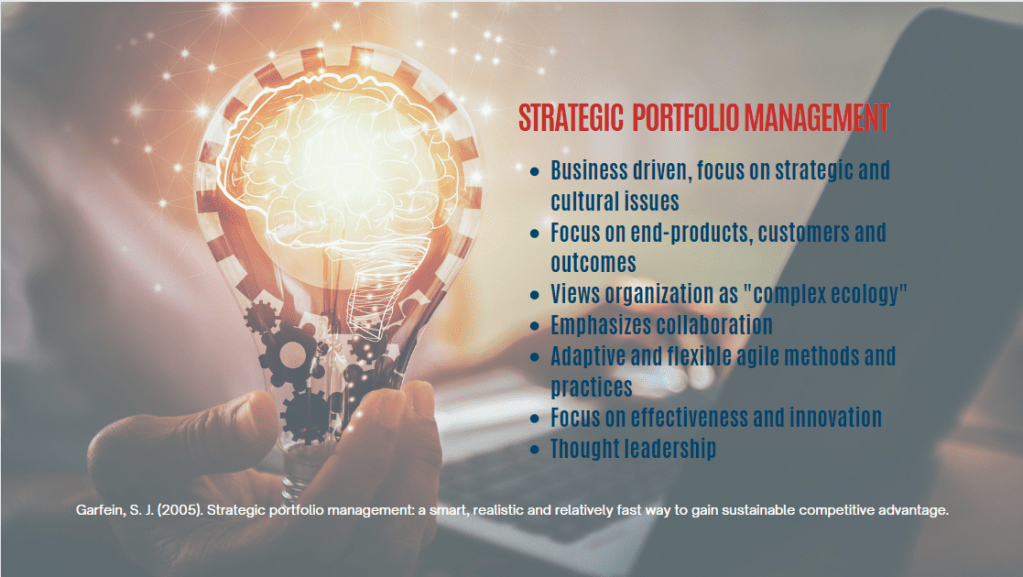
The thinking behind Strategic Portfolio Management is a bit different, even though Project, Program and Project Portfolio Management, and PMO activities are an important foundation for SPM. Here is the summary of Strategic Portfolio Management characteristics Garfein (2005); I think this is summarizing the way of thinking well:
Strategic Portfolio Management – It is all about saying NO
Strategy is all about making choices, saying YES to some of the opportunities, but saying NO to others, even though they are super interesting. This is especially important for strategic development portfolios: to be selective, to prioritize; this will help organization to focus on most important items. Read more about Prioritization from the previous blog post!
What does the strategy mean in practices for our development portfolio? Is our portfolio strategy driven, or can we loosely link all types of development to our strategy? One of the great tools, I recommend for strategic development portfolios is Objectives and Key results – if you want to learn more, have a look at OKR blog text too!
Do you want to learn more? Sign up to new online course!
I am super proud to present the first version, Minimum Viable Product, of Strategic Portfolio Management Fundamentals course via Udemy platform. Couse includes ~2 hours of video lessons, Strategic Portfolio Management maturity model, and an extensive workbook you can use to develop your portfolio management practices further!
Williams D., & Parr T. (2004) Enterprise Program Management: Delivering value. Palgrave MacMillan.
Garfein, S. J. (2005). Strategic portfolio management: a smart, realistic and relatively fast way to gain sustainable competitive advantage. Paper presented at PMI® Global Congress 2005—North America, Toronto, Ontario, Canada. Newtown Square, PA: Project Management Institute.
Sing up to monthly news letter to get the latest blog updates!
Processing…
Success! You're on the list.
Whoops! There was an error and we couldn't process your subscription. Please reload the page and try again.
Many organizations have Long Range Planning (LRP) during the spring, and this may be sometimes a source of confusion and also – frustration.
Here a few typical questions and concerns: Why do we need to do this? Who needs this information? We already have our roadmap, so why use the planning template? What, no template provided this year? We do not yet know the details of next year, as we are working with agile methods. Our strategy will be updated this year, so we cannot yet do planning for the next strategy round… Really, do we start the budgeting already in April this year, we just finally concluded this year’s funding details!!!
Yes, creating future plans is never easy, but the whole process can be made a bit smoother. I try to summarize 5 tips for Smoother Longer Range Planning for Development Portfolios! Would you have other tips to share?
What is this LRP?
When discussing with different teams, a common question is, what does LRP actually mean. Here is how I usually explain it:
Many organizations have bi-annual planning cycles – first looking into long range plans (LRP) during Q2, and budgeting at the end of the year. The idea is not to do detailed budgeting in the spring but to identify big development initiatives, which would create significant business benefits, and also require investment funding. And also to make prioritization decisions of what is not in the plans, to create focus and alignment.
Planning cycles in many companies – Long range planning in Q2 & budgeting in Q4
The long range planning process is focusing on the future – what are the key development initiatives and programs, new product lines, or offerings planned? Typically the planning horizon for LRP is 1-5 years – plans are more accurate for the next year, and more indicative for the next 2 or 5 years.
Long range planning (LRP) is typically lead by the finance function, although development portfolios contribute significantly by providing planning scenarios.
Long range planning (LRP) is typically looking into 1-5 years horizon.
Long range planning scenarios
One of the tools for Long range planning is building different kinds of scenarios. Here are few scenarios, which might be interesting to look into:
If we can do all we want -scenario – what would we develop?
If we keep the current investment level – scenario – what would be included in our plans?
If we need to do budget cuts of x% scenario – which items are must haves?
If we invest into new offerings or business models scenario – where would we invest in?
If we do this huge ERP renewal consuming a lot of resources – what should we leave out?
So depending on the portfolio, different planning scenarios may be good openings for discussion and prioritization. Also many portfolio management tools provide support for scenario planning.
How about agile teams?
For agile teams, backlog and features are often prioritized quarterly, or monthly. However, it is good to have also high level roadmap and vision. Let’s review what LRP could me for different agile teams?
Agile Program teams – what is the high level roadmap or vision for the program? What key business outcomes planned? Big epics or themes part of the future vision?
Continuous development teams – will the development need be stable, or is there a need to grow the team due to increased demand? Or is the solution already in a mature phase, and less development is needed?
Agile product teams – what is the high level roadmap and vision for the product line? Developing new products or launching new offerings? Retiring some products? Changing a technology platform or building strategic partnerships?
But let’s have a loot at the 5 tips to make LRP process smoother:
1. Start early enough
Align with your finance team on schedules and start early enough, so that you will have enough time to prepare for LRP.
If the time for creating the plan is very short, key stakeholders get stressed, and the end results may not reach your quality standards. Typically also several iterations and discussions are needed.
2. Find the correct level of detail – top down or bottom up approach?
Think about what is the correct level of detail for your LRP – would a high-level understanding be enough, and use a top-down approach for collecting the development ideas with the leadership? Or would you like to involve smart team leads, program managers, and owners in the discussion, as they know the content best?
If you involve all teams for collecting the ideas, and do the planning bottom-up, the work may be quite heavy and take a lot of time across the organization.
So my recommendation would be to keep it as simple as possible, but involve the people, who have the vision!
3. Use a tool or simple template for consolidating the information
If every team provide the information in a different format, it is impossible to see the big picture. Apples are compared to bananas and what ever fruit salad.
If you have a portfolio management tool in use, look into options to utilize the scenario planning functionalities. When using the same format for roadmaps tools provide, pulling information together is also easier. I have been looking into the ideas module and road mapping of our portfolio management tool this year and will try to utilize those for data consolidation.
If you do not have a tool available, simple template may be helpful to keep the development plans in a similar format. Some people hate the templates, others just need to have them to provide guidance.
4. Schedule reviews and prepare for iterative alignment
Schedule reviews and prepare for iterations – typically the discussions related to LRP may take several iterations, as it may be the first time to bring the plans from different teams together.
Long range planning is a great time to create alignment across business and technology units and in the enterprise level:
What are our development portfolio focus areas for the next years? What planning scenarios do we have?
What are other business units focusing on? Can we find synergies? Do we have dependencies?
What would be the investment funding need for the next years?
What support would we need from other units and functions, e.g. from R&D or IT to be successful?
And other way around, what demand do we get from different business units? Do we need new technology investments or build up new capability areas?
What new content will be deployed to our sales organizations from different global portfolios?
What run cost impacts would we expect from the development roadmaps?
And in enterprise level – can we afford to do all of this development? Should we sequence some of the big initiatives?
This is actually really important, and for me, in the heart of the LRP process. It is not only about the finances, it is about the content.
5. Keep portfolio pipeline up-to-date and adapt to change!
If you have a portfolio pipeline up-to-date throughout the year, LRP would focus more on prioritization and look further into the future. Read more about the portfolio pipeline from the previous post!
If your portfolio data gets out of shape during the year, it will always be a big effort to create your plans. First for LRP, and then for budgeting, and again next year…
Also typically first changes or surprises happen already in January – a new must have project or M&A, or something similar happens. The past years have been full of big surprises from the market and political environment – and impacting also the plans. When you have transparency on your current plans, it is easier to also change the plans. Quarterly reviews and rolling planning are also great approaches (see previous blog post: Time for Quarterly Portfolio Review? and From managing past cost to rolling forecasting). I would love to learn more about integrated business planning (IBP) and how it works in the big complex organizations, too.
Portfolio management is challenging by nature, as it is dealing with future events and opportunities – information in project selection is often uncertain and sometimes even unreliable. The decision environment is typically also dynamic – the status and prospects of projects are changing and also market environment. And resources are always limited – resource transfers between projects are not always seamless. In this blog, I wanted to share 4 goals of portfolio management from a classic article Cooper, Robert G., Scott J. Edgett, and Elko J. Kleinschmidt. “Portfolio management: fundamental to new product success”.
Even though article is quite old, and focusing on product portfolio management, I think these goals are still quite relevant. I will highlight some of the key learnings from the article and also add on some reflections. I hope this is useful, and I would also recommend to check out the original article with a lot more insights!
Let’s go through the four goals!
Goal 1: Value maximization
The number one goal of portfolio management is to maximize the value of the portfolio. How to actually do this?
Simple approach used by many companies is to calculate Net Present Value (NPV). For each project in the portfolio, Net Present Value is calculated and projects, with the highest value are selected into the portfolio scope. NPV works well in theory, but in real life, defining the business benefits is always tricky – and not always fully objective. Oftentimes also in the portfolio level, different projects are not easy to compare against each other.
Another method defined in the article is Expected Commercial Value (ECV) – this method takes into consideration probability of technical success as well as commercial success. This is really important, as even the best product or service will not have high commercial value, if commercial model is not successful, and other way around – if product or service is not working well, commercial model cannot fix the issues. Another method, called Productivity Index (PI), tries to maximize the value of the portfolio for the given resource constraints. Calculation within these methods seems to be a bit complex for practical implement, but conceptually really good food for thought!
There are also other scoring models as portfolio tools, where projects are scored on each criteria, such as strategic alignment, market attractiveness, or reward vs. risk. If you are interested to learn more, have a look at the article!
Goal 2: Balance
The second goal is to develop a balanced portfolio. There may be different attributes to achieve balanced portfolios, e.g. balance across different time horizons (See previous blog post: Is Your Development Portfolio Balanced Across Different Time Horizons?), balancing the risk level of portfolio, or balancing across different markets, technologies, product categories or project categories.
A typical scoring model for project selection summarized in the article includes the following factors with scaling from 1-10, anchored scale points 1,4, 7 & 10:
Reward
Business Strategy Fit
Strategic Leverage
Probability of Commercial Success
Probability of Technical Success
The article has also nice examples with traditional bubble diagrams, if you are interested to learn more.
In real life, as resources are always limited, portfolios tend to be easily unbalanced. There may be too much investment into certain business unit or product family and lack of investment into some others. There may be too much investment into products and services needed in one geographical area or market and not enough focus on other high potential markets. There may be too much focus on certain process areas and IT tools, and lack of focus on some other equally important. If the lack of balance is due to strategic priorities, that is fine – but if portfolio is not balanced unintentionally, this might cause issues in a long run.
A good practice is to review the portfolio periodically, e.g. quarterly (See previous blog post: Time for Quarterly Portfolio Review?) and check if any balancing actions would be needed.
Goal 3: Strategic direction
The article states that Strategy becomes real when you start spending money! This is true, development portfolios are key vehicles to take strategy into action. Here are two ways to ensure the portfolio is aligned with the strategic direction:
Strategic fit – are all projects consistent with your business’s strategy?
Spending break down – does the breakdown of your spending reflect your strategic priorities?
As tools to manage these aspects, two approaches are defined:
Bottom-Up approach – Strategic criteria is built into project selection tools, such as scoring factors introduced earlier
Top Down Strategic approach – Strategic Buckets Model – based on the business strategy, buckets of money are enveloped for different types of projects. Examples of strategic buckets defined in the article were buckets per different product line, own buckets for new product projects, platform projects or other (e.g. extensions, improvements or cost reductions).
Most companies have too many projects in the pipeline and due to limited resources, resulting in pipeline gridlock. This is also one of the key challenges almost every portfolio management practitioner highlights during the discussions.
To solve this challenge, there are two questions:
Do you have enough of the right resources to handle projects currently in the pipeline?
Do you have enough resources to achieve your new product goals?
As a solution for both questions capacity planning is based on the current project’s roadmap and future development needs. Mapping resource demand and available capacity is a significant effort with large portfolios and big organizations – portfolio management tools may support these views!
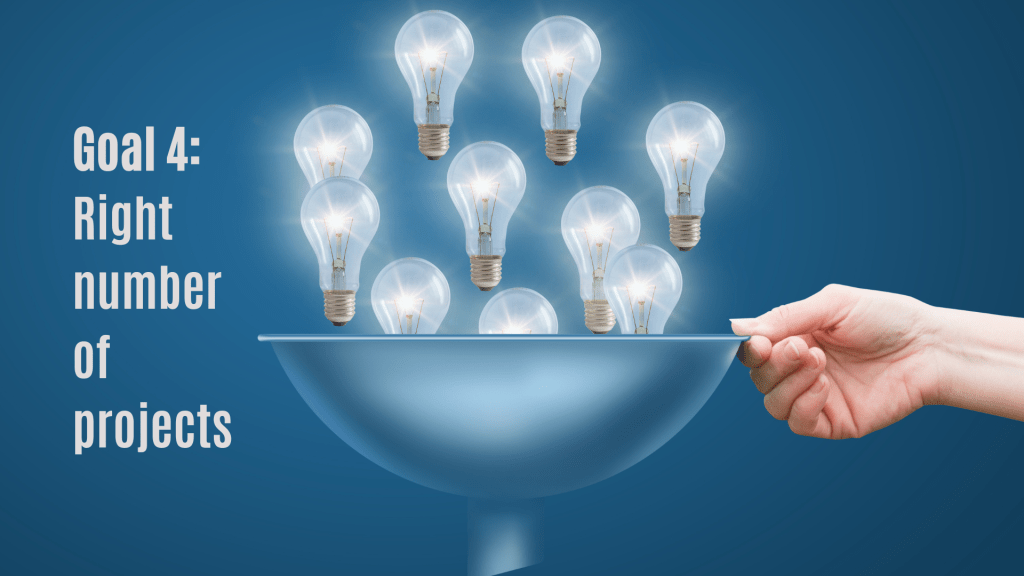
In addition to capacity management, I would also strongly link this goal to prioritization! It is really important to create limit the number of new projects initiated and also kill unsuccessful projects.
Cooper, Robert G., Scott J. Edgett, and Elko J. Kleinschmidt. “Portfolio management: fundamental to new product success.” The PDMA ToolBook 1 for New Product Development 9 (2002): 331-364. Link
Previous blog posts, which might be also interesting:
Development is the way to transform company from the current state to the future to-be state. One of the challenges in many portfolios is to focus too much on initiatives developing short term solutions: current products and offerings, existing processes and ways of working. Continuous improvement is super important, but if there is lack of development initiatives building future competitiveness, it is a good time to look if portfolio would need rebalancing.
I will review here some models for mapping your portfolio content based on the different horizons:
McKinsey Three Horizons model
McKinseys Three Horizons model introduced in The Alchemy of Growth (Bahai & Coley, 2000) divides investments into three horizons:
Horizon 1 – focus on growing and defending a company’s core businesses to ensure near-term success. Investments are typically well known and there is a low uncertainty. This is a kind of comfort zone for many portfolios – examples of investments could be enhancing existing products and offerings and improving current operating model, and IT systems.
Horizon 2 – investments are focusing on scaling new revenue streams, perhaps a bit outside of core offerings with higher investments and longer investment horizons than in horizon 1. New capabilities needs to be built to support horizon 2 investments.
Horizon 3 – investments in horizon 3 have high level of uncertainty, high level risk, and often high level of research and development required. These development initiatives could lead to creation of completely new markets for company – and potentially there could be a very high profits available in the future.
Investments into horizon one feel safe – this the comfort zone for many of us – we know this staff well and there is not so much risk. However, if all investment money is spent in Horizon 1, your portfolio may be already late with your Horizon 2 or Horizon 3 investments – too much investment into short term may damage future competitiveness. Some companies have a practice to create own portfolios for Horizon 2 or Horizon 3 investments – to give an own investment bucket for forward looking initiatives.
SAFe Investment Horizon Model – Guiding Investments by Horizons
Scaled Agile Framework has also adapted three horizons model with some enhancements. In addition to horizons 1-3, also Horizon 0 for retiring products and solutions was added – this is good, as it is important to also decommission old solutions. Horizon 1 is also split into two categories: Investing and Extracting solutions. Horizon 2 solutions are emerging next generation horizon 1 products, where as horizon 3 is focusing on new opportunities with longer return of investment time.
Categorizing investments into different horizons is a great tool – as a one time effort or even by adding horizon into your portfolio data.
Scaled Agile Framework (SAFe) – Guiding investments by Horizon
Exploit and Explore Portfolio by Strategyzer
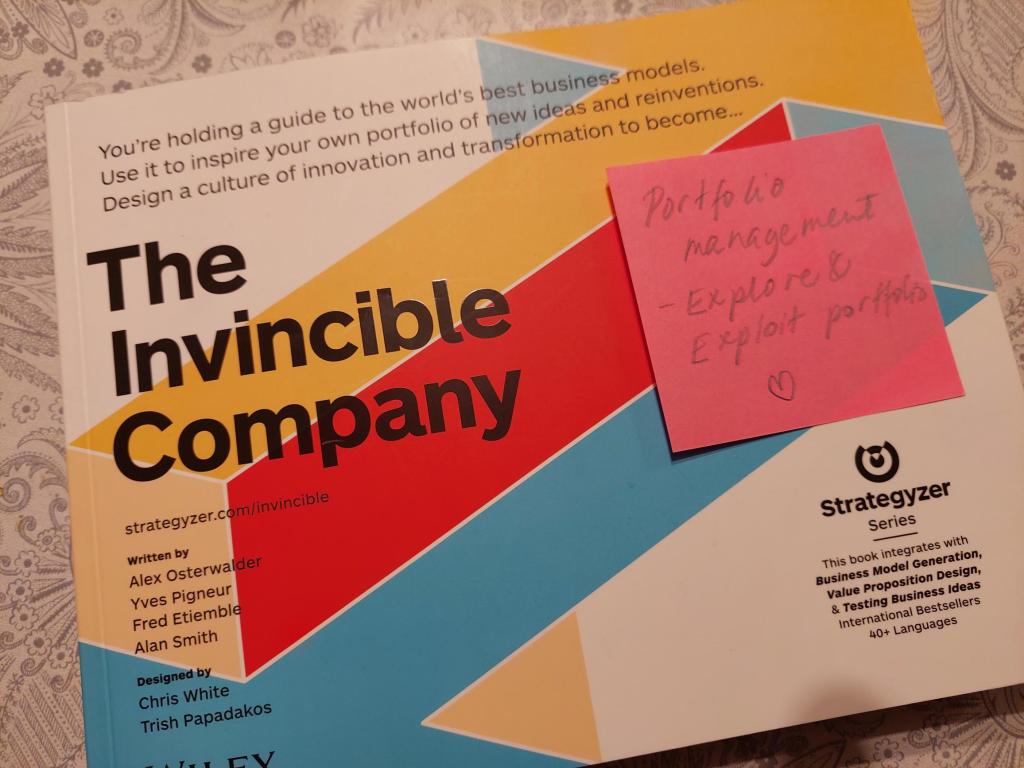
The idea within Exploit and Explore Portfolios by Strategyzer’s The Invincible Company is to divide portfolio into products, offerings or solutions belonging to either Explore or Exploit portfolios.
Within Explore portfolio, there are new initiatives, perhaps belonging to Horizons 2 and 3. Items are mapped based on the Expected return and Innovation risk – a visual tool to map the different products and services.
Within Exploit portfolio, there are existing products and solutions – perhaps Horizons 1 and 0 might belong here. Items are mapped here based on Return and Death & Disruption risk.
For product portfolios, also product life cycle stages are commonly used tool to balance product portfolio across Development, Growth, Maturity and Decline stages.
Key takeaways – is your portfolio balanced across time horizons?
A good practice for any development portfolio is to check when doing long range planning or yearly budgeting work, how much money you are spending on each time horizon. This is a good agenda item to be also discussed during the quarterly review (See my previous post – Time for a quarterly portfolio review?) If you do not have this information gathered in your portfolio data, this can be done as one-time analysis for example yearly.
Also in enterprise level, this is a good exercise to look into as part of the strategy implementation – how much are our development portfolios spending on developing Exploit portfolio or Horizon 1 and 0, and how much are we investing into future competitiveness?
The balance between different time horizons depends on each portfolio vision, as well as company strategy and risk tolerance.
References
Baghai, Mehrdad, and Steve Coley. The Alchemy of Growth: Practical Insights for Building the Enduring Enterprise. Basic Books, 2000.
Sometimes when we are busy with day-to-day work, it is not so easy to take time for thinking about development portfolio vision – what would bright future look like! However, if clear inspiring vision is missing, prioritization may be difficult as there are many potential future visions to look into. A common vision creates also motivation across teams – our development work will contribute to this cool future vision – it really matters in a big picture! And my contribution counts!
I will summarize couple of tips how to work on your development portfolio vision. These methods work well for transformation programs or large projects too! Or even for your personal development – why not?
The Bright Future Method
My former colleague Mirette Kangas has been teaching The Bright Future method, which is one of the great tools, I recommend getting familiar with. You can find lots of great content, also The Bright future materials Yle Lean Culture Toolkit 2.0, but here is a short summary of the method also in English:
The idea is simple, gather your team, and start to systematically think about what the bright future will look like.
Let’s jump into the bright future now!
Even though it is not always easy, this workshop should not focus on current state challenges, but focus on the bright future ahead.
For each round, it is good to start alone and ideate (writing items into post-its physically or via online white board). Next step would be the share the ideas in pairs, discuss and create more ideas together. The it is time to consolidate ideas within your group – share highlights and put post is to the canvas. If you are working with a large workshop, whole group can also have a short round table to share the highlights. Tip for facilitator – remember strict time boxing, to have time for each round!
Round 1: Thinking
What kind of thinking and beliefs guide the creation and behavior of structures (and how does it differ from how people think today)?
Round 2: Structures
What structures do we have in our bright future that enable and promote the activities and behavior we describe?
Round 3: Behavior
How should we act (and how is it different from the current state) in order to produce the kind of results we describe?
Round 4: Ideas about the Results
What value do we produce for our customers and other reference groups?
What kind of outputs and services do we produce?
Summarize and prioritize development items into your roadmaps and backlogs
Summarize your results together to create an inspiring bright future vision!
And remember to use the workshop results actively – consolidate development ideas into backlog, and prioritize – do you have low hanging fruits, do you identify new development epics to reach your bright future vision? Also updating your future roadmaps to achieve the future vision is important – tips related to road mapping will be covered in the next blog post – stay tuned!
For me, a temptation is to skip rounds 1-3 and move directly to the Results part – however, thinking also about change of thinking, supporting structures and behavior are super important. So follow the process!
For Finnish speaking readers, strong recommendation to check out Yle Lean Culture Toolkit 2.0 by Mirette Kangas with the original materials for The Bright Future method – also lots of other great materials I recommend to look into!
Portfolio vision in Scaled Agile Lean portfolio management
Again, Scaled agile framework (SAFe) includes great tools for portfolio vision definition. Here are my favorite ones:
Postcard from the future – wish we were here! You could use Postcard from the future to summarize your Bright Future workshop results.
Portfolio Canvas (adapted from The business Model Canvas) – creating current state and future state portfolio canvases – good tool for portfolio managers working with agile or hybrid development portfolios!
TOWS Strategic Options Matrix based on SWOT analysis – familiar idea for many of you, always a great way to summarize options
Identifying portfolio epics and enablers based on the future vision – if this step is forgotten, it is unlikely to actually reach the future vision!
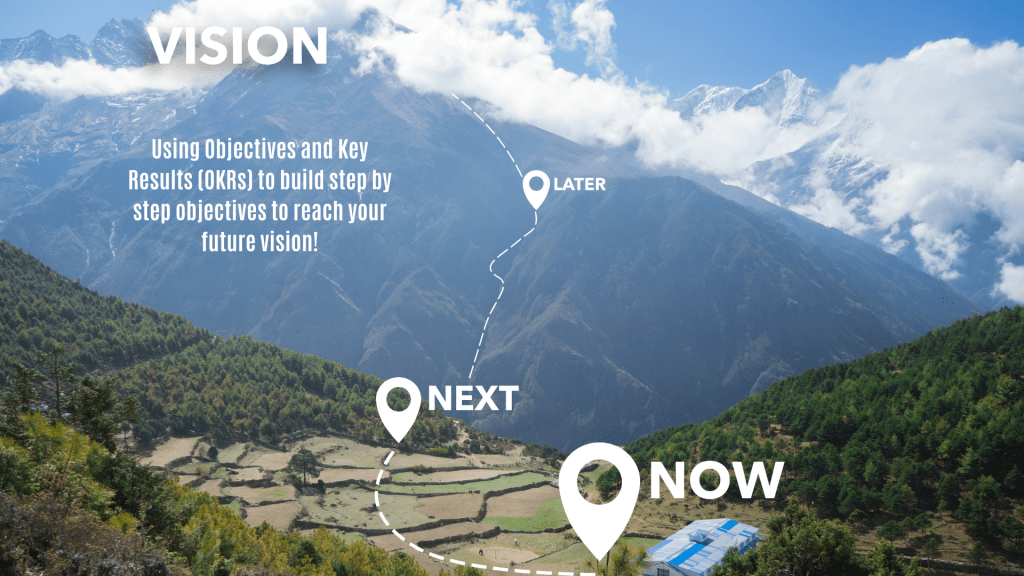
Making the bright future concrete via Objectives and key results (OKRs)
Objectives and key results are a great tool to setup time bound objectives – and are a great match to make vision concreate and measurable. Have a look at the tips related to OKRs via the previous blog post!


























 Strategic Portfolio Management