-
Portfolio management – 5 to-do’s before tool implementation!
There are great tools to support strategic portfolio management in the markets with advanced portfolio management and visualization capabilities. Portfolio management tool helps to create transparency across organization – business and technology units, finance, and support functions. When development work is needed from many organization units, such as different business teams and functions, IT and R&D and external vendors, managing the big picture via clear roadmaps helps a lot. Furthermore, having a common tool for managing portfolio finances supports financial planning and helps to create visibility on costs and benefits.
However, tool alone does not solve everything, and there are few things to look into before actually starting tool implementation. Here are couple of key learnings what to do from the buyer organization viewpoint, before kick starting actual tool development!
Have a look! If you have other tips to add, I would love to hear from you!
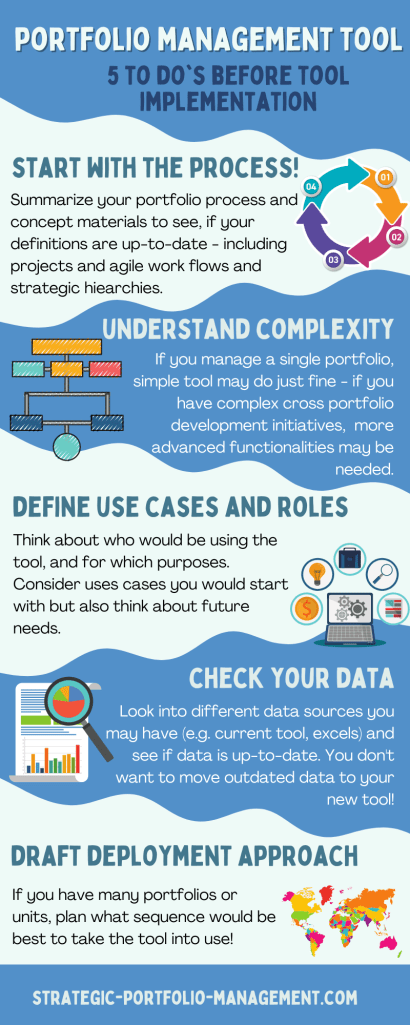
Portfolio management tool – 5 to-do’s before tool implementation 1. Start with the process!
Before initiating your tooling project, it is good to go through your key process steps. Here is a simple checklist:
- Do you have a common process defined for your portfolio or across organization? Process can (and should) be simple, but it is needed to setup the tool for you.
- What are the phases and gates for your projects – do you have one model or several?
- Do you have agile work or continuous development – do they follow for example portfolio kanban process?
- If you have an existing process, what is the feedback from the practitioners? Can you simplify your process? Are all project gates still actively used?
- Do you have a defined portfolio structures (e.g. portfolios, sub portfolios, programs or other strategic structures)? If not, it is good to check the needs with different portfolios. This step may require some iterations, if tool has not previously been used.
- What are your financial portfolio cycles, e.g. yearly, quarterly or monthly? How do you want to follow up financials?
Note! Even though it is important to work on process, one should not get stuck with process definition details – basic definition is enough, and details should be also checked while implementing the tool, as each tool has some unique features – sometimes also impacting process.
2. Understand complexity & portfolio structures – one portfolio or multiple portfolios with complex dependencies?
Complexity of portfolios varies a lot from company to another. Large corporations may need to manage many different types of portfolios or manage the same data from different viewpoints (see linked post Development portfolios in large companies – what is your viewpoint?).
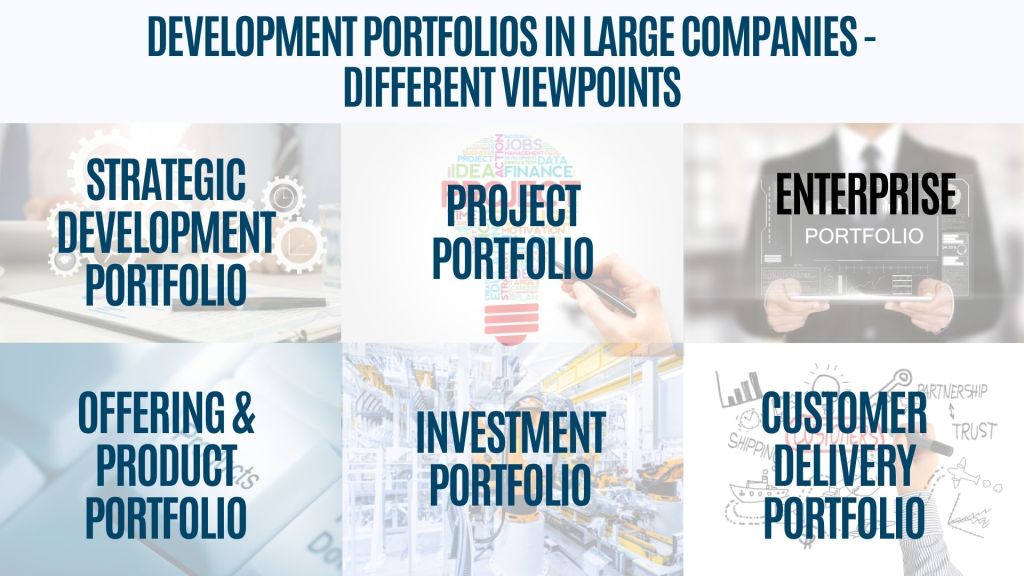
Development portfolios in large companies – which portfolios are you focusing on? Thus, it is good to align on scope and structures at the beginning of the work! Here are couple of questions to look into:
- What is the scope of your portfolios to be implemented – do you include business and IT development, R&D, customer delivery portfolios, product portfolios, innovation portfolios etc.?
- Do you implement tool for a single portfolio or across the whole company? Do you need to look into enterprise view, too?
- If you manage a single project portfolio, a simple and cost-efficient tool works well. If you operate in a large corporation, where you have many portfolios and work is executed by many different units, more advanced features may be needed.
3. Define use cases & roles – what tool capabilities do you need?
Different tools have a huge variety of functionalities, and one gets easily overwhelmed by all the possibilities.
What tooling capabilities are you looking for?
As each of the tool capability requires also some deployment effort, good practice is to start with a prioritized set of capabilities – Minimum viable product. What are the key capabilities tool should support with?
On the other hand, when implementing the new tool, it is good to look into future needs as well, so that tool also has capabilities to support more extensive use. Typically, these capabilities could be more extensive integrations, product or application portfolio management, scenario planning, and more sophisticated functionalities related to strategic objectives. To give you some inspiration, you can use the below picture to prioritize and sequence your tool planning:
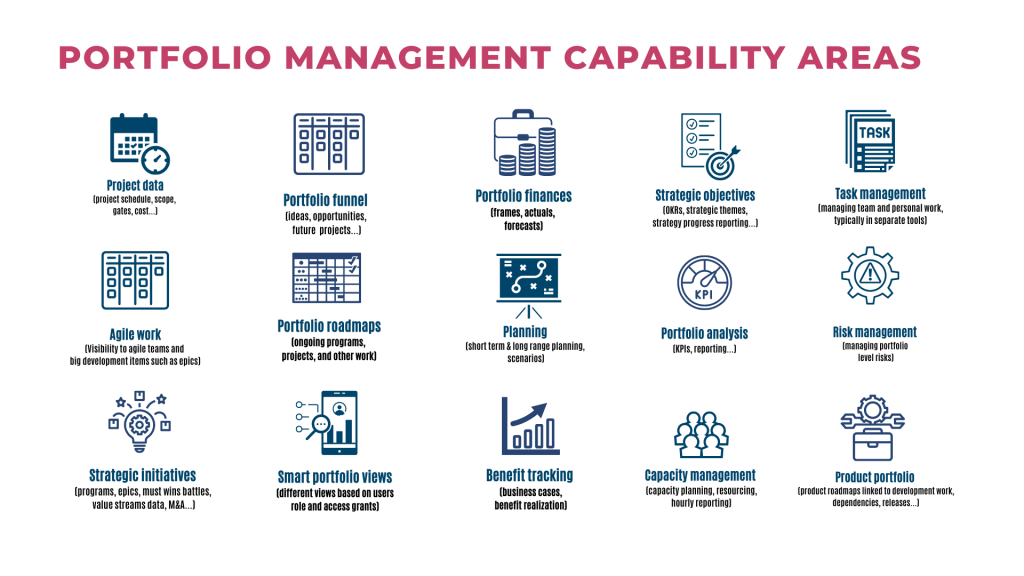
Typical portfolio management capabilities to plan tool implementation – what are your focus areas and what are the future capabilities tool should support with? Define user roles
Another important step during the planning phase is to define user roles – who would be actually using the tool – which roles would update the data and which roles would need transparency? Sometimes it may make sense to start with a small group of heavy users, e.g. introduce the tool for portfolio and project managers only, and then extend the use for a wider group of people. Here is the checklist:
- Define user roles for the tool (e.g. portfolio managers, program managers, project managers, finance controllers, line managers; owners, sponsor and leadership roles; how about team members for hourly reporting?)
- Think also about user groups, who would need transparency to portfolio roadmaps even though not actively editing the data (e.g. portfolio owners, business and technology leaders)
- Do not forget key user and admin roles!
- Good to do also a rough estimation of how many users would belong to different user groups – this may be helpful for the tool license discussions.
Define use cases
Based on the tooling capabilities and user roles, what are the use cases you would like to get started with? Few questions to think about:
- Define use cases – what are the important use cases you need to get started with?
- Identify also use cases, which might be useful for the future, but you do not need them right away (for example future needs to integrate the tool to other systems)
- Remember to get inputs also for technical things, like access management, configuration and tool maintenance from your IT partners
4. Check your data!
Before tooling implementation, it is good time to check what data you have. The approach is a bit different, if you are replacing an existing tool to a new one, when compared to a situation, where portfolio data may be in different excels and may lack common field definitions. Here are couple to things to consider:
- Where is your data? In an old tool or multiple tools, or in different places such as excel sheets? Or do you need to start by collecting the data into once place?
- Do you have similar data available across portfolio or across portfolios or does each portfolio have different data sets?
- Do you have relevant data gathered? This is a good time to see, if all current data fields are relevant and meaningful.
- Is your data up to date? This is a good time to update data, before new tool setup!
- Are you able to consolidate all available data to excel or other format for migration purposes?
- Are roles clear – who is responsible for portfolio data in each organization or portfolio? Tool will not help, if no-one is updating portfolio data.
Check out also other blog text related to Portfolio data – 5 tips from practitioners!
5. Draft your deployment approach
In addition to technical tool implementation, organizational change management, training and alignment plays a key role when implementing common tools across enterprise. You may want to avoid big bang type of deployment, if possible.
- Do you have pilot portfolios you would start with?
- Can you sequence other portfolios based on the interest and urgency?
- Which user groups and roles would need trainings?
- Would you create modular training materials or videos, which would be available also for new team members in the future?
- How about change management? If the way of working is changing, line managers may need strong support during the implementation phase.
Bonus tip – learn about tool concepts
There are plenty of great portfolio management tools full of interesting functionalities! Before you initiate your project, get familiar with the tool concepts, how they work and how they would support your needs. Tool data models may also bring really great possibilities for you to create transparency across organization or sometimes include some limitations. If possible, look for videos, demo to try the tool out or create a proof of concept!
Here are links to some of the portfolio management tools I have used or got familiar with:
Also for example JIRA has been used successfully to connect development work to portfolios.
If your favorite tool is missing for the list, I would be happy learn more and to add it here!
Check out also Gartner Strategic Portfolio Management reviews and rating!
-
From project portfolios to hybrid portfolios – combining projects and agile work
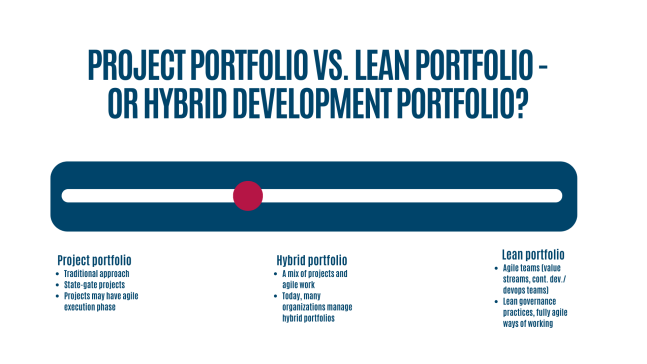
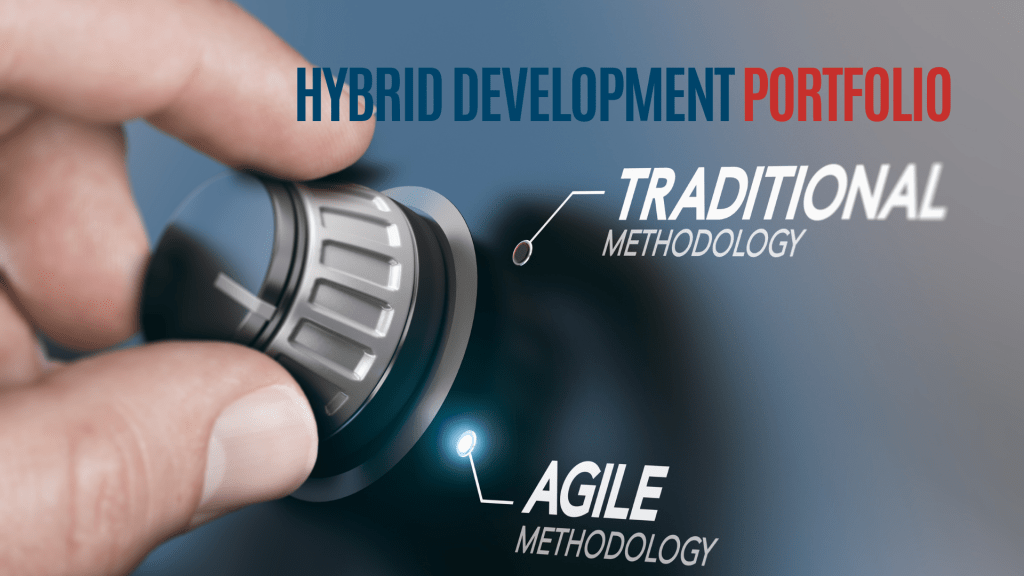
Hybrid development portfolio combining traditional projects and agile work Many companies have well established practices for managing project portfolios. Projects are followed up and governed based on the stage-gate model – and portfolio may include for example a collection of projects, programs, and other activities. There is an own standard for project portfolio management (PPM), which has been taken widely into use.
On the other hand, agile practices and continuous development teams have become more and more common. Popular Scaled agile framework (SAFe) has introduced a great set of practices for Lean portfolio management (LPM) – in SAFe development is organized via value streams and executed fully in agile mode.
However, most of the organizations are somewhere between – having still plenty of projects (often with agile execution), but also continuous development executed by the agile teams, continuous improvement or devops teams. Where is your organization now, somewhere in between? Where would you like to be in the future?

Scale from traditional project portfolios to hybrid portfolios combining projects and agile to lean portfolios – Where are you now, and where would you like to be in the future? Typical challenges for hybrid portfolios including projects and agile work
Managing a hybrid portfolio including projects and agile work is not completely straight forward – there are typically several challenges from the development portfolio view point:
- Transparency – project portfolio includes projects, but continuous development may lack visibility in terms of development roadmap, outputs, outcomes and benefit tracking
- Finance – Stage gate projects have gate approvals for financing decisions, where as agile teams have other means for prioritization and allocation of finances; also company budgeting and cycles may be sometimes conflicting with lean budgets and guardrails
- Governance – practices are quite different in traditional project steerings, when compared to quarterly practices many agile teams are committed to
- Ways of working – Different units within company may have different ways of working, e.g. some units have adopted agile ways of working, where as others are still working with project models – also project may need work from many continuous development teams
I will go through some practices, which have been helpful when managing hybrid portfolios:
Building MVP with a project and ramping up continuous development capabilities
When developing something completely new, for example a new IT solution or getting started with a new innovative product or service, there may not be a continuous development team available, who could take the lead on development. In these cases, it has been a good practice to build Minimum Viable Product (MVP) and capabilities to start continuous development during the project phase – project resourcing is helping, as it may take some time to define the concept, hire team members, select technology and make needed decisions. This works especially for hybrid portfolios, where both models are actively used.

Project may be a great way to develop Minimum Viable Product (MVP) for a new solution and ramp up continuous development capabilities Another case, where projects have been helpful are complex process or technology changes, where development is needed from many different teams and there is a lot of integrations or changes in business processes, and project may be combining business and technology development across different areas together. Also, if the people side of the change is significant, and the there is need for deployment within the units, rollout project with systematical change management approach may help a lot.
Creating transparency to continuous development
Even though continuous development teams prioritize content via backlogs or Kanban boards, there is a need to communicate towards a wider group of stakeholders what are the key themes or epics continuous development team is focusing on. This is especially important for teams serving many business units, to create trust and transparency. One option is to create high level transparency to continuous development roadmap also in the portfolio level – without going to too detailed level.
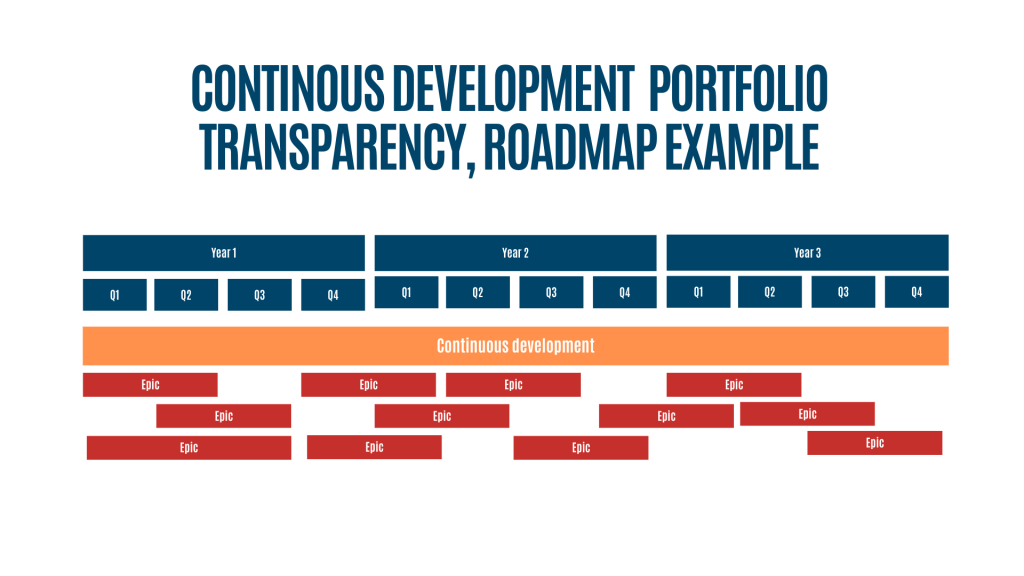
Creating transparency on continuous development roadmap in portfolio level – Epic term from Scaled agile framework may be useful Great Lean portfolio management practices for hybrid portfolios
Scaled agile (SAFe) includes an extensive framework of practices for lean portfolio management. Here are couple of practices, which I feel work very well even for hybrid portfolios, have a look!
- Portfolio vision & canvas
- Strategic themes
- Quarterly portfolio reviews
- Epics
- Measuring portfolio performance
- Forecast and budget dynamically
- Guardrails for financial decision making
- OKRs (see the previous post about OKRs for development portfolios)
If you have good tips to share for managing hybrid portfolios, I would love to hear from you!
-
Closing the gap between strategy and development portfolios using Objectives and Key Results (OKRs)
It is the time of the year, when organizations and teams start to work with yearly planning. One of the challenges many organizations struggle with is the gap between strategy and development portfolios – something seems to be missing between!
Ensuring strategy implementation via development portfolios challenging in many organizations
The challenge is often threefold. Strategy teams deploying company strategy may be struggling with how to measure and follow up on strategy progress – are we on a right track and what is happening in development portfolios? Portfolio owners and managers may be struggling with what the strategy actually means for our development portfolio – is it concrete enough to guide development prioritization decisions? And as a result, if no clear portfolio-level prioritization is provided, development teams and experts tend to have too many things ongoing and lack focus.
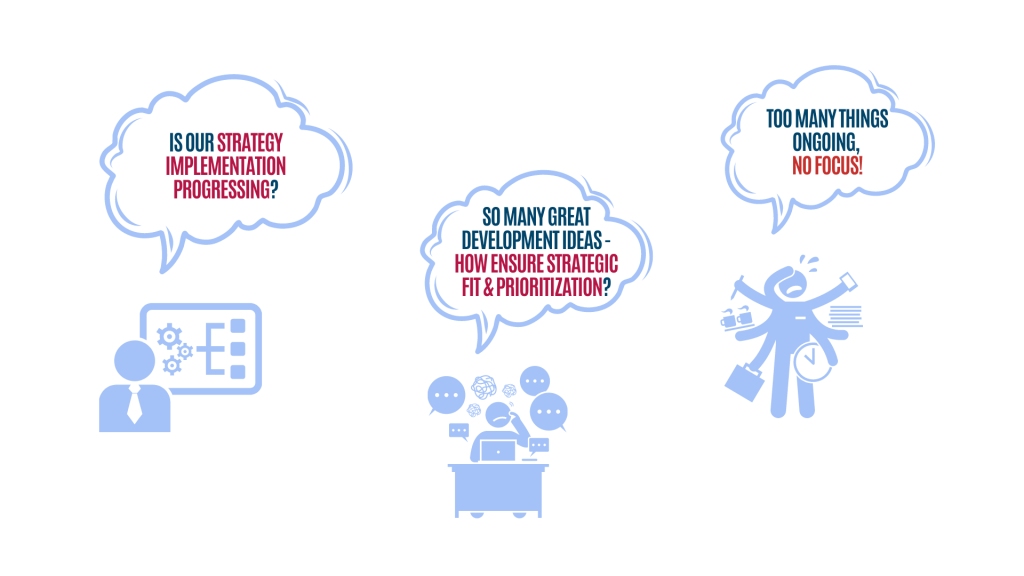
Challenges in many organization – strategy progress follow up is difficult, development portfolio is not fully aligned with the strategy and too many things ongoing – development teams lack focus There are many great approaches to take strategy into action, such as strategic goals or themes, must win battles, hoshin kanri, and strategic transformation programs. One practical tool to close the gap between the strategy and development is Objectives and Key Results (OKRs). OKRs are part of lean and agile tool box and also Scaled agile framework, but also a great tool for any development portfolio.
I had a great opportunity to learn about OKRs last year, when we were deploying OKR practices with different development portfolios and teams in a global company. Thank you so much for Mirette Kangas and different portfolio teams for the great learning journey! I will go through some of the key learnings here:
What are Objectives and Key Results (OKRs)?
The idea with Objectives and Key Results is easy and intuitive – we define inspiring objective combined with measurable key results.
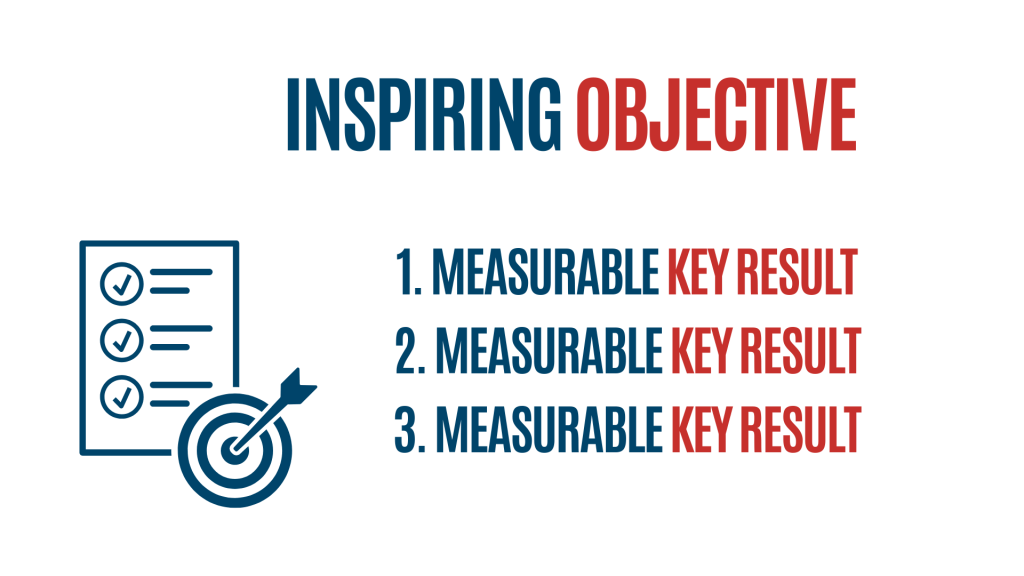
Objectives and key results (OKRs) – Inspiring objective with concrete measurable key results What should Objective look like?
- Inspiring – this is what the bright future looks like for us!
- Ambitions – stretching our comfort zone, we are really proud to achieve this goal!
- Concrete and action oriented
- Only 1-3 objectives (max 5) to create clear focus
- Linked to strategy, vision and mission
- Short and and precise
- Can be defined for a specific time, e.g. quarterly or yearly based on portfolio needs
How about Key results (KR)?
- Defining, how to get to the objective
- Measurable (number, yes/no…), baseline and target defined
- 1-3 key results to be defined per objective (max 5)
- Defined typically together with the team
- Owner defined
- Linked to portfolio initiatives and tasks, but NOT a task or project
- Often defined for per quarter, but also yearly cycle may work well in portfolio context
Feedback loops – this is where the magic happens!
There is a great value in OKR definition – OKRs can be used for inspiration, communication, and alignment. However, the real value comes from the regular feedback loops – how are we progressing and are we doing the right things to achieve our Key results? OKRs should not be yet another thing, but they should be included into the standard meeting agendas to be followed up systematically.
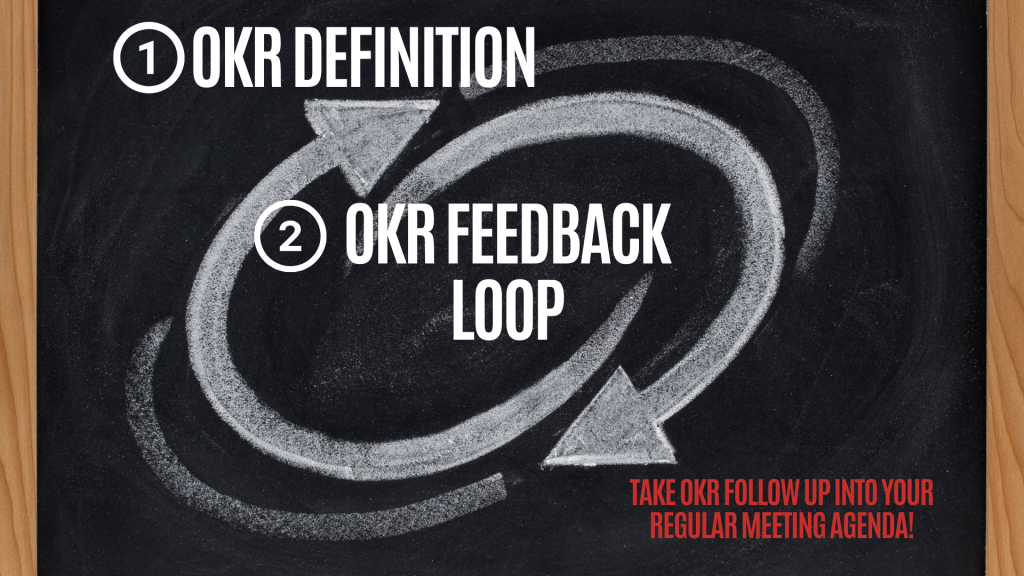
OKR definition and feedback loops – taking OKR follow up into regular meeting agenda How can you link OKRs to a development portfolio?
Objectives and key results may be defined for a development portfolio to create clarity and focus and support with the prioritization decisions. Clear portfolio level objectives are an important tool for communication towards development teams, but also to create alignment across business units and portfolios. Key results on the other hand are extremely powerful tool to measure how we are progressing during the year – are we achieving our key results or would we need to take special actions?
Often, OKRs may be really helpful also for large transformation programs – what does to good look like for us and how do we measure it in practice. OKRs may be also a great tool for unit, team or individual levels – just to ensure, there are not too many OKRs defined for the same scope or content to avoid confusion!

Objectives and key results (OKRs) for different levels – Portfolios, programs, or teams One of the challenges I have had when defining OKRs is that I start to think immediately about practical projects or tasks – of course, that is part of my profession! However, I try to think key results more from the outcomes view point – and then link actual development on how do we implement our key results. If work cannot be linked to any of key results – is really needed in the portfolio scope?

Objectives and key results (OKRs) & Development portfolio How to get started?
- You can try out OKRs for your personal development – it is a great tool to really think what you want to achieve, and how you would know if you are there? Have regular feedback loops to see if you are going to the right direction. Learn and fine tune your OKRs!
- Defining great OKRs takes time and usually several iterations – allow time for learning with your team
- If you are implementing OKRs within your organization, start with one area or unit, gather learnings and scale up based on the learnings
- Include OKRs as a part of normal governance and meeting routines – this is how feedback loops will not be forgotten
- OKRs can be really simple and elegant, do not make it too complex or scientific!
Do you want to learn more?
If you want to learn more, would recommend for any leader Measure What Matters by John E. Doerr!
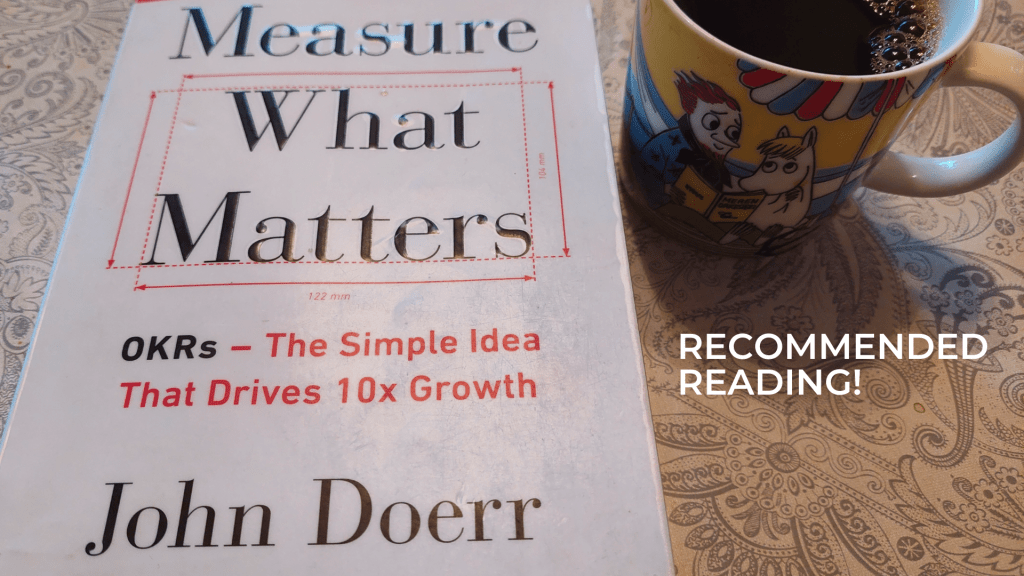
Recommended reading: Measure What Matters by John E. Doerr Applying OKRs in the Scaled Agile Framework
For Finnish speaking colleagues a really nice book also available by Juuso Hämäläinen and Henri Sora: Strategia arkeen OKR-mallilla
For inspiration, a bit longer video: How Google sets goals I will consolidate later also learnings from some case studies. Here are couple of academic studies which might be interesting:
Using OKRs with Balanced Scorecard
OKRs as a results-focused management model: a systematic literature review
John Doerr TED Talk (11 min) – check this out! -
Developing strategic portfolio management practices step by step

Strategic portfolio management maturity model
I have been looking for a maturity model to assess strategic portfolio management maturity to identify easily what would be the key development areas for an organization. Traditional project portfolio management seems to be quite well studied, and I liked for example this one: Project Portfolio Management maturity model, also Gartner’s Project portfolio and program management maturity model gives really good insights. However only project portfolio management is usually covered and for Strategic portfolio management, I have not found a good one yet. But if you have identified one, I would be really happy to share thoughts with you!
As a part of my academic study, I have been consolidating best practices for different Strategic portfolio management capability areas and this actually lead me to think about what maturity model could look like. This is a lot of fun, as there are so many great practices to explore and I have tried out many practices during the past years, and also learned a lot during my academic interviews.
I will introduce also here some of the thinking behind:
Maturity levels – improving maturity step by step
Organization cannot jump from beginner level to world class – finding the best practices for your organization and implementing the practices requires many small implementation steps, discipline, change management and courage – but it is worth it! Here is my current thinking, what different maturity levels could look like:
BEGINNER – Organization has started to implement basic portfolio management practices. Importance of portfolio management has been recognized by the leadership.
FOUNDATIONS – Important foundation elements of strategic portfolio management and systematical ways of working are in place. Clear priorities create clarity and focus across organization.
ADVANCED – Transparency is created across stakeholders, portfolio is prioritized regularly, and capacity and dependencies are managed efficiently. Common tools and processes are used systematically across organization. Feedback is systematically collected to develop ways of working.
WORLD CLASS – Portfolio is balanced to enable future competitiveness. Practices are optimized across development and product portfolios and organization is continuously learning and improving ways of working.

Strategic portfolio management maturity model – improving portfolio maturity step by step In real life, many companies are in the Beginner level – strategic portfolio management may have not been a priority in the company, even though for example project management maturity may be high and there is a long tradition of managing a project portfolio. Furthermore, within one organization, there may be portfolios with advanced ways of working, whereas one portfolio may be just getting started.
Maturity grid – selecting your portfolio focus areas
All organizations and portfolios are unique – one portfolio within organization may benefit most of setting up capacity management practices, where as another organization may need more structured governance practices.
Maturity level within one portfolio may also vary a lot between different capability areas – some advanced practices may be in place, but some areas may still be in the beginner level. It is good to have a look across different capability areas to see which areas would require development actions and create a concrete action plan. Maturity grid is a useful tool to map out different capability areas, and also identify where you are now, and where you would like to be. Here is an example, what it could look like:

Strategic portfolio management maturity grid – identifying your current state and target state Quick assessment questions
Here is a list of quick assessment question – as a food for thought! In the actual maturity model, there is a deep dive into different portfolio capability areas with more details to define what good looks like.

Strategic portfolio management maturity model – quick assessment If you answered YES to most of the questions, you have many great portfolio management practices in place! Congratulations, that is a fantastic starting point to develop ways of working forward. However, if you answered NO to many questions, that is not unusual either! Many organizations are in the beginning of the journey, and may need some practical help to actually get started.
-
Portfolio data – 5 tips from practitioners
Portfolio data is not something programs, projects and development teams always look forward to maintaining. And to be completely honest, I have been sometimes annoyed with the requests to fill in templates too, when not fully understanding what is it needed for and who actually uses the end results.
Portfolio data should not be only for reporting purposes, it should be used actively – to create transparency, communicate about progress, to have regular feedback loops on reaching objectives, balance demand and capacity, follow up on benefit realization and plan for the next steps.
Portfolio data was also emphasized by experienced professionals I interviewed during the spring and my notes are full of great insights how to make this part more meaningful and easier for development teams, stakeholders and management. Here are 5 tips consolidated based on interview results – I hope these are useful for you!
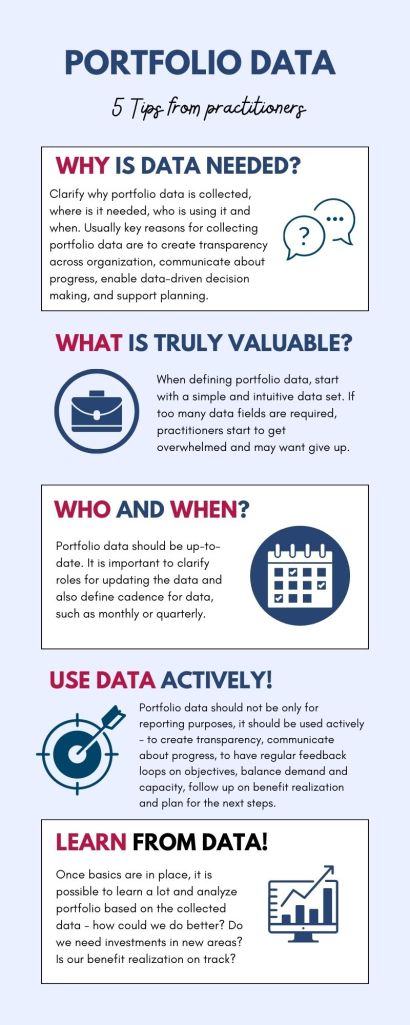
Portfolio data – 5 tips from practitioners! Let’s go through each area in more detail:
Why is portfolio data needed?
Clarify why portfolio data is collected, where is it needed, and by whom and when in your organization. Smart stakeholders working with development teams are more willing to maintain the data, when they understand why it is important!
Here are some key reasons relevant for many organizations:
- Creating transparency across organization – portfolio views are needed in enterprise business, and unit levels as well as for different stakeholder view points
- Communication – portfolio roadmaps, business cases and status updates are important tools to communicate about team plans to a wider group of people. If this data is hidden in slide decks, it may be difficult to manage dependencies across projects and portfolios.
- Data driven decision making – enabling better decisions, when seeing the big picture, understanding business case, risks and dependencies. Decision making is often needed in project, portfolio levels, and solid data is helping out a lot!
- Master data related to projects, continuous development and other work as well as strategic initiatives and programs is important – data, such as project name, should not vary across the systems.
- Balancing demand and capacity – when all demand and work across organization is visible, it is easier to plan capacity and also make better prioritization decision.
- Finances and planning – it is important to be able to forecast and follow up on actions and plan also future horizons (budgeting, long range planning). When portfolio data is up-to-date, budgeting and mid-term or long range planning is just updating plans, not collecting everything from the scratch.
What is truly valuable for your organization?
Often portfolio data sets may grow over time, as a new field is added every now and then – over the time portfolio templates may grow to be too complex – and no-one actually knows why a certain data field is needed today.
- When defining portfolio data, start with a simple intuitive data set. If too many data fields are required, practitioners start to get overwhelmed, don’t know what fill in and may give up. Think, what is truly valuable, and what data is followed up and used actively.
- If you have existing portfolio data, check out if different fields have been filled by practitioners, and if these data fields are actually used by someone. Be brave while leaning your data model! Simple is beautiful! No-one likes a project template filled with unnecessary details, which are nice to have.
- Note! If you need to do special portfolio analysis, you can also collect data separately; no need to have a huge amount of data fields, which you might (or might not) need one day.
Who updates the data and when?
Portfolio data has only little value, if it is not systematically maintained. Roles and cadence for data updates is important.
- Start with the definition: who maintains the data? Clarify the roles!
- What is the cadence for maintaining portfolio data? Many organizations have monthly cadence, but some fast moving areas may need weekly cycles. Also quarterly cadence may make sense, if organization does not have all portfolio management roles filled and if quarterly cycles are natural for the organization.
- Follow up – this is especially important at the beginning, when getting started with your portfolio data. Regular reminder and practical support sessions may be helpful, when getting started!
Use portfolio data actively – think about different use cases!
Data should not be only for reporting purposes, it should be used actively – to create transparency, communicate about progress, to have feedback loops on objectives, balance demand and capacity, follow up on benefit realization and plan for the next steps.
- Learn what works best for your organization – hear out what needs different stakeholders have!
- Think about different use cases and different roles using data – how to create transparency and different portfolio views?
- Avoid extracting data to static reports as it gets outdated fast – use tools and reporting capabilities as much as possible.
- Avoid having the same data in many different systems or tools, unless they are integrated, and one of the the systems is master. It is really difficult to maintain the data in many sources!
Learn from data – how could we improve?
Once basics are in place, it is possible to learn a lot and analyze portfolio based on the collected data.
- How could we do better? Do we have challenges in portfolio execution or managing our idea funnel?
- Are we achieving our objectives as planned?
- Is our benefit realization on track? Are we achieving our objectives as planned?
- Do we need investments in new areas? Is our portfolio balanced, or do we focus too much on keep the business running activities?
I would love to hear your pro tips how to make portfolio data easier to keep up-to-date and more helpful for different stakeholders!
-
Development Portfolios In Large Companies – What Is Your Viewpoint?
When discussing about development portfolios, there are many different viewpoints and expectations among the stakeholders – which leads often to misunderstandings. I will try to open up some of the most common viewpoints here: strategic portfolios, project, and hybrid portfolios, work portfolios from the unit perspective, enterprise view to portfolios, and also other portfolios which are connected to development!
Expectations and interests vary based on the role of the stakeholder. Here are some themes, which are often discussed in this context:
What people think when discussing about development portfolio management? Strategic portfolio – transforming company towards the bright future
In many companies, strategic development portfolios are the vehicle to transform company towards the bright future and implement strategy in practice. Strategic portfolios may be inventing new business models, building new products and offerings, transforming organization, implementing changes to operating model, developing IT tools and capabilities or improving business processes, sales and operations. Portfolios may be organized around sub portfolios for different business functions or directly into transformation programs, strategic initiatives, projects, epics, value streams or must win battles for example.
Managing a strategic portfolio is challenging! How to select the best ideas for implementation? How to ensure portfolio is balanced – there is enough focus also to future horizons? How to follow up systematically business case and benefit realization? One strategic transformation program may include work from many different organizational units, such as business development teams, R&D and IT units, marketing and finance functions. Even though strategic portfolios are usually business driven, many other organizational units are working hard to make strategic initiatives happen!

Strategic portfolio view – Strategic portfolios may include sub portfolios for different business units, but also transformation programs, strategic initiatives, value streams, projects or for example must win battles. From project portfolios to hybrid portfolios
Many companies have long traditions of managing project portfolios. Project portfolios include typically a collection of individual projects. Portfolio decisions are managed via gates and also financing is usually linked to gate decisions. Projects have been traditionally implemented with a waterfall based development model, but today, many companies execute development with agile ways of working. The project portfolio is often looking into projects of one unit, for example, a business unit, R&D, or IT unit. Project portfolio management creates great structure and visibility, and is still a relevant approach in many cases.
Today, in addition to development projects, agile initiatives and continuous development teams have become more and more popular. Quite often, project is developing and new IT solution and ramping up continuous development capabilities. After the project has delivered and deployed the new solution across organization, continuous development will take place. Portfolio including projects and agile work & continuous development may be considered a hybrid. Sometimes it is tricky to manage a hybrid portfolio, when ways of working, financial practices and governance varies in projects and agile work. More about hybrid portfolios via the blog post: From project portfolios to hybrid portfolios combining projects and agile work!
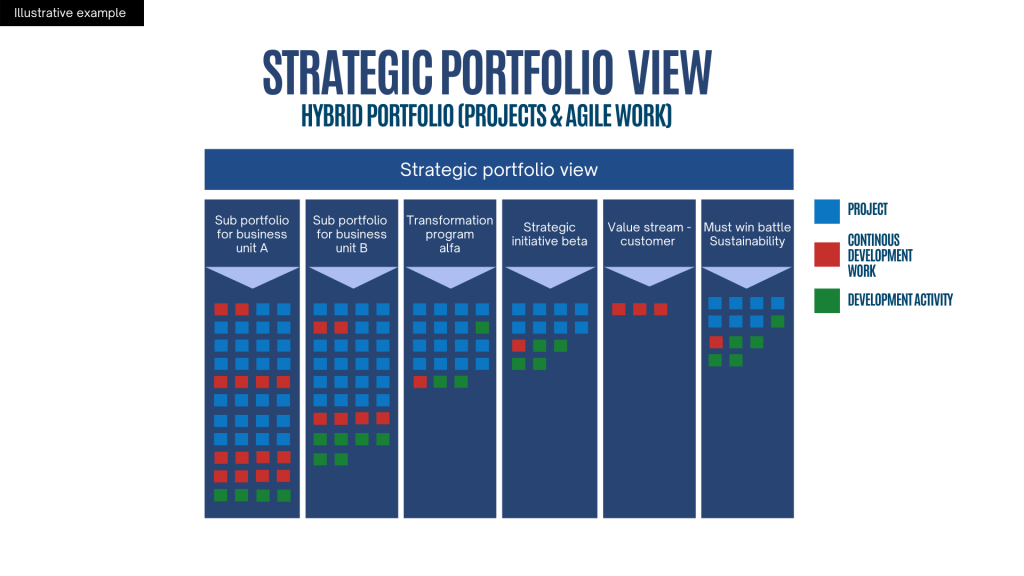
Hybrid portfolios may include traditional projects and also agile work, such as work from continuous development teams or value streams. Work portfolio view – unit view to all projects, continuous development and other large activities
Many global functions, such as marketing, R&D, IT, or finance may be struggling, when demand is coming from different business units, portfolios, and transformation programs at the same time. One solution is to create a work portfolio view – a collection of projects, continuous development work, and other larger activities delivered by the unit. Some units create visibility to their work items via portfolio management tool roadmaps, and some may prefer Kanban or backlog management tools for visual management.
Work portfolio view may be really helpful, when organization needs transparency and prioritization on all work coming from many different strategic initiatives and business units. Work portfolio transparency may also help business portfolios in many ways – business teams are able to see what type of IT developments are happening in other business units and may find synergies. Transparency is helpful when prioritization is needed – is it possible to sequence work, manage dependencies and do work creating most value first?
Strategic portfolio and work portfolio views are not in conflict with each other – they are just different view to the same work to create transparency. If priorities are clear in strategic portfolios, it is easy to prioritize the work portfolio also. Also teams and team members love it, when there are clear priorities and focus – less hassle and faster time to market for the priority items!
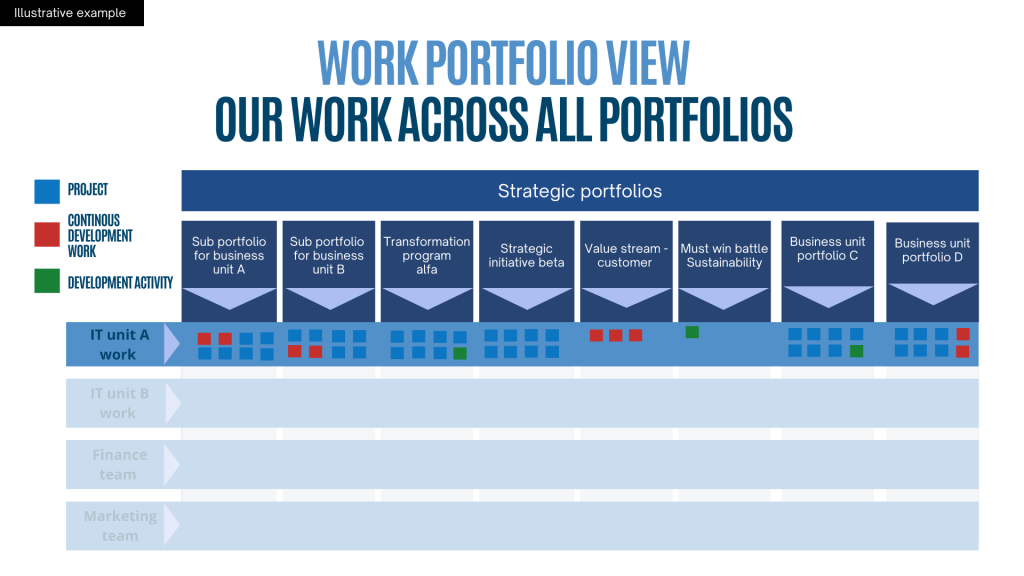
Work portfolio view – Projects, continuous development work, and larger activities unit is responsible for – work items may belong to different strategic portfolios. Enterprise level view – how is our strategy implementation progressing?
Many companies want to follow up on strategy progress happening across different portfolios – are we taking strategy into action across the company? Sometimes it is also good to look across all strategic portfolios to optimize strategic initiatives – how do we best deliver value to the customers, are there synergies or major dependencies? Should we sequence some of the largest initiatives, to ensure the organization is able to adapt to the change? Also, common planning and budgeting processes, and cross-portfolio reviews may help to manage dependencies across global portfolios.
In many cases, it may be difficult to create a holistic view across all portfolios. Different portfolios may have different tools and practices, and consolidation in the enterprise level may take a lot of time.
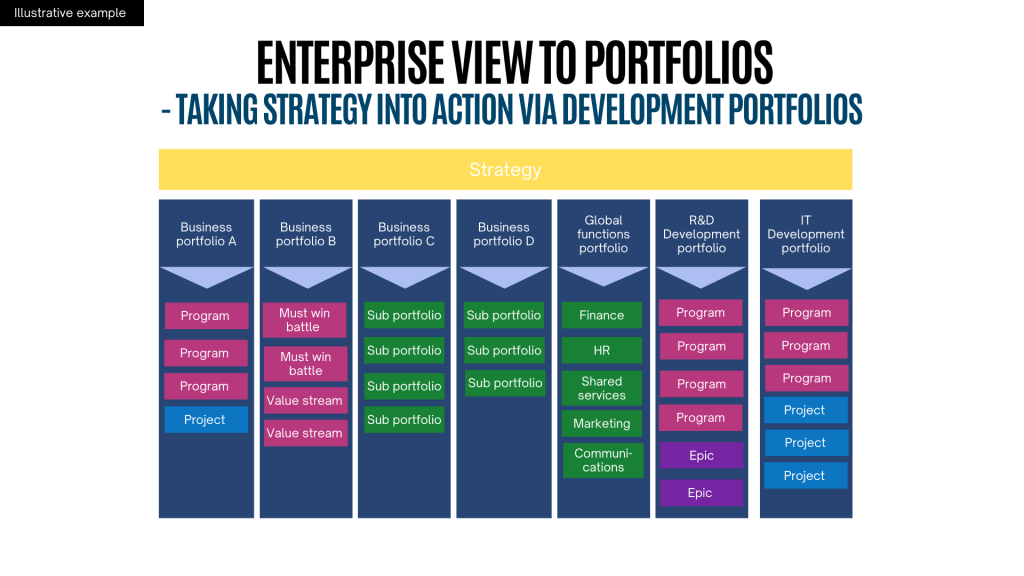
Enterprise view to portfolios – how is our strategy implementation progressing? Portfolio structure vary from company to company. From projects to products – offering and product portfolio & application portfolio
Today, many teams have moved from developing via projects to developing products. Also in the context of scientific literature, new product portfolio management is an own field of study. Product development teams are introducing new products, features, and functionalities via regular product releases – there may be physical hardware components, software, and services included. The product portfolio is also linked to product life cycle management – new products are introduced and old ones are retired. In parallel to product portfolio, business teams are also looking into offering portfolios – how to price, sell, package, and servitize products. Both viewpoints are closely interlinked – even though you would have a great product, it will not be successful without systematical commercialization work!
In the context of IT, also application portfolio is an important outcome of development portfolios. Large companies may have hundreds of applications, and application portfolio may be growing all the time – creating also additional run costs and also capacity needed to further develop and maintain these solutions. Continuous development teams may also be extremely important contributors to strategic initiatives – sales tooling solution team could for example enable a new pricing model for upcoming offering launch! Even though each continuous development team manages their backlog, creating visibility to big ticket items or epics continuous development teams are working focusing on relevant also in portfolio level.
You can read more about product and offering portfolios via the Blog post: From project portfolios to product portfolios – focus on development outcomes!
Still some other portfolio viewpoints…
I will still list some other important portfolios linked to development very shortly:
- Even though customer deliveries are not directly development focused, sometimes special customer cases may also require product, supply, or operations development. The customer delivery portfolio has also a close linkage to product development – new features, solutions or services need to work with high quality for first customer deliveries.
- Factory units are managing portfolios of investment projects. Large transformations programs or new product development may also require physical investments, such as factory or property investments.
- Technology and patent portfolios are also linking closely to R&D and IT development.
- New innovations may be managed as a part of strategic portfolios, or as a dedicated innovation portfolio looking into future horizons.
- Also when working with strategic partners or building a partner ecosystem, partner portfolio plays a key role.
- Sourcing teams are managing vendor portfolios.
- Six sigma project portfolio – super valuable development ideas for development portfolios!
- Lean portfolio management – fully aligned approach with agile ways of working has been successfully implemented also in many organizations. If you have experiences on how this works in practice, I would love to hear about your practices!
- Last but not least, in addition to global development portfolios, also local units may need to manage their own local project portfolios – there may be local developments and global rollouts happening.
No wonder there is a lot of confusion among the stakeholders, as there are so many development related portfolios and different viewpoints.
I would love to hear, what viewpoints are relevant for you? Did I miss something critical? Do you use completely other terminology for some of these viewpoints?
-
Portfolio management challenges – what is new?
One of the classic portfolio management articles (Cooper et. al, 1997) analyzed portfolio management challenges many companies struggled with. Here is the top 5 challenges identified:
- The portfolio of projects does not reflect the business’s strategy
- Portfolio’s quality (performance of projects) is poor
- Go/Kill decision points are weak and Poor projects are not killed
- Resources are scarce, and there is lack of focus
- Too many trivial projects and too few projects aiming at real breakthrough
After 25 years, these challenges are still relevant for many organizations. It is still difficult to prioritize portfolio based on the strategy, portfolios still tend to have bad projects or agile initiatives, it is still extremely hard to kill projects, it is still difficult to prioritize and it is still easy to select quick wins over initiatives to build future competitiveness. Good food for thought for any practitioner!
What are the key challenges today?
During my interviews with experienced portfolio management professionals, classic challenges mentioned above were highlighted many times. But also many things have changed since 1997. Here is a collection of challenges many organizations may identify today:
A. Hybrid portfolios including projects and agile initiatives are difficult to manage – instead of managing traditional project portfolio, portfolio may include a mix of projects and agile initiatives with different ways of working. Many organizations have traditional planning, budgeting and governance processes, but part of the organization is rapidly transitioning towards Lean and agile ways of working. (Read more via dedicated blog post: From project portfolios to hybrid development portfolios combining projects and agile.)
B. Creating transparency across organization – managing dependencies and complexity. When products and services, processes and tools have become more and more complex, managing development and deployment of complex hardware-software-services solution requires a lot of alignment and communications across the organization.
C. Managing capacity for strategic initiatives hard, when development work needed from many units. Within large organizations, strategic transformation initiatives my require work from many units: different business units, R&D units, IT teams, global functions, sales organizations, and operations.
D. Portfolio priorities not up-to-date due to rapid changes in business environment. During the past years, business environment has changed rapidly for many companies. If portfolio priorities are not regularly reviewed and updated as needed, development portfolio may have
E. Lack of investment into future horizons and innovative solutions – portfolio not balanced. As development is the way to build the bright future and meet strategic targets, enough development capacity should be allocated to build future horizon competitiveness, not only focus on quick wins. (Read more via dedicated blog post: Is Your Development Portfolio Balanced Across Time Horizons?)
And then one more bonus challenge, which is also relevant for many organizations:
Bonus: Portfolio management fundamentals – improving organizational maturity across all portfolios. Good portfolio management practices help organization to make data-based decisions and created transparency and focus – if fundamentals such as processes, governance, discipline, communication and common tools are not in place, or each unit has different practices, managing portfolios may become difficult. (Read more via blog post: Developing Strategic Portfolio Management Maturity Step by Step)
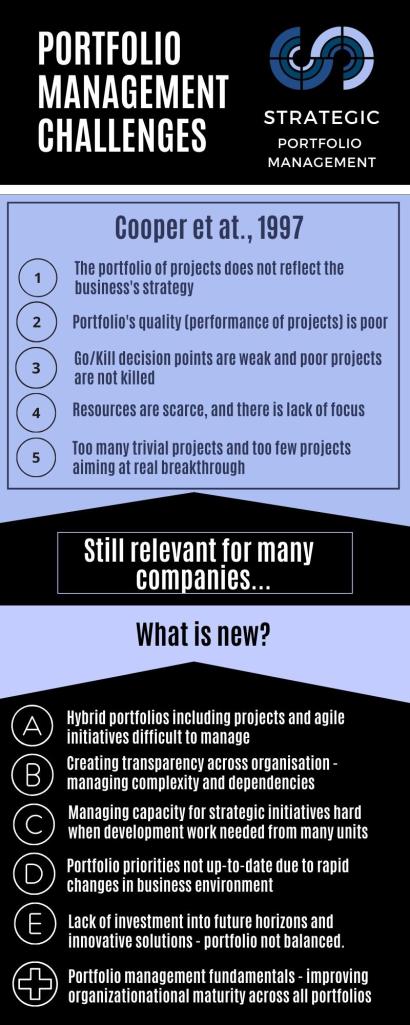
Portfolio management challenges – and what is new? Do you relate to these, or do you have other challenges?
References
Cooper, Robert G., Scott J. Edgett, and Elko J. Kleinschmidt. “Portfolio management in new product development: Lessons from the leaders—I.” Research-Technology Management 40.5 (1997): 16-28.
-
Strategic portfolio management – WHY?
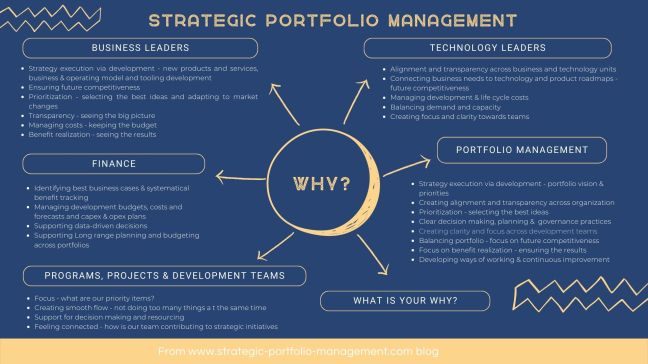
Sometimes, when discussing with development teams and other stakeholders, value of portfolio management is not fully acknowledged. Portfolio management may be considered as additional bureaucracy with no value add – budgeting, steering meetings and requests to update data.
However, if portfolio management is not efficient, people start to notice something is not quite right: too many initiatives ongoing at the same time, parallel projects ongoing in different departments with the same content, and development seem to be overall a bit chaotic.
This blog is dedicated to why strategic portfolio management is important – six key WHYs highlighted. I would also love to hear your thoughts via comments to understand different viewpoints – do you agree?
First of all, development is the way to transform company towards the bright future – to truly take strategy into action! If development portfolio is not aligned with strategic goals, strategy implementation is not likely to be successful.
Portfolio management should always be a continuous activity, and prioritization should not be one-time-activity during the budgeting season. Portfolio should always include the most valuable initiatives – continuous prioritization needed when business environment changes. Also sometimes we start a super promising project, but notice our assumptions were not right – project should be killed or rethought.
Smart people tend to contribute to a large amount of great development ideas – one of the key challenges of portfolio management is to select the best of best ideas. Development ideas may come from many different stakeholder groups – business teams, product development, operations, sales teams or from customers – and they may be small and large ones. Portfolio management may help to solve this challenge – setting up portfolio funnel to systematically collect, evaluate, experiment and prioritize development ideas.
Many teams struggle with having a lot of work coming from many different directions – if teams do not know key priorities, they may spend most of their valuable time on activities, which are not high priority. Also having too much to do starts to be very stressful in long run. Clear strategic portfolio priorities help teams to focus on most important initiatives – less hassle and faster time to market!
Also in the company level, there may be too many large transformations ongoing – money may be one limitation, but also time of best professionals and organization’s ability to adapt to change may be limited. Alignment across business and technology units and optimizing the sequence of large initiatives based on available capacity is important. Brave leadership is needed to prioritize and sequence large initiatives – but this really pays off.
Defining business cases and finding great KPIs to follow benefit realization is never easy – however, if this part is missing, how would we know if we are investing in correct initiatives? Strategic portfolio management has focus on business benefits across all initiatives – systematical benefit tracking is in place.
Last but not least – it is easy to say yes to quick wins – developing existing process or tool, where you see the benefits almost immediately. Continuous development is super important, but there should be a balance: balancing portfolio to including initiatives for different time horizons – also enough focus on future competitiveness.
One extra: one of the areas creating a lot of headache in many organizations is governance – some organizations have too many or too large steering groups and unclear roles, where as some other organizations lack of key governance structures to enable smooth decision making. One of the key goals of portfolio management is to create clarity on decision making – there should be simple but powerful governance, empowering also teams.
What is your WHY – why is portfolio management important to you or your organization?
Here is a summary – I hope it helps!
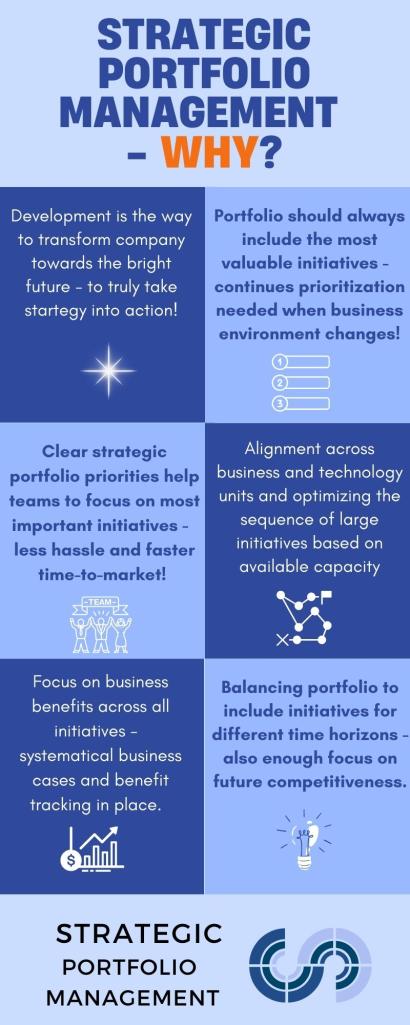
Strategic portfolio management – WHY? Different roles and stakeholders – why?
When discussing with different stakeholder groups in large organizations, each of the stakeholder group have different needs and expectations in terms of portfolio management. When you are discussing portfolio management with different stakeholders, it is good to discuss what is the why for them – this is how you can also support different stakeholder groups. Here is a summary of WHY for couple of key stakeholder groups:
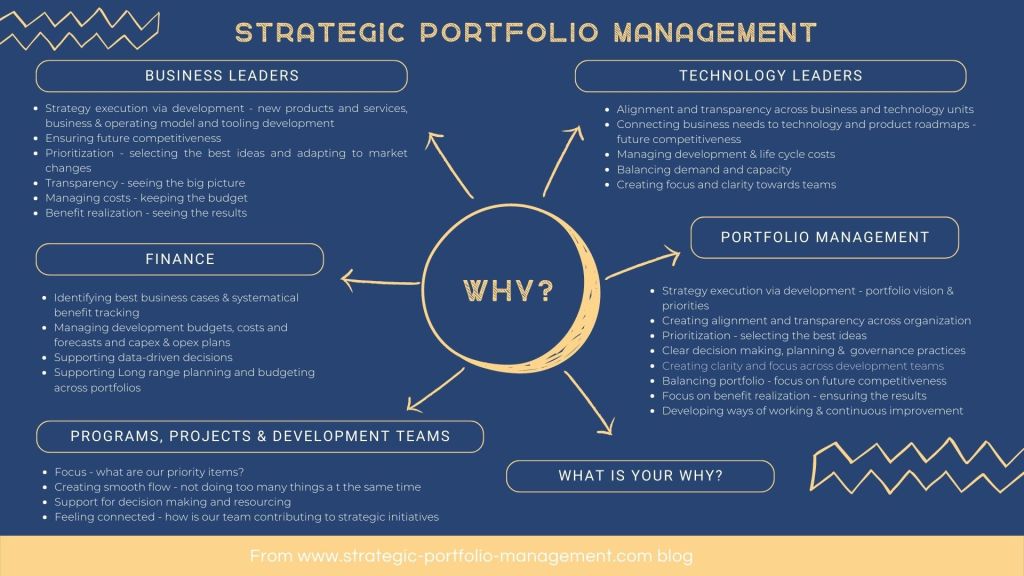
Strategic portfolio management – WHY for different stakeholder groups. What is your WHY? Check out a short video for further inspiration!
Strategic portfolio management – WHY? Video for inspiration
I would love to hear your thoughts!
Each organization and portfolio are unique, and have different flavors. Is your why included, or did I miss it? Why is portfolio management important for your stakeholders.
-
Portfolio management tips from professionals
As a part of my research, I had an opportunity to interview more than 20 portfolio management professionals from different companies. Interviews were full of great insights and learnings. I will share with you a consolidated list of tips, which were highlighted by these professionals.
Do you agree, or would you have something to add?

Portfolio management tips from professionals -
Welcome Strategic Portfolio Management Blog!
My name is Heli Hiisilä, and I want to share my learnings from both practical experience in big companies, but also learnings from my PHD research and literature!


Strategic Portfolio Management
Taking strategy into action via development portfolios – sharing best practices via a blog
 Strategic Portfolio Management