-
Designing Development Portfolios in Enterprise Level – What is your approach?
New business strategy, big organizational or operating model change, or merge of companies may lead to a need to redesign the development portfolio structure. Also, the introduction of Lean and Agile ways of working may impact portfolio design. Let’s check out different options for Enterprise level designs, and also some key topics to consider when planning the setup:
Portfolio structure based on business units and functions
A common way to get organized around development portfolios is to organize development into development portfolios owned by different business units and functions. This has been also a traditional ways within project portfolios – different units manage their own development portfolios taking business unit strategy into action. With large businesses, portfolios may be also slit to sub portfolios owned and managed by different departments, as the development content may vary a lot. Within business portfolios, development may be organized around projects, Programs, strategic initiatives, such as Must win battles.
Also global functions, such as HR and Finance often have own development portfolios, developing cross business capabilities. When the development is organized based on the ownership of work, also R&D and IT have their own development portfolios.
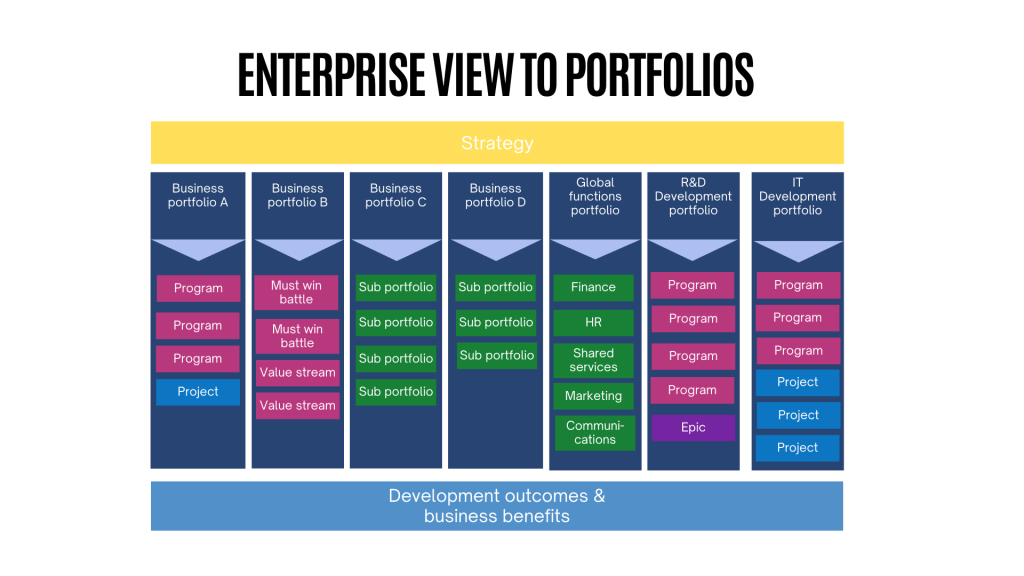
The model where development is organized around units works well, when each unit have clear roles and responsibilities in the strategy implementation, and development content does not typically requiring work from many other units.
Key points to consider in the enterprise portfolio level: is development happening across different unit portfolios aligned to take the strategy action optimally? Is there enterprise level transparency on key initiatives? How do you follow up on strategy implementation?
Let’s check out also other ways to get organized!
Cross organization transformation programs
When developing content which requires contribution from many different units and teams, there is no single clear owner in the organization and development outcomes impact the whole company, a common approach is to get organized around cross organizational transformation programs. Typical examples of such implementations may be for example ERP or CRM implementations impacting business processes, operating model and IT solutions for many different units.
Setting up governance, resourcing and way of working for such transformation programs require a lot of alignment – how are each unit contributing with the resourcing, who makes the decisions, who has the budgets? Do you have an enterprise level portfolio for these strategic transformations, or is one of global organizations owning the initiatives?
Key points to consider in the enterprise portfolio level: are several large transformative initiatives ongoing at the same time, and could the initiatives be sequences to ensure success of critical ones? How do you manage the governance to make transformation successful?
Value stream based portfolio structure
Today more and more development is organized via agile development. I happed to check out Scaled Agile Framework 6.0 last weekend, and there was a really nice Portfolio site added to the framework: Portfolio – Scaled Agile Framework. In the Scaled Agile Portfolios, development is organized around Development Value streams, and portfolios are organized around value. I like the thinking, to optimize the flow – however, this is a big change in thinking from the traditional way of organizing development into unit or function development portfolios. There are great examples, among others of business unit, regional or innovation portfolios within the sites, so check it out, if this is useful for you.
Key points to consider in the enterprise portfolio level: how is agile development visible in your development portfolios? Are you organized around value or around functions?
Optimizing the use of capacity
One of the key challenges for many professional development organizations, such as IT teams and R&D is how to optimize the use of capacity. Especially in the models, where IT development is distributed in many different business unit organizations, there may hundreds of projects ongoing with different types or resourcing needs from the same teams – and the there are typically few experts who’s contribution would be needed in many projects at the same time. How can a resource manager make the decision which initiative should get the results? Is it based on who shouts loudest?
Key points to consider in the enterprise portfolio level: how do you create transparency and prioritize work from different portfolios? Do you have too many smileys in the pipeline, considering the expert resources you have?
Managing cross portfolio dependencies
When development is happening in multiple development portfolios simultaneously, there is a danger of developing simultaneously similar solutions without alignment – leading to waste. There may be also complex dependencies between different initiatives, via common enablers, shared technical components or key resources. Creating transparency and alignment may require sharing sessions, discussions and sometimes also common portfolio management tools may also help.
Also enterprise architecture team plays a key role here – when the development is becoming more and more complex, someone needs to look into the solutions at the company level – to find synergies, to use common building blocks, and to avoid sub optimal solutions.
What does enterprise architecture have to do with enterprise level portfolios? Well, today, when development content has become increasingly complex,
Key points to consider in the enterprise portfolio level: Are development portfolio dependencies managed actively to see synergies between different initiatives? Is enterprise architecture team looking across all development portfolios to ensure smart decisions for the whole organization are made when developing IT and digital solutions?
Recommended reading
Portfolio – Scaled Agile Framework
You might be also interested in one of the previous blogs:
Development Portfolios In Large Companies – What Is Your Viewpoint?
Finding The Balance – Centralized vs. Decentralized Portfolio Management
-
Managing offering portfolio – boosting existing offering or develop new offering – or both?
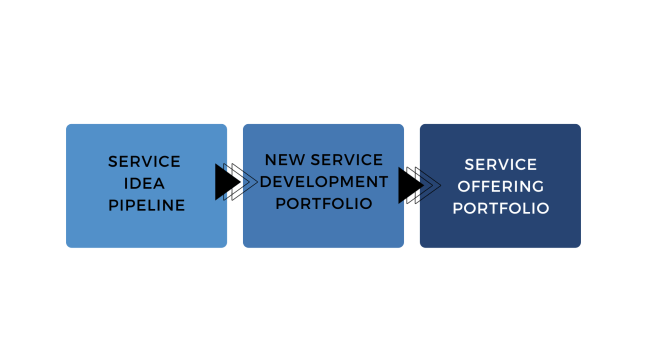
I have had great discussions with peers in different companies related to service offering portfolios, and I have noticed there are truly many viewpoints to offering portfolios.
Teams focusing on development usually think more about the New Offering Development Portfolio – what are the new offering development initiatives teams are focusing on? Also there are brilliant development ideas from many different sources in the Idea pipeline to develop new service concepts or to further improve current offering with new features. When discussing with the sales and operations people, focus is naturally on available customer offering portfolio: what can we sell for different customers segments and in different geographical areas? How do we bundle offering – what to sell together?
Here is how I have structured this portfolio funnel based on the literature, but also based on practical experience:
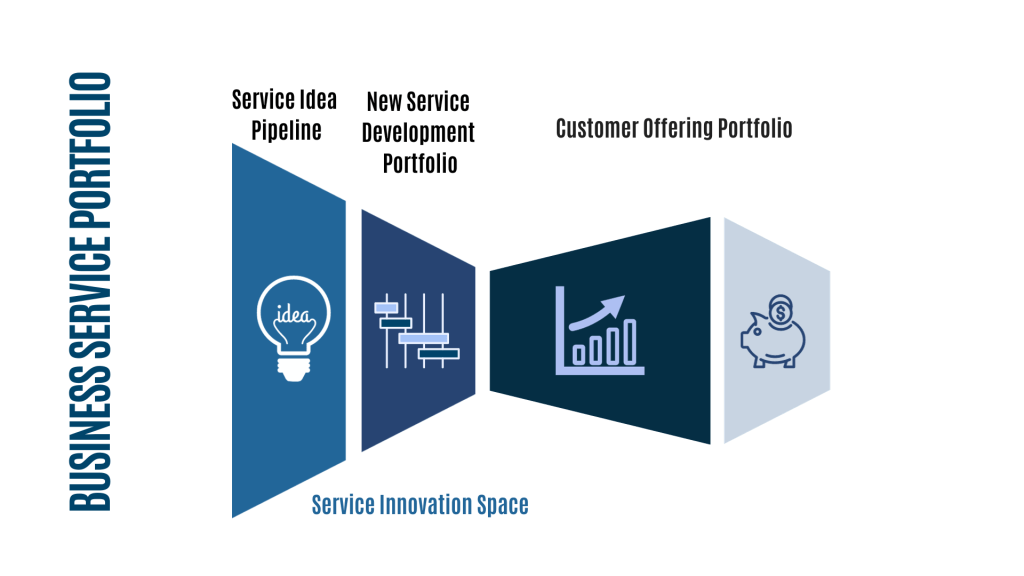
Service Idea Pipeline
Service innovation space was already covered in detail in the previous blog post: Exploring Service Innovation Space.
Based on the studies, the ideas for new service offerings may be originated form many different sources: from customer co-creation and feedbacks, from the sales teams actively meeting the customers, from the operations delivering the service, or any other internal stakeholder groups, partners or even from regulation or legislation. To capture systematically these ideas is critical – otherwise your next 1 billion opportunity may be lost.
Capturing the idea into innovation tool or backlog is not enough – the idea requires analysis – do we have be business case, is the idea aligned with the strategy, and how the idea could potentially be implemented? Here are few good practices, which are
- Collect actively development ideas from many different sources: customers, partners, service delivery organization and operations, sales, R&D and other stakeholder groups.
- Consider both incremental development ideas of existing services, but also new innovative ideas which could lead to new service concepts within your organization.
- Create a funnel for development ideas to see in which phase idea is – this is really important to manage the expectations – you don’t one anyone to start to sell something, when idea is still just an idea.
- Be willing to kill your darlings – one easily falls in love with the idea team has worked hard on – however, if you cannot find business case or strategy fit – idea should be killed or parked to be consider in the future.
New Service Development Portfolio
Within New Service Development Portfolio, we should see all service development initiatives, which are under development. There may be large development initiatives, such as development programs requiring work from many different teams and units, but also smaller incremental development activities to improve the existing services.
Good practices:
- Create transparency on service development activities. Projectize the service development, as you would do for new product development. In many organizations, service development is incremental and not fully visible in development portfolios. Projectized approach helps to create transparency within the organization on status and readiness of service development. If you develop services via continuous development teams, that is equally ok – create transparency via portfolio epics or other means.
- Also services require systematical productization and commercialization – in order to develop a scalable service, one needs to carefully understand customer value proposition, define the processes and way of working for the service, train the organization, and often also develop supporting IT tooling. Usually this is more work than anyone anticipated, when kick starting the project!
- New Service Development differs from the New product development – fine tune your service development process to enable iterative learning, customer engagement and flexibility in decision making. Read more here: Developing new products and services – are there differences?
- Don’t forget deployment – when you have invested so much on service development, make sure you pay enough attention on engaging the whole organization, so that the sales is capable to sell new services, delivery organizations knows how to manage delivery and commissioning and operations have smooth processes for running the services. Create feedback loops to improve the services based on the learnings!
- Check out also tips for go-to-market: 5 ways to improve go-to-market of new offering.
Customer offering portfolio
In customer offering portfolio, we may have a wide range of available offerings towards customers, depending on the size of your portfolio.
Here are few topics to consider for the existing offering portfolio:
- Creating clarity towards customers and sales on available offering is critical. There are many ways for creating the transparency, and sometimes also multiple viewpoints may be need. Read more of offering portfolio dimensions in a previous blog post: Ideas To Build Offering Portfolio – Which Offering Portfolio Dimensions Are Relevant For Your Organization?
- Do you have offerings you are still scaling up within the organization? Systematic post-launch follow up is absolutely critical. And not only to passively follow up, but gather feedback from customers, own organization, partners and competition to truly optimize your results.
- Can you create transparency on performance of the offering portfolio? Do you get easily numbers, or would you need to take some actions to improve the performance management across all offerings?
- Do you have retiring offerings in your portfolio? Make also bold decisions to retire offerings, which are not performing as expected or are replaced by a new offering. Maintaining too many services simultaneously requires a lot from the whole organization.
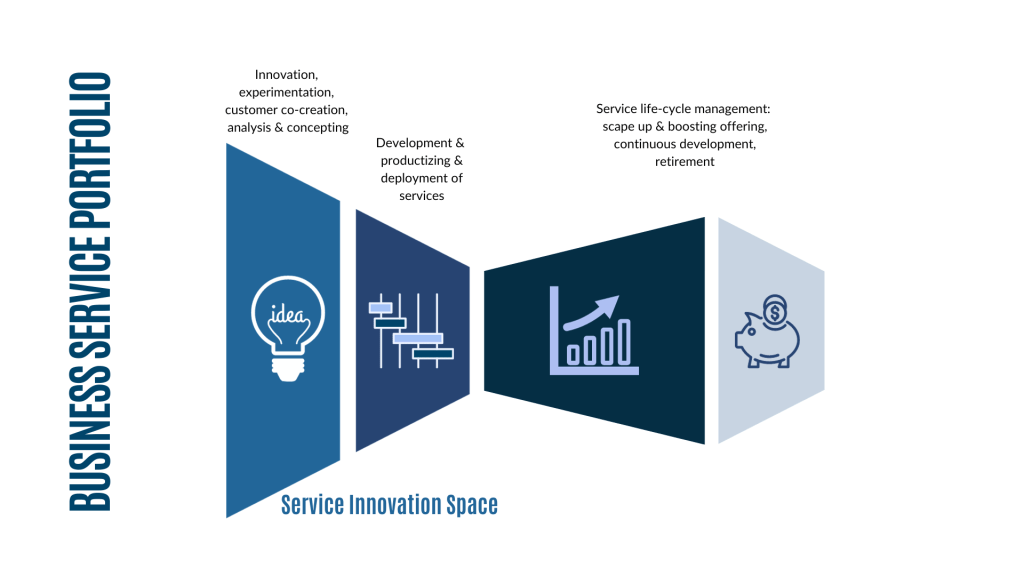
Do you manage a funnel or a tunnel?
One of my most read blog posts has been about managing the portfolio funnel (Do you manage a Portfolio funnel, or Portfolio tunnel?). The same principles apply to the service offering portfolio as for any other portfolio – it is important to look into the different phases of the portfolio funnel, prioritize and create transparency, and not to just focus on one specific part. For me this illustration has helped a lot when we have had a confusion offerings in different phases of the funnel:
As always, I hope this helps! And happy to hear your reflections, both if you agree or disagree on certain parts!
-
Exploring Service Innovation Space – Are you utilizing all opportunities?

Thank you to the network for the engaging discussions centered on service innovation and ideation over the past months. I have been looking deeper into the service innovation space, and I’ve come across some valuable insights from researchers to give food for thought!
What is service innovation?
The service innovation space refers to the activities related to developing and improving services. It involves applying innovative strategies, technologies, and processes to enhance the value, efficiency, and customer experience of service-based businesses.
Service innovation can take many forms and can be applied across a wide range of sectors, including finance, healthcare, retail, transportation, hospitality, and more. The aim is to create new or improved services that meet the evolving needs and expectations of customers while also create business growth and competitiveness.
In the service innovation space, organizations often adopt a customer-centric approach, putting the customer at the center of their innovation efforts. This involves understanding customer preferences, pain points, and aspirations to identify opportunities for service improvement and differentiation. Service innovation unfolds through multifaceted approaches:
- Co-creation: Involving customers and other stakeholders in the service design process to ensure that the final product meets their needs and desires.
- Digital transformation: Leveraging digital technologies such as Internet of Things, artificial intelligence, data analytics, automation, and mobile applications to enhance service delivery, personalization, and efficiency.
- Optimizing processes: Streamlining and improving internal processes to reduce costs, increase productivity, and deliver services more efficiently.
- Developing a Service ecosystem: Collaborating with partners and integrating complementary services to create a comprehensive ecosystem that delivers enhanced value to customers.
- Service management: Implementing processes to effectively address service failures or customer dissatisfaction, and turning negative experiences into positive ones and building customer loyalty.
- Continuous improvement: Establishing systematic way of working for feedback collection, analysis, and learning to identify areas for service enhancement and maintain a culture of innovation.
Food for thought: Do you you leverage all of these areas already now? Or would you have opportunities for example via improved service management, being more systematic with the continuous improvement feedback loops, or building the partnerships?
Framework for Service innovation space
Service innovation may take many forms, and I really liked the framework proposed by Bessant and Davies (2007) including four types of service innovations:
- Service offering innovation – changes in the actual offering or value proposition
- Process innovation – changes how services are created and delivered
- Position innovation – changes in the context of the service
- Paradigm innovation – a holistic change in the mental models underlying the business

Another aspect highlighted in the model by Bessant and Davies, was that the innovations can be radical or incremental – for each ‘innovation type’. If you are interested to learn more, check out the excellent article with examples included, too.
Food for thought: If you think about the innovative services from your organization context – to which category would do they belong to? Would you have opportunities to explore also other categories more? Furthermore, do have radical innovations or incremental innovations in your portfolio?
Service innovation activities
Another great article I would recommend is Daniel Kindström: Towards a service-based business model – Key aspects for future competitive advantage! Have a look at the article, but I will shortly share my key takeaways related to Service innovation activities here:
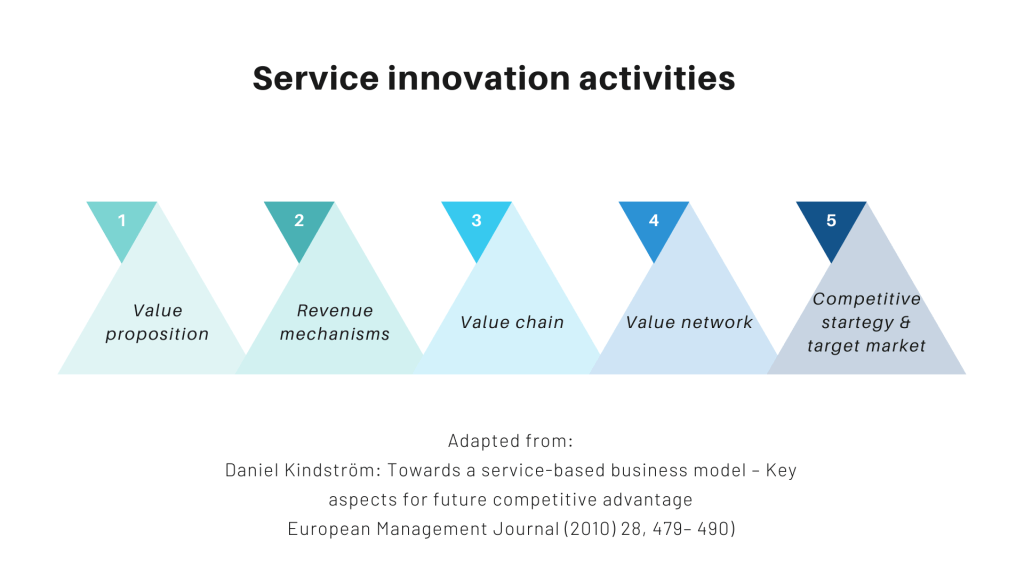
- Value proposition – starting from the customer value propositions and validating how is the innovative new service creating customer value.
- Revenue mechanisms – moving from cost plus pricing to value based pricing and finding the best pricing model fitting customer needs; finding advanced revenue schemes via partnerships.
- Value chain – developing the value chain from easy to address value parameters for sales, designing service development process and supporting organizational roles.
- Value network – identifying the opportunities to expand value proposition via the value network, involving both customers, partners and suppliers to enable best service delivery; taking the coordination role within the value network
- Competitive strategy and target market – developing service strategy for differentiation, and identifying target customer segments, and customer roles based on the value created.
Food for thought: Are these service innovation activities inbuilt into your service development processes, or would benefit taking a closer look into some of these items? I would consider all of these aspects critical, when working with new innovative service concepts.
The service innovation space is constantly evolving, driven by changing customer expectations, technological advancements, and competitive pressures. Organizations that embrace service innovation and adapt to the evolving landscape are better positioned to succeed creating differentiation from the competition. For me, developing services is balancing between continuous improvement of existing services, but also developing new innovative service concepts!
I hope you got some inspiration from the blog, and let’s exchange thoughts, if the topic is close to your heart!
References
Bessant, J. and Davies, A. (2007) Managing service innovation. Innovation in Services (DTI Occasional Paper No. 9). Department of Trade and Industry, UK.
Daniel Kindström: Towards a service-based business model – Key aspects for future competitive advantage European Management Journal (2010) 28, 479– 490)
-
The most popular blog posts from 2023, event recordings and online courses available

It is time to wrap up the year 2023 – and thank all the readers of the blog and experts joining the online courses and events during the year!
Dadaa, here is the top three from the blog with most views globally:
3rd place: Developing Strategic Portfolio Management Practices step by step
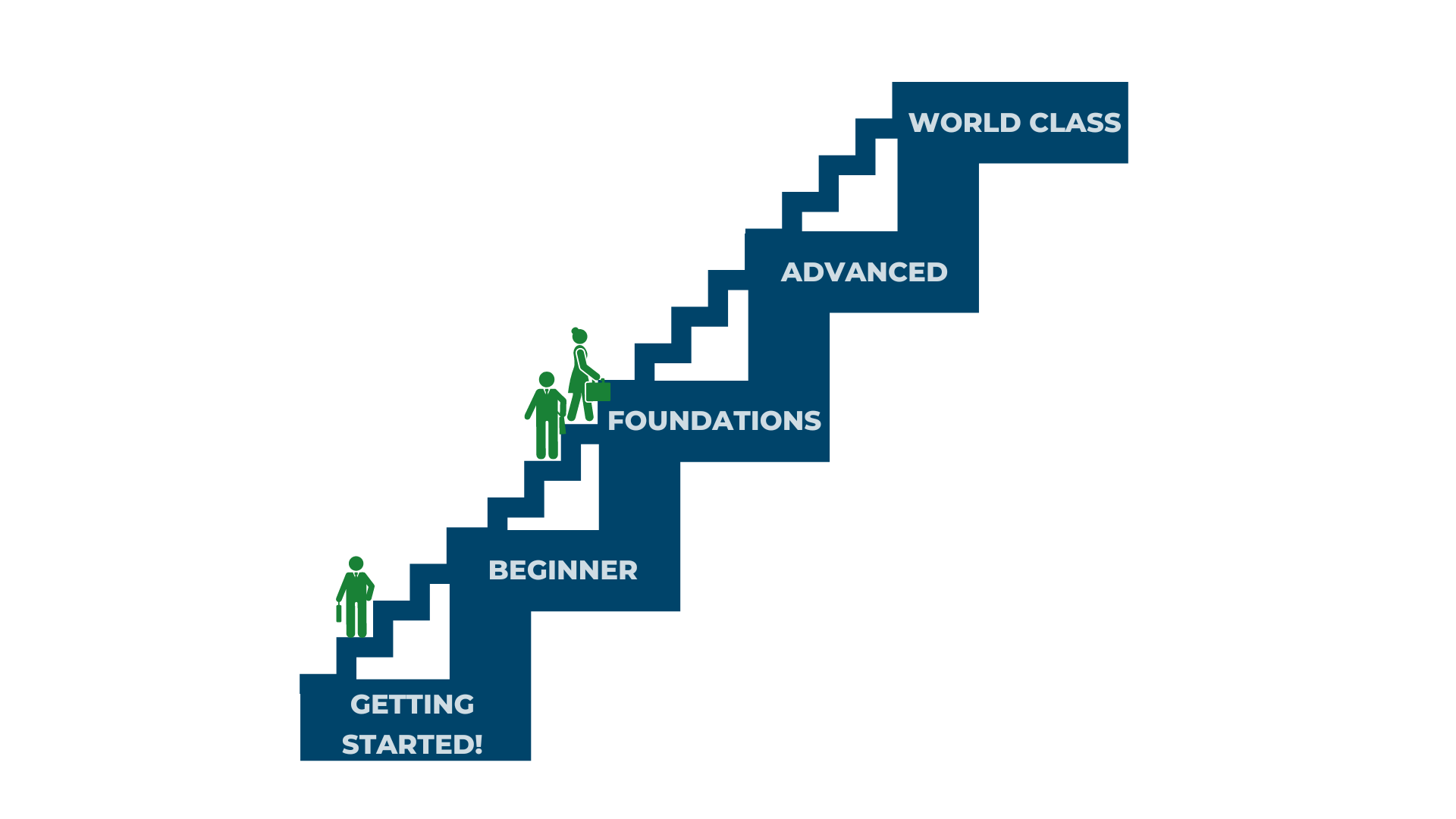
This is one of the articles, where I receive most contacts from the experts around the world. How to develop Strategic Portfolio Management Practices step by step?
Developing strategic portfolio management practices step by step
During the Spring, I had an opportunity to participate to Itonics Innovation Brunch – Check out the key note Improving Strategic Portfolio Management Maturity Step by Step.
2nd place: 4 Goals of Portfolio Management

No wonder this post has become popular – portfolio management is challenging by nature, as it is dealing with future events and opportunities – check out the 4 key goals of portfolio management from the blog:
4 Goals of Portfolio Management
1st place: Do you manage a portfolio funnel, or Portfolio tunnel?
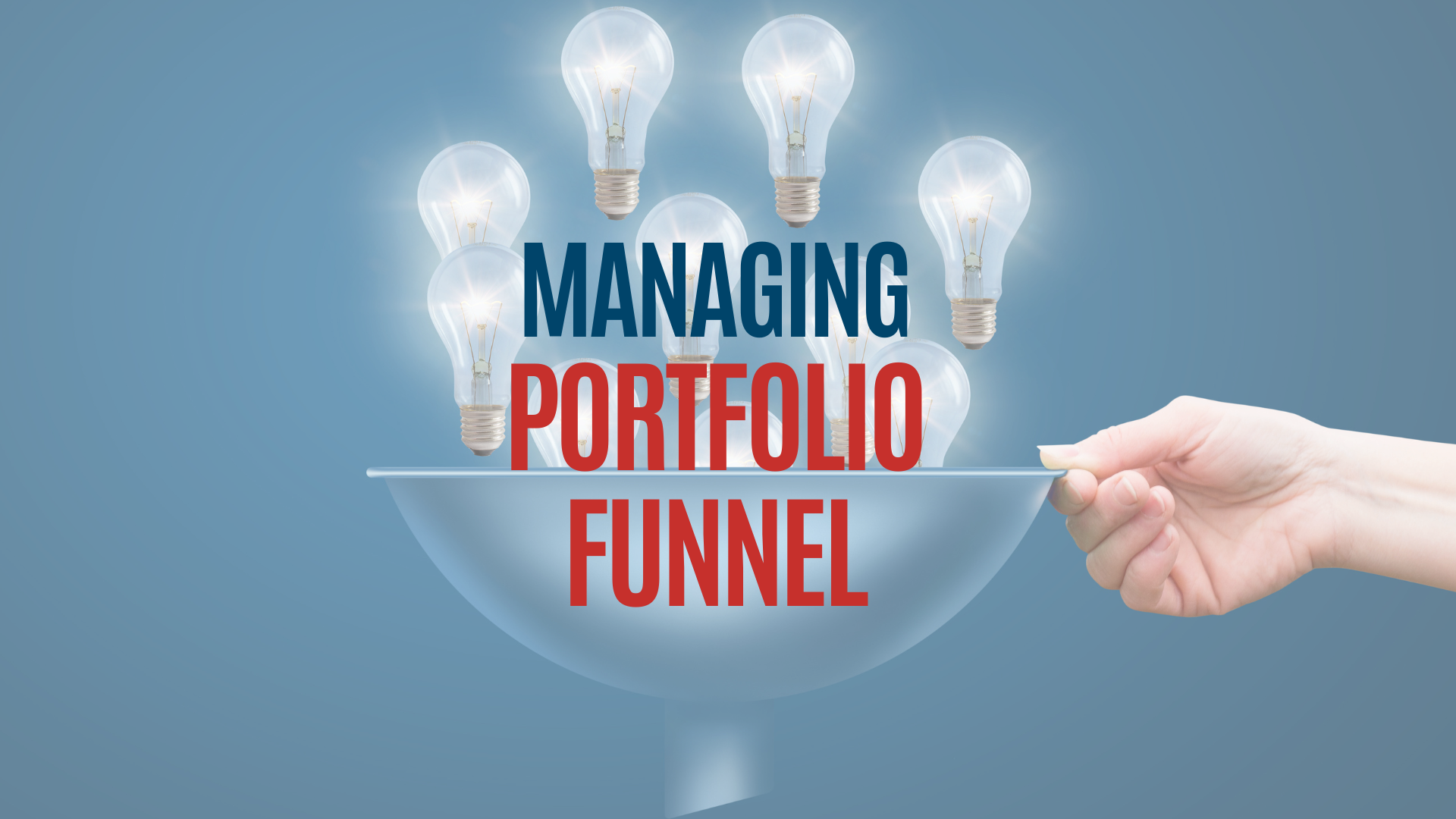
This is also one of my favorite ones – and one of the most trickiest parts when managing a complex development portfolio – have a look:
Do you manage a Portfolio funnel, or Portfolio tunnel?
Webinar – Ready, Steady, Go!
One of the fun events during the autumn was the webinar we co-hosted with wonderful Caroline Bondier. If you missed it, have a look: Leading Strategic Initiatives Webinar with Caroline Bondier from Articana
Time to wrap up 2023, but let’s catch up during 2024!
-
Building a modular offering portfolio – just a dream?
Is your offering portfolio well organized or do you have a big number of individual offerings? What I am hearing a lot, not all companies have well structured offering portfolios, due to large range of product families and a big number of solutions and services.
I love the idea of modular offering portfolio, where products and services may be bundled into offering packages based on the customer needs and preferences. Modular design is an important principle in product design and IT architectures, but the same idea applies well also for offering design. Let’s review different approaches to build modularity into offering portfolio!
Offering bundling of product based solutions and services
Today, many products and solutions have become more and more complex, including physical hardware products or components, as well as software and sometimes even digital services. The terminology varies from company to company, but often solution layer is often used to combine products and services as solution, which is helping to solve a customer problem and creates customer value.
In addition to a solution itself, there may be additional services, such as delivery, installation and commissioning as well as training and technical support completing the solution itself. The solution and complementing service are often delivered as one-time transactional offering package.
There are many types of services, such as core services (basic maintenance and repair services) or advanced services (e.g. complex digital services), and different service elements may be bundled into the same offering package. Sometimes also services are referred as products or service products.

To summarize, offering can be a combination of products/components/solutions and services, with the common value propositions offered as a package towards customers. Do you have a common definitions in your organization for what is meant by offering, products, solutions and services? Without to go to too academic discussions, it is good to have
Bundling offering packages based on modular products, and services to support different customer needs
When thinking about modular offering, offering is composed of different independent modules, such as products and services. The same product or service may be included in many different offering packages, which may be designed to meet different needs of the customers. Modularity of offering may for example enable different types of service levels for different customers or tailored offering packages for different customer segments with differentiated value propositions.
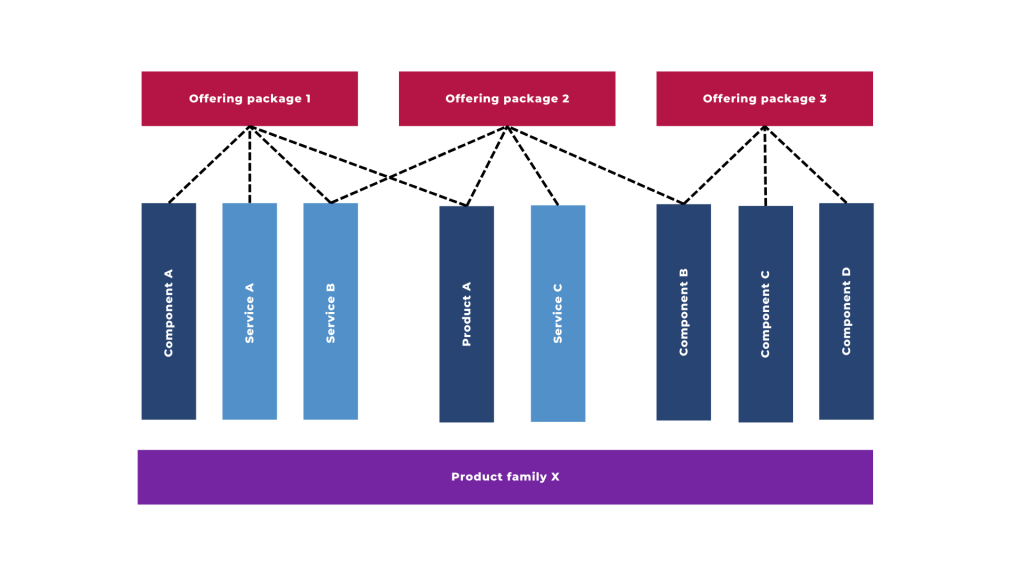
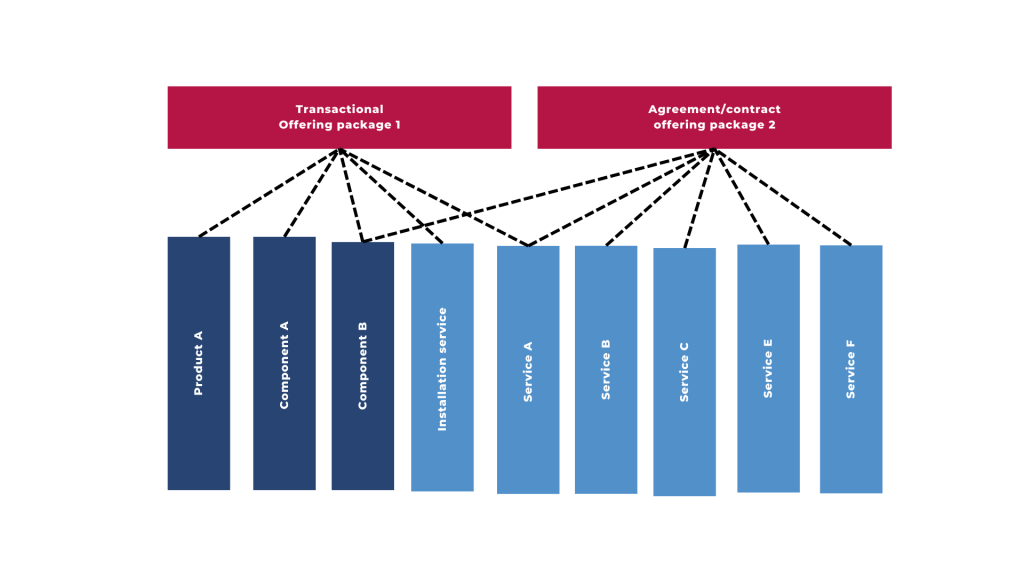
Same services may be bundled based on the business model customers preferences
Customer may prefer different business models during the different life cycle phases, and some customers may prefer transactional purchasing, where as other prefer more predictable agreement based models. With the modular offering portfolio, same service elements may be packaged in a different ways based on the customer preferences.
Further reading:
Check out also previous post, which might be interesting: Ideas To Build Offering Portfolio – Which Offering Portfolio Dimensions Are Relevant For Your Organization? – Strategic Portfolio Management (strategic-portfolio-management.com)
-
Developing new products and services – are there differences?
How does the development of physical products differ from development of services – or does it differ? In the context of New Product Development (NPD), portfolio management has been studied a lot during the past decades in order to optimize the product portfolio. However, I was interested in learning more about New Service Development (NSD), and noticed, that this area has been studied less.
I found an amazing article by Aas, Breunig and Hydle: Exploring new service portfolio management (International Journal of Innovation Management,2017) and wanted to reflect on the key insights via the blog! Based on the literature summarized by Aas et al., there are indeed some clear differences:
- New Service Development processes are often more incremental, informal and ad-hoc than New Product Development processes
- A higher number of stakeholders are involved from different units and functions during the new service development, than in NPD processes
- The effects of NSD on business performance have more intangible, strategic, long term and qualitative nature than the effects of NPD
Let’s have a look in more detail, what were the key lessons learned from the case study:
Many sources of ideas for new service concepts
Typically for new services, ideas come from a big number of different sources, such as customers, own employees from different units and functions, suppliers, competitors, and sometimes also from government. The ideas may be of different sizes, and of different nature ranging from development of new digital services to improvement of operational service process steps or compliancy to regulation or improvement of existing service offering. In the portfolio level, prioritizing such a wide range of different types of ideas from different sources is not always easy – how to compare ideas with can range from operational improvement to completely new service concepts?
Lessons learned 1: The recommendation from the article by Aas et al. (2017) was to exploit different sources of ideas and base New Service Development portfolio decisions on both strategic alignment and value criteria. This helps to create a balanced portfolio, and not to focus too much on just one type of ideas, e.g. ideas improving internal efficiency.
New Service Development is often hidden and based on small changes – creating transparency via NSD portfolio
New product development (NPD) has been traditionally executed via stage-gate projects ensuring all the needed steps to develop high quality products. Based on the study by Nijssen et el. (2006) New Service Development (NSD) is often ad-hoc and hidden – not clearly visible in the development portfolios. Continuous improvement is extremely valuable – however when developing a completely new type of service concepts or radical innovations, development work requires typically a lot of work across the organization and extensive resourcing.
Lesson learned: Accelerating new service development by transforming ideas into formal New Service Development projects, in the early phases of the development. Based on my own experience, a projectized approach often helps to create awareness in the organization, supports with the resourcing and systematic decision making. If development is happening via agile teams without projects, for a new service development, I have learned, that it is a good practice to have certain check points, to ensure end-to-end quality and readiness before Launch decisions. Creating overall transparency on ongoing NSD initiatives and their progress is also important in large organizations.
Flexibility in development process and decision making needed
In the study, one finding was, that NSD projects were often incremental by nature, and smaller than typical new product development projects. Larger NSD projects required also typically several decision gates, before Launch readiness, and project model was close to Cooper’s ‘state-gate-lite’. Also the NSD projects had a high level of heterogeneity, as the development ideas varied a lot, and one process did not fit all the different cases.
When developing new services, there may be changes in parallel in service concepts, technology, organization and processes. For example, when working with new digital services development projects, there has been a need to introduce new roles and processes to support the service management of the new services.
Lesson learned: The NSD portfolio process requires flexibility to successfully support the high heterogeneity in the new service development projects – one way does not fit all types of projects.
Involving many stakeholders

When developing new service concepts, support and participation from many different units and departments are needed. New service development often impacts long end-to-end value and process chains, and the alignment between different teams is important to create a successful concept. Based on the study, also in the decision making, representatives from different functions and units were involved in the NSD portfolio steerings.
Lesson learned from the study: NSD portfolio decisions need to be taken in collaboration by a group of managers representing different functional areas. I would also add, that involving stakeholders from different units during the project, creating alignment and awareness across different teams is super important, not only in the managerial level.
Developing a combination of products and services?
I have also worked with combination of products and services, for example solutions where a physical hardware is supporting a digital service. In these product-service-software solutions, complexity of both worlds are combined: there needs to be systematical way of working to support developing a high quality product, but the development process should also support iterative learning required in service development processes! These interesting product-software-service solutions would deserve an own blog!
References
Aas, Breunig, and Hydle: Exploring New Service Portfolio Management. International Journal of Innovation Management, 2017.
Nijssen, EJ, B Hillebrand, P Vermeulen and RGM Kemp (2006). Exploring product and service innovation similarities and differences. Research in Marketing, 23, 241–251.
Fuglsang, L and F Sørensen (2011). The balance between bricolage and innovation: Management dilemmas in sustainable public innovation. The Service Industries Journal, 31(4), 581–595.
-
8 Key Reasons for Moving Towards Service Oriented Business Models and 5 steps to get there!
This autumn, the blog theme has been service offering development and this week’s blog is focusing on transition from product orientation to service orientation. From the strategic portfolio management viewpoint, building a solid service offering portfolio truly makes sense – let’s review key reasons why (especially) manufacturing companies are shifting more and more towards services and also the most important steps how to get there:
8 Key Reasons for Moving Towards Service Oriented Business models
Revenue generation – from one time product sales to continuous revenue streams

Service business is typically good business – instead of relying on one-time transactional product sales, services may provide steady and growing revenue streams through service contracts, subscriptions and additional transactional service offerings. The recurring revenue models provide also more stability and predictability when compared to the traditional product-based models.
Building competitive advantage – and avoiding commodity trap
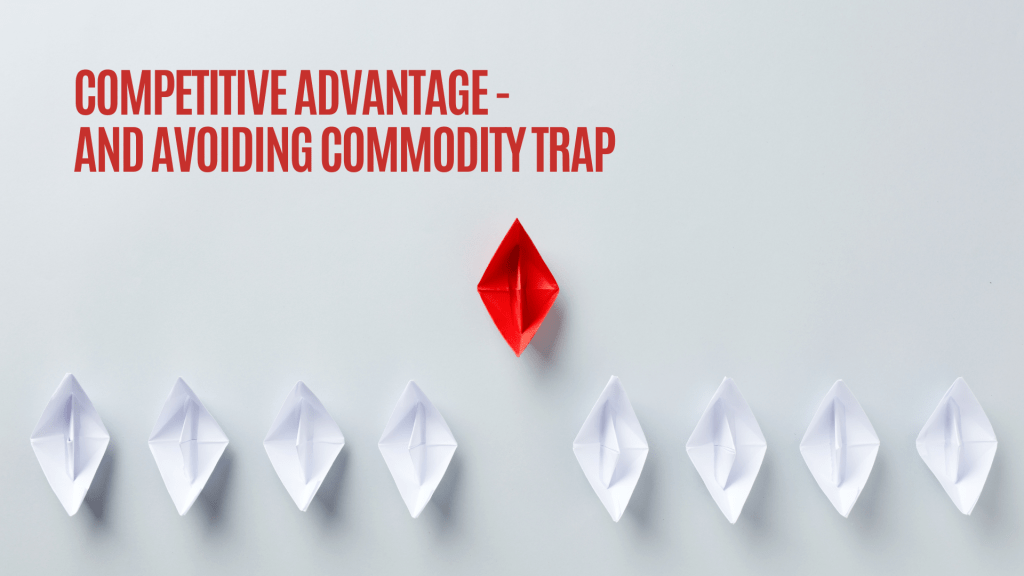
Today, markets are highly competitive, and manufacturing companies are looking ways to differentiate. New types of value adding services are often helping to differentiate from competitors competing with lower prices. Services built into the operating model of the company are not as easy to imitate or copy, as the the traditional production of hardware based components.
Value adding services for unique customer experiences
Offering value-added services alongside their products allows them to stand out and provide unique customer experiences. Additional value may be created in many different ways, for example:
- Via highly reliable delivery and installation
- Integrations between the company core systems
- Easy to deal with service concepts
- Providing new type of data based services with insights
- Digital services with new unique features built on top of physical products
Value adding services help to build stronger relationships with customers and creates a competitive advantage that is not solely based on the physical product.
Increasing customer satisfaction and retention

By offering services complementing the products, manufacturing companies can enhance customer satisfaction. Services such as installation, maintenance, repair, and training can improve the overall customer experience and ensure that the products perform optimally throughout their lifecycle.
This, in turn, leads to higher customer loyalty, repeat business, and also to positive word-of-mouth recommendations.
Adapting to changing Market Demands

Many customers today prefer outcomes and solutions rather than simply buying products. By offering services that address specific customer needs and challenges, manufacturing companies can align themselves with market demands and provide comprehensive solutions that go beyond the product itself.
Supporting customer sustainability targets
Service-oriented approaches often contribute to a more sustainable business model for manufacturing companies. For example extending the lifecycle of products through life-cycle services such as repair and refurbishment or product upgrades, may reduce significantly environmental impact. Also for example selling as service business model may help to offset the financial costs of implementing more sustainable solutions
Leveraging opportunities enabled by technology

Today, technology enables new solutions including for example predictive maintenance, remote monitoring and other proactive services, which can help to optimize product performance and efficiency and also minimize downtown. Key enablers for such services may be the Internet of Things (IoT), sensors based solutions increasing the availability of data, connectivity solutions, and different types of integrations and interfaces. Also Artificial Intelligence enable more automation and value adding insights.
Value via Ecosystems and Networks

Ecosystems and value networks play a crucial role in the service orientation of manufacturing companies. By participating in ecosystems and building value networks or even leading one, manufacturing companies can leverage the expertise and capabilities of other entities within the network creating value add to customers.
5 steps when moving from product orientation to service orientation
When transition from product orientation to service orientation, there are significant impacts also in the strategic development portfolio, operations, way of working and even in organizational setup. I would recommend to get familiar with a super good article written by Daniel Kindström: Towards a service-based business model – Key aspects for future competitive advantage. Here are some key takeaways I picked up from the article to support moving from product based to service oriented approach:
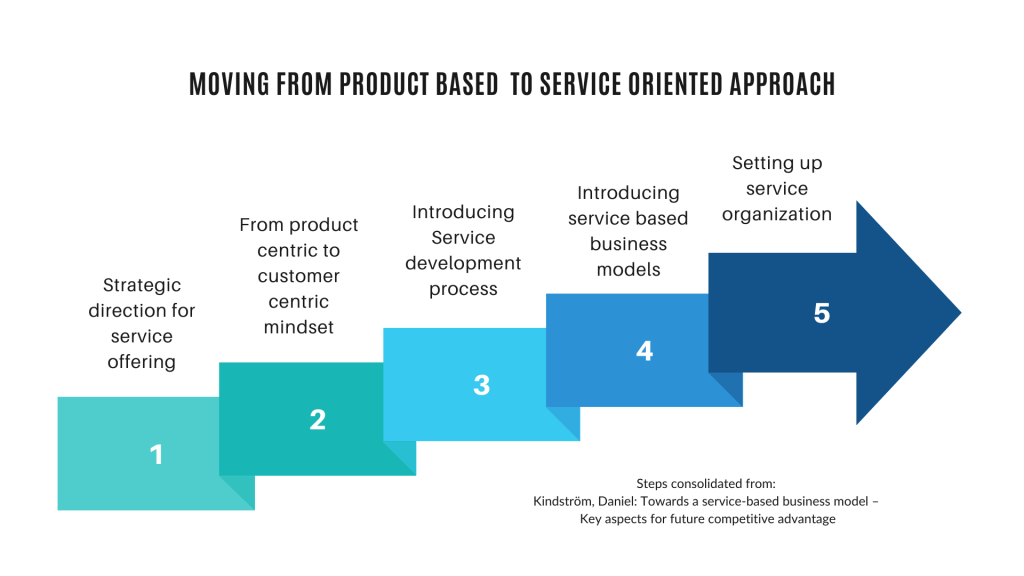
- First of all, strategic direction for service offering is required – are you complement the product based offering, creating completely new type of digital services, or what type of services and customer value do want to focus on?
- The mindset shift from product centric to customer centric approach is required when working with new service offering concepts solving customer problems. This may be a long journey for many organizations with long traditions of building world class hardware products.
- The service development process differs from product development process – what is your process to develop services? Do you need to develop both product based offering and services together?
- Introducing service based business models – what is it for customers, what are the value propositions and how is the revenue created? Is the model transactional, agreement based, selling as a service / subscription based, or is the value created via the partner ecosystem…?
- Setting up service organization – who is delivering the service? For example, do you need to setup new processes and roles, when supporting new digital services? Do you need to create a network of partners and vendors to support your services?
Overall, the move towards a service orientation allows manufacturing companies to go beyond the traditional transactional model and build long-term relationships with customers. Services provide opportunities for revenue growth, customer satisfaction, and adaptation to evolving market dynamics, ultimately leading to a more competitive and sustainable business.
However, also new capabilities, ways of working, business models and even organizational structures are required – introducing a new service offering may require development and change management in many different levels. The service-based business models would deserve an own blog post, so stay in the loop!
References
Kindström, Daniel: Towards a service-based business model – Key aspects for future competitive advantage. European Management Journal (2010) 28, 479-490.
-
Do You Hear Laughter? Tips for Creating Psychological Safety for Development Teams
Project work and developing new products and solutions require a lot from the teams – there may be complex problems to be solved, challenges to get started with the new initiative, stretched timelines to meet, and different types of needs coming from many different stakeholder groups. But even though development work is often very demanding – the best teams still manage to have fun together and achieve a lot!
I am part of my workplace Grow training this autumn and got inspired by the psychological safety theme – here are some reflections on how psychological safety can help Development portfolios perform better!
Making things happen – and having fun in the team level

I am a big fun of Amy Edmondson – and her Creating a Fearless Organization. Based on Amy Edmondson, Psychological safety is not about being nice, avoiding conflicts or an excuse to complain, but creating an environment where development teams have high performance standards, but still feeling safe enough to speak up about mistakes and concerns – and being unafraid to bring up also ideas and questions.
Based on my experience, best performing teams make things happen, but also still manage to have fun. For me, it is always a good sign, when I hear laughter from the development team. When the team has fun together, is also easier to bring up difficult topics, and also find the solutions. Best teams have also fierce debates, as the aim is to find the best solutions. And not to forget wild ideas, which can be enhanced and enriched together as a team.
Inviting to participation – across the organization

When developing complex solutions impacting the work of different business units and end-to-end processes, a significant amount of communication and alignment across the organization is needed. Does the development team feel safe when introducing new ideas and concepts with the stakeholders? How is the feedback given and received?
As a lead of a strategic initiative, there may be many stakeholders groups to be alignment with – and a need to build new connections between the units, which have not been earlier collaborating actively. The way of working, terminology and tools used may differ, and there is a big risk of misunderstanding. Here it is important to keep the big picture, but also actively align with different stakeholder groups, listen and use the feedbacks actively to improve the final outcomes. Are your workshops safe environment to give feedback, bring up ideas and debate?
As a stakeholder of a strategic initiative, it is important to offer support for the development team, even though topic might be new to you, and you may feel uncomfortable to certain extend. Listening actively, and trying to connect the development vision to your own area of expertise is important – and to avoid starting with your own agenda first. Also, bringing up the potential development needs is important, as the development team may not have all the needed knowledge for end-to-end value chain. Are you giving the feedback in a constructive way, which are easy to take into consideration and invite to dive deeper into the topic together?
One of the clear trends I have seen in many companies, is to reduce the amount of steering meetings, and increase the amount of sharing via other means. Great practice widely used by agile teams is to organize demos and reviews – seeing concretely what has been developed helps everyone to understand the content, and bring up also development needs.
Psychological safety in portfolio level decision making
When I was quite fresh from the university, I was working for a large transformation program which had been ongoing for several years. The planned go-live was closing and many team members were really worried about the performance of the solution – as after go-live, the new system could risk the company continuity. When the performance issues were discussed, an experienced management consultant gave an advice: “Senior managers are like sheep, you don’t want to scare them off.”
Well, after all these years I still disagree with that – teams should feel comfortable bringing up also concerns and senior management deserves to get objective and data based understanding. In the end for that specific project, company internal controls worked as they should, and the performance challenges were addressed before the go-live. Oh, what a learning it was for all the stakeholders involved, and big emotions also involved!
Another big ERP implementation project, where I worked, faced a big challenge with technical environments one month prior to go-live. As a program lead, this was not an easy news to bring up, but as a team, we got the full support from the management and all the vendors involved, and the year end schedule was kept thanks to good team work. I think here psychological safety played a key role in that case – discussing openly about the challenge enabled also finding the solutions with all parties.
Here are few tips for portfolio managers and senior management to help the teams:
- Encourage teams to share, organize demos and reviews with the rest of the organization – this helps to create alignment and get feedbacks early. Seeing is believing! Participate, sponsor and create a positive and encouraging atmosphere to these events!
- No news is not always good news – encourage teams to share openly about their progress and seek for alignment – not only within gate approvals, then it might be too late.
- Build flexibility into the decision making – can teams bring up key topics to decision making forum to inform senior management or when guidance is needed?
- Don’t kill the messenger – when something goes wrong, don’t find who to blame, but think ways to support to solve the challenge!
- Hearing laughter during team meetings is usually a good sign – the best teams have fun and also achieve a lot together!
More blog posts related to portfolio governance available here: Development Portfolio Governance.
References
Amy Edmondson – Creating a Fearless Organization – Youtube video
-
Team of Teams – tackling complex challenges

Today, the complexity of solutions, processes and IT tools has grown, and development teams are working with complex challenges.
Based on the great discussions on the previous blog posts related to agile teams and business agility, here is another post related agile teams. The concept of a “team of teams” was popularized by General Stanley McChrystal in his book “Team of Teams: New Rules of Engagement for a Complex World.” Here are some key ideas related to the concept, to give inspiration:
Dealing with complexity and rapidly changing environment by distributing decision-making authority
Traditional hierarchical structures and command-and-control systems are often inadequate in dealing with complex and rapidly changing environments. In today’s interconnected world, challenges are typically complex and require flexible and adaptive approaches. To effectively tackle complex challenges, organizations need to move away from centralized decision-making and embrace a more decentralized approach. Decision-making authority should be distributed to the teams on the ground who have the most relevant information and expertise.
Each team within the organization should be empowered to make decisions and take action based on their understanding of the mission and the information available to them. This requires trust, clear communication, and a shared understanding of the organization’s priorities and values. In the portfolio level, clear guiderails may help to achieve this – what decisions can be made in the team level, and where portfolio level decision making is needed?
Transparency and shared consciousness
Another key idea from the book, is that establishing a shared consciousness across the organization is important. This means that all teams should have access to real-time information and a common understanding of the larger mission and goals. Open communication and transparency are essential for creating this shared consciousness.
Rather than operating in isolated silos, teams should form collaborative networks that allow for effective coordination and information sharing. Inter-team collaboration and cross-functional communication are vital for breaking down organizational barriers and enabling collective problem-solving.
Is the current way of getting organized around development support collaboration?
Experimentation and continuous learning
The team of teams approach emphasizes the importance of continuous learning and adaptation. Teams should be encouraged to experiment, learn from failures, and iterate on their approaches. A culture of learning and innovation is necessary for staying agile in a rapidly changing environment.
Traditionally waterfall based state-gate models have not supported the experimentation and iterative learning – how is it today in your organization?
The new role of the leader
Traditional leadership roles also need to adapt to the team of teams model. Leaders should focus on providing guidance, fostering collaboration, and creating an environment where teams can thrive. The role of leaders is to empower and enable teams rather than micromanage or control them.
Overall, the team of teams concept promotes a more agile, decentralized, and collaborative approach to tackling complex challenges. By leveraging the collective intelligence and capabilities of teams, organizations can become more responsive, adaptable, and effective in today’s dynamic world. If interested to learn more, I would recommend checking out this book!
References
McChrystal S., Collins T., Silverman D. & Fussel C. 2015. Team of teams. New rules of engagement for a complex world. Portfolio Penguin.
-
5 + 5 + 5 Tips for making better portfolio decisions

Portfolio governance meetings have often tight agenda’s – there may be many decisions to be made, and complex topics. Smooth decision making requires systematical work – good preparation, discipline and focus during the meetings and also systematical follow up work after the meetings. To help different roles shine, here are 5 tips for facilitators, 5 tips for presenters and 5 tips for steering group participants. Have a look!
5 Tips for the Facilitator – Helping The Presenters Shine!

- Prepare presentations and materials with the presenters – communicate clearly when the materials need to be ready, review and coach also the presenters, so that they can shine during the meeting and the flow of decisions will be smooth!
- Send out agenda and prereading material 48 hours before the meeting. This is especially important, if you have big decisions on agenda.
- Keep the meeting schedule – be clear on time slot planned for each presentation and politely also remind of the slots. It is fair to give all presenter’s their slot.
- Summarize the decisions and key conclusions and share the meeting minutes within 24 hours after the meeting – it is good practice to share the meeting minutes when the participants still have fresh memories on the discussions.
- Follow up on action points systematically after the meeting. I think this might be the trickiest part, but also perhaps most important one!
5 Tips for Presenters – Prepare well, present clearly

- Provide the prereading material on time. Often, a good practice is to provide the materials 48 hours before the meeting – so align on the schedule and meeting practices with the meeting facilitator.
- Be clear with your decision proposal – are you looking for a decision, guidance or support – or is your presentation an update?
- Keep your presentation time slot – if you have 10 min presentation slot, do not come to the meeting with 20 slides! You can always have backup or additional prereading materials, as needed.
- You can ask kindly to take the questions at the end of the presentation, so that you can go through the material without interruptions
- If you are unclear with the decision – be brave and ask for clarification. Usually if you did not get a clear decision, other participants have the same challenge.
5 Tips for Steering Group Members – Give your full focus
- Read the prereading materials in advance, and collect also feedback from your organizations as needed
- Give your full focus on topic – join on time, focus fully on presentations and don’t multitask
- Be an active participant – Ask questions, and give your guidance and comments, but also listen to other view points and presentation carefully
- Support decision making – help facilitator and presenter to reach to a conclusion
- After the meeting check the meeting minutes and your action points, and communicate the decisions with your own organization.
Further reading


Strategic Portfolio Management
Taking strategy into action via development portfolios – sharing best practices via a blog

